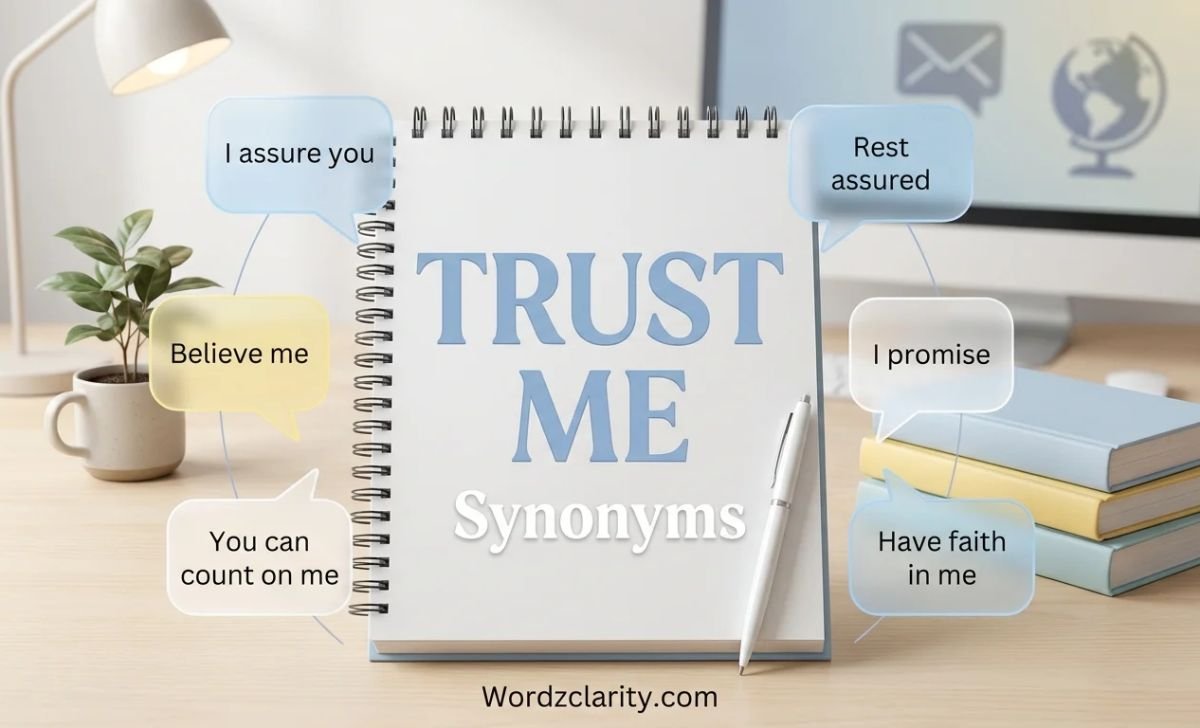
“Trust me” asks someone to believe what you say, rely on your judgment, or feel confident that you will do what you promise.
It works well in everyday conversation, but another phrase may fit better when you are writing an email, giving advice, reassuring someone, or speaking in a professional setting.
Some alternatives focus on belief, while others express certainty, reliability, reassurance, or commitment. This list of trust me synonyms includes common phrases such as “believe me,” “take my word for it,” and “I assure you,” along with formal, casual, professional, and conversational alternatives. The key is to choose a phrase that matches both your meaning and the situation.
What Does “Trust Me” Mean?
“Trust me” means believe what I am saying or have confidence in me. It can also mean that someone should rely on your judgment, ability, promise, or advice.
For example:
Trust me, this restaurant is worth trying.
Here, the speaker is asking the listener to believe their recommendation.
The phrase can have different shades of meaning depending on context. It may express:
- Belief: asking someone to accept what you say as true.
- Reliability: asking someone to depend on you.
- Reassurance: helping someone feel less worried.
- Confidence: showing that you are sure about something.
- Commitment: promising that you will do something.
Because of these differences, not every alternative below is an exact replacement in every sentence.
Quick Comparison of Trust Me Alternatives
| Alternative | Main meaning | Tone | Best used for |
|---|---|---|---|
| Believe me | Believe what I say | Neutral | Conversation |
| Take my word for it | Accept my statement | Casual | Advice |
| I assure you | Remove doubt | Formal | Professional communication |
| Rest assured | Give reassurance | Formal | Emails and business |
| You can count on me | Depend on me | Neutral | Support |
| I can confirm that | Verify information | Professional | Work |
| I promise | Make a commitment | Neutral | Personal situations |
| I can vouch for it | Confirm reliability | Conversational | Recommendations |
| You have my word | Give a promise | Formal/neutral | Commitments |
| I’m confident that | Express certainty | Professional | Work and writing |
The important difference is purpose. “Believe me” asks for belief, while “you can count on me” focuses more on reliability. “I assure you” is mainly used to reassure someone.
1. Believe Me
Meaning: “Believe me” asks someone to accept what you are saying as true.
Best used when: You want to emphasize that your statement or experience is genuine.
Example:
Believe me, I checked the figures twice.
Note: “Believe me” is one of the closest everyday alternatives to “trust me,” but it focuses more on believing a statement than relying on a person.
2. Take My Word for It
Meaning: This means asking someone to believe you without needing additional proof.
Best used when: You are sharing an opinion, experience, or recommendation.
Example:
Take my word for it; the second route is much faster.
It is natural in conversation and often sounds more conversational than “trust me.”
3. I Assure You
Meaning: “I assure you” means that you are confidently telling someone something is true, often to remove doubt or worry.
Best used when: You need a more formal or reassuring expression.
Example:
I assure you that we are taking the matter seriously.
This is often more suitable than “trust me” in professional writing.
4. Rest Assured
Meaning: “Rest assured” tells someone that they can feel confident because a situation is under control.
Best used when: You want to reassure someone, especially in formal communication.
Example:
Rest assured, your request is being reviewed.
It is common in customer service, business emails, and official communication.
5. You Can Count on Me
Meaning: This means someone can depend on you to help or do what you have promised.
Best used when: You want to emphasize personal reliability.
Example:
You can count on me to finish the report before Friday.
This is not an exact synonym in every context because it focuses on dependability rather than belief.
6. You Can Rely on Me
Meaning: “You can rely on me” means that someone can depend on you.
Best used when: You want to show that you are dependable or willing to provide support.
Example:
You can rely on me if you need help with the presentation.
It works in both personal and professional conversations.
7. You Can Depend on Me
Meaning: This tells someone that you are dependable and will support them or fulfill a responsibility.
Best used when: The context involves responsibility, help, or commitment.
Example:
You can depend on me to keep this information confidential.
It is especially useful when “trust me” refers to reliability.
8. I Give You My Word
Meaning: This is a strong way to promise that you will do something or keep a commitment.
Best used when: You want to make a serious personal promise.
Example:
I give you my word that I will take care of it.
It can sound more serious or personal than the simple phrase “trust me.”
9. You Have My Word
Meaning: “You have my word” means that you are giving someone your promise.
Best used when: You want to assure someone that you will honor a commitment.
Example:
You have my word that I will handle the matter carefully.
It is natural in serious conversations and formal personal statements.
10. I Promise
Meaning: “I promise” directly expresses a commitment to do something or tell the truth.
Best used when: The speaker wants to give personal assurance.
Example:
I promise I’ll call you as soon as I arrive.
It is usually more personal than professional.
11. Take It From Me
Meaning: This means that the speaker has enough experience or knowledge to make their statement worth accepting.
Best used when: Giving advice or speaking from personal experience.
Example:
Take it from me, rushing the process will only create more problems.
This phrase is common in informal conversation.
12. I Can Vouch for It
Meaning: “I can vouch for it” means that you can personally confirm that something is genuine, reliable, or good.
Best used when: You are supporting a person, product, service, place, or claim based on your experience.
Example:
I’ve used that software for years, so I can vouch for it.
It is useful when “trust me” means “I can personally confirm this.”
13. I Can Confirm That
Meaning: This means that you can verify or state that something is true.
Best used when: You are communicating factual information, especially at work.
Example:
I can confirm that your application has been received.
This is more precise and professional than simply saying “trust me.”
14. I Stand by This
Meaning: “I stand by this” means that you continue to support or believe a statement, decision, or opinion.
Best used when: You want to show confidence in something you have said or written.
Example:
I stand by this recommendation after reviewing the latest results.
It works particularly well in professional and written contexts.
15. I’m Confident That
Meaning: This phrase expresses strong belief that something is true or will happen.
Best used when: You want to show confidence without directly asking someone to trust you.
Example:
I’m confident that this approach will save us time.
It is often a better choice than “trust me” in professional writing.
16. I’m Certain
Meaning: “I’m certain” expresses a high level of confidence that something is true.
Best used when: You have strong reasons for your conclusion.
Example:
I’m certain that we discussed this during the last meeting.
Unlike “trust me,” it states your confidence directly.
17. I’m Positive
Meaning: “I’m positive” can mean that you are completely or very sure about something.
Best used when: You are speaking informally and want to emphasize certainty.
Example:
I’m positive I left my keys on the desk.
It is common in everyday American English.
18. Without a Doubt
Meaning: This phrase emphasizes complete confidence or certainty.
Best used when: You want to strongly support a statement.
Example:
Without a doubt, that was the best option available.
It is not a direct substitute for “trust me,” but it can express the certainty behind the phrase.
19. You Can Be Sure
Meaning: “You can be sure” tells someone that they can feel confident about a particular fact or outcome.
Best used when: You want to provide reassurance.
Example:
You can be sure that we will keep you informed.
It can sound more polished than “trust me” in professional communication.
20. I Can Guarantee It
Meaning: This means that you are giving a strong assurance that something is true or will happen.
Best used when: You genuinely have enough certainty to make a guarantee.
Example:
I can guarantee it will be completed by the deadline.
Note: A guarantee is stronger than “trust me,” so do not use this phrase when you cannot reasonably promise the outcome.
21. I Give You My Assurance
Meaning: This is a formal way to provide confidence or reassurance.
Best used when: You are writing in a formal or official context.
Example:
I give you my assurance that the matter will be handled promptly.
It sounds more formal than everyday “trust me.”
22. Let Me Assure You
Meaning: This phrase introduces a statement intended to remove doubt or concern.
Best used when: Someone is worried or uncertain about a situation.
Example:
Let me assure you that your concerns have been heard.
It is particularly useful in professional communication.
23. You Can Trust Me
Meaning: This directly tells someone that you are trustworthy.
Best used when: The main issue is confidence in your honesty or reliability.
Example:
You can trust me to keep your information private.
This is a direct variation of the focus phrase rather than a completely different expression.
24. Have Faith in Me
Meaning: “Have faith in me” asks someone to maintain confidence in your ability or actions.
Best used when: The situation involves uncertainty, personal support, or encouragement.
Example:
Have faith in me; I’ll find a way to solve the problem.
It can sound more emotional or dramatic than “trust me.”
25. Put Your Trust in Me
Meaning: This means asking someone to place confidence or reliance in you.
Best used when: You want to emphasize personal trust.
Example:
Put your trust in me, and I’ll do everything I can to help.
It is grammatically correct but can sound more dramatic than ordinary conversation.
26. Count on Me
Meaning: “Count on me” means that someone can depend on you.
Best used when: You are offering help, support, or reliability.
Example:
Count on me to be there when you need help.
It is shorter and more natural than some formal alternatives.
27. Depend on Me
Meaning: This asks someone to rely on you.
Best used when: You want to emphasize your willingness to take responsibility.
Example:
Depend on me to keep the project moving.
This is less common as a standalone everyday phrase than “count on me.”
28. Rely on Me
Meaning: “Rely on me” tells someone that they can depend on your help, judgment, or support.
Best used when: You are emphasizing reliability.
Example:
Rely on me to make sure everything is ready.
It can work in both professional and personal contexts.
29. I’ll Take Care of It
Meaning: This means that you will handle a task or problem yourself.
Best used when: “Trust me” means that the listener can leave a responsibility in your hands.
Example:
Don’t worry about the booking. I’ll take care of it.
It does not mean “trust me” in every situation, but it can replace the phrase when the focus is responsibility.
30. Leave It to Me
Meaning: This tells someone that you will handle a matter yourself.
Best used when: You want to reassure someone that they do not need to manage the task.
Example:
Leave it to me; I’ll contact the supplier this afternoon.
It is friendly and confident.
31. I’ve Got This
Meaning: “I’ve got this” means that you are confident you can handle a situation.
Best used when: You want a casual way to reassure someone about your ability.
Example:
Thanks for offering to help, but I’ve got this.
This is informal and common in spoken English.
32. I’ve Got Your Back
Meaning: This means that you will support or protect someone when they need help.
Best used when: Talking with friends, teammates, or close colleagues.
Example:
Don’t worry about the meeting. I’ve got your back.
It is strongly informal and should generally be avoided in formal business writing.
33. I’m Telling You
Meaning: This phrase emphasizes that the speaker is being serious or truthful.
Best used when: You want a casual way to stress your statement.
Example:
I’m telling you, this is the easiest way to do it.
It is conversational rather than formal.
34. Seriously
Meaning: “Seriously” can emphasize that what you are saying is genuine or important.
Best used when: You want a brief casual expression of sincerity.
Example:
Seriously, you should try the new version.
It is not an exact synonym for “trust me,” but it can perform a similar conversational function.
35. No Joke
Meaning: “No joke” tells someone that you are being serious and are not exaggerating.
Best used when: You want to emphasize the truth of a surprising statement.
Example:
No joke, we finished the entire project in two days.
It is informal and unsuitable for most formal emails.
36. For Real
Meaning: “For real” can emphasize that something is genuine or true.
Best used when: You are speaking casually with friends or in informal online communication.
Example:
For real, that was the best concert I’ve seen all year.
It is a slang-like conversational expression, not a formal synonym for “trust me.”
37. Mark My Words
Meaning: “Mark my words” means that the speaker is very confident that a prediction or statement will prove true.
Best used when: Making a strong prediction or emphasizing certainty.
Example:
Mark my words, this idea will become popular.
It can sound dramatic, so it is better suited to informal or rhetorical situations.
38. I’m Serious
Meaning: “I’m serious” tells someone that you are not joking or exaggerating.
Best used when: Someone may doubt whether you genuinely mean what you are saying.
Example:
I’m serious. You should back up those files today.
It can sometimes replace “trust me” in casual conversation, but it focuses on sincerity rather than trust.
39. I Mean It
Meaning: “I mean it” emphasizes that your words are sincere and should be taken seriously.
Best used when: You want to reinforce a promise, warning, compliment, or statement.
Example:
You did a great job, and I mean it.
It is natural in spoken English.
40. Take My Advice
Meaning: This phrase asks someone to follow your recommendation because you believe it is useful.
Best used when: “Trust me” is being used to give advice.
Example:
Take my advice and save a copy before you make any changes.
It is more specific than “trust me” because it focuses on accepting advice.
41. Hear Me Out
Meaning: “Hear me out” asks someone to listen to your explanation before making a judgment.
Best used when: You want someone to consider an idea that may initially sound unusual.
Example:
Hear me out before you decide that the plan will not work.
It is not a direct synonym, but it can serve a similar conversational purpose when persuasion is involved.
42. I Know What I’m Talking About
Meaning: This statement emphasizes that the speaker has knowledge or experience in a particular area.
Best used when: You want to support your advice or opinion with your experience.
Example:
I know what I’m talking about; I’ve repaired this type of machine before.
It can sound confident or defensive depending on tone.
43. I Know This From Experience
Meaning: This tells the listener that your statement is based on personal experience.
Best used when: You want to explain why someone should take your advice seriously.
Example:
I know this from experience: leaving the task until Friday creates unnecessary stress.
This is often more informative than simply asking someone to trust you.
44. I Can Back This Up
Meaning: “I can back this up” means that you have evidence, experience, or support for what you are saying.
Best used when: You want to show that your claim is supported by something concrete.
Example:
I can back this up with the results from last year.
This is useful when credibility matters.
45. I Can Stand Behind This
Meaning: This means that you are willing to support or take responsibility for a statement, product, recommendation, or decision.
Best used when: You want to express professional confidence.
Example:
I can stand behind this recommendation because we tested it with several users.
It is especially useful in business and professional writing.
46. You Have My Assurance
Meaning: This formally tells someone that they have your promise or reassurance.
Best used when: You need a formal expression of confidence or commitment.
Example:
You have my assurance that your concerns will be reviewed.
It is more formal than “you have my word.”
47. Be Assured
Meaning: “Be assured” tells someone to feel confident about a particular situation.
Best used when: You are writing a formal statement or professional message.
Example:
Be assured that we are working to resolve the issue.
It is less conversational than “trust me.”
48. You Can Depend on This
Meaning: This expression says that something is reliable or can be counted on.
Best used when: The subject is a service, result, process, or arrangement rather than the speaker personally.
Example:
You can depend on this system to save your work automatically.
This distinction makes it different from “you can depend on me.”
49. I Can Confirm
Meaning: “I can confirm” states that you have verified or can confidently verify information.
Best used when: You are communicating facts in professional or formal situations.
Example:
I can confirm that the payment was received this morning.
It is especially useful in emails and workplace communication.
50. I’ll Make Sure
Meaning: “I’ll make sure” expresses a commitment to take responsibility for a result.
Best used when: You want to reassure someone that you will handle something properly.
Example:
I’ll make sure the final document is ready before the meeting.
It does not mean “trust me” in every context, but it is a natural alternative when the phrase is being used to promise responsible action.
Professional Ways to Say “Trust Me”
In professional writing, it is often better to state what you can confirm, guarantee, handle, or support rather than simply asking someone to trust you.
Useful choices include:
- I assure you — for reassurance.
- Rest assured — for calming concern.
- I can confirm that — for verified information.
- I’m confident that — for professional confidence.
- You can rely on this — for reliability.
- I stand by this — for supporting a decision or statement.
- I can vouch for this — for personal confirmation.
- I’ll make sure — for responsibility.
For example, instead of:
Trust me, the issue will be resolved soon.
A professional email could say:
I can assure you that our team is working to resolve the issue.
The second version tells the reader more clearly what the speaker is doing.
Casual and Slang Alternatives to “Trust Me”
For friends and informal conversations, expressions such as these sound more natural:
- Believe me
- Take it from me
- Trust me on this
- Seriously
- I’m telling you
- No joke
- For real
- I’ve got this
- I’ve got your back
- Mark my words
- I’m serious
- I mean it
These expressions are not all exact synonyms. Some emphasize sincerity, some emphasize certainty, and others emphasize support.
For example:
Trust me on this. The movie gets much better after the first half.
sounds casual and natural.
By contrast:
Rest assured that the movie gets much better.
would sound unusually formal in the same situation.
Ways to Say “Trust Me” in an Email
The right phrase depends on what you want to say.
For reassurance, you can write:
I assure you that we are reviewing the issue.
For confirmation, try:
I can confirm that your request has been received.
To show reliability, you could say:
You can rely on our team to keep you updated.
To show responsibility, write:
I’ll make sure the revised file is sent before the deadline.
For confidence, you can say:
I’m confident that this approach will address the problem.
Choosing a phrase that matches your meaning makes your email clearer and more natural. using “trust me” as a general phrase in every professional situation.
“Trust Me” vs. “Believe Me”
Trust me is broader. It can ask someone to believe you, rely on you, or have confidence in your judgment.
Believe me focuses more directly on accepting what you are saying as true.
Compare:
Trust me, I’ll handle the project.
Here, the speaker is asking for confidence in their ability or reliability.
Believe me, I saw what happened.
Here, the speaker mainly wants the listener to accept their statement as true.
“Trust Me” vs. “I Assure You”
These phrases overlap, but they have different emphasis.
Trust me asks for confidence in the speaker.
I assure you provides reassurance or confidently states that something is true.
Compare:
Trust me, everything will be fine.
I assure you that we are doing everything possible.
The second sentence is more natural in formal or professional communication.
“Trust Me” vs. “Take My Word for It”
“Take my word for it” asks someone to accept your statement without requiring independent proof.
Take my word for it; this is the easiest route.
“Trust me” can carry the same meaning, but it may also involve trusting the speaker’s judgment, reliability, or intentions.
“Trust Me” vs. “Rest Assured”
“Rest assured” gives reassurance.
Trust me, we’ll solve the problem.
Rest assured, we are working on the problem.
The first is more conversational. The second is more formal and is common in professional communication.
“Trust Me” vs. “Count on Me”
“Trust me” can mean several things, while “count on me” specifically emphasizes dependability.
Trust me, this is the right decision.
Count on me to finish the work.
The first asks the listener to believe the speaker’s judgment. The second promises reliable action.
How to Choose the Right “Trust Me” Synonym
Think about what you mean before choosing an alternative.
- To ask someone to believe you: Use believe me or take my word for it.
- To reassure someone: Try I assure you or rest assured.
- To show reliability: Use you can count on me or you can rely on me.
- To make a promise: Choose I promise or you have my word.
- To confirm information: Say I can confirm that.
For professional writing, I’m confident that and I stand by this can show confidence.
In casual conversations, take it from me, seriously, and I’m telling you sound more natural.
Choosing a phrase that matches your meaning will make your English sound more natural.
Is “Trust Me” Formal or Informal?
“Trust me” is a normal English expression, but its tone depends on the context.
It is very common in everyday speech:
Trust me, you’ll enjoy the trip.
In professional communication, it can sometimes sound too personal or vague if the reader needs evidence or a clear explanation. In those situations, a phrase such as “I can confirm that,” “I assure you,” or “I’m confident that” may communicate the intended meaning more precisely.
The phrase itself is not incorrect or automatically unprofessional.
Common Mistakes With “Trust Me” Synonyms
One common mistake is assuming that every phrase containing an idea of confidence is an exact synonym for “trust me.” They are not.
For example:
- Believe me focuses on accepting a statement.
- I assure you focuses on reassurance.
- Count on me focuses on reliability.
- I promise focuses on commitment.
- I can confirm focuses on verification.
- I’m confident focuses on certainty.
- Rest assured focuses on reducing concern.
Another mistake is using strong phrases such as “I can guarantee it” when you cannot actually guarantee the outcome.
The best alternative is the one that matches your intended meaning.
Examples of Trust Me Alternatives in Sentences
Here are a few natural examples across different situations:
Everyday conversation:
Believe me, this shortcut will save us time.
Giving advice:
Take my advice and read the instructions first.
Work:
I can confirm that the report was sent this morning.
Customer service:
Rest assured, your request is being handled.
Personal support:
You can count on me if you need help.
Making a promise:
You have my word that I’ll keep you updated.
Casual conversation:
Take it from me, that book is worth reading.
Professional recommendation:
I can stand behind this recommendation based on our testing.
FAQs
What is another way to say “trust me”?
Common alternatives include believe me, take my word for it, I assure you, rest assured, you can count on me, and you have my word. The best choice depends on whether you mean belief, reassurance, reliability, or commitment.
What is the closest synonym for “trust me”?
Believe me is one of the closest everyday alternatives when “trust me” means asking someone to accept what you are saying as true. Take my word for it is another close conversational option.
How do you say “trust me” professionally?
Use a phrase that explains the reason for confidence, such as “I can confirm that,” “I assure you,” “I’m confident that,” or “I stand by this.” These often sound clearer in professional communication.
What is a formal way to say “trust me”?
“I assure you,” “rest assured,” “I can confirm that,” and “you have my assurance” are formal alternatives. Choose according to whether you are confirming information or reassuring someone.
What are some slang or casual alternatives to “trust me”?
Casual expressions include “believe me,” “take it from me,” “seriously,” “I’m telling you,” “no joke,” and “for real.” These are mainly suited to informal conversation.
Is “believe me” the same as “trust me”?
They overlap, but they are not identical. “Believe me” mainly asks someone to accept your statement as true, while “trust me” can also involve confidence in your judgment, reliability, or intentions.
Is “I assure you” a synonym for “trust me”?
It can work as a close alternative when “trust me” is being used to reassure someone. However, “I assure you” focuses more on removing doubt or concern than on asking someone to place general trust in the speaker.
How do you say “trust me” in an email?
The best choice depends on the message. Try “I can confirm that” for factual information, “I assure you” for reassurance, “rest assured” for calming concern, or “I’m confident that” when expressing professional confidence.
Conclusion
The best trust me synonyms depend on what you want to communicate. Use “believe me” when you want someone to accept your statement, “I assure you” when you want to reassure them, and “you can count on me” when you want to show reliability.
In professional writing, phrases such as “I can confirm that” and “I’m confident that” can be more precise. For casual conversation, “take it from me” or “I’m telling you” may sound more natural.
Choosing the phrase that matches your exact meaning will make your English clearer and more effective.
Read More Blogs
- Synonyms for Sketch: Meanings, Examples, the Right Word to Use
- Machine Learning Synonyms: 50 Related Terms and Alternatives
- Synonyms for Scarcity: 50 Words and Phrases for Limited Supply
- Synonyms for Apartment: Meanings, Examples, and Usage

I am Junaid Tariq, the author of Synonymplus.com, with 3 years of experience in English vocabulary, synonyms, word usage, and writing. I enjoy creating clear and useful content that makes learning English easier and more practical.
My goal is to help readers find the right words, understand their meanings, and use them correctly in everyday communication. I focus on writing simple, accurate, and easy-to-understand content for students, writers, professionals, and anyone looking to improve their English vocabulary.
Through Synonymplus.com, I share helpful guides, synonym lists, word meanings, examples, and practical language tips. With my experience and passion for English, I aim to provide reliable content that helps readers write better, speak more confidently, and expand their vocabulary.