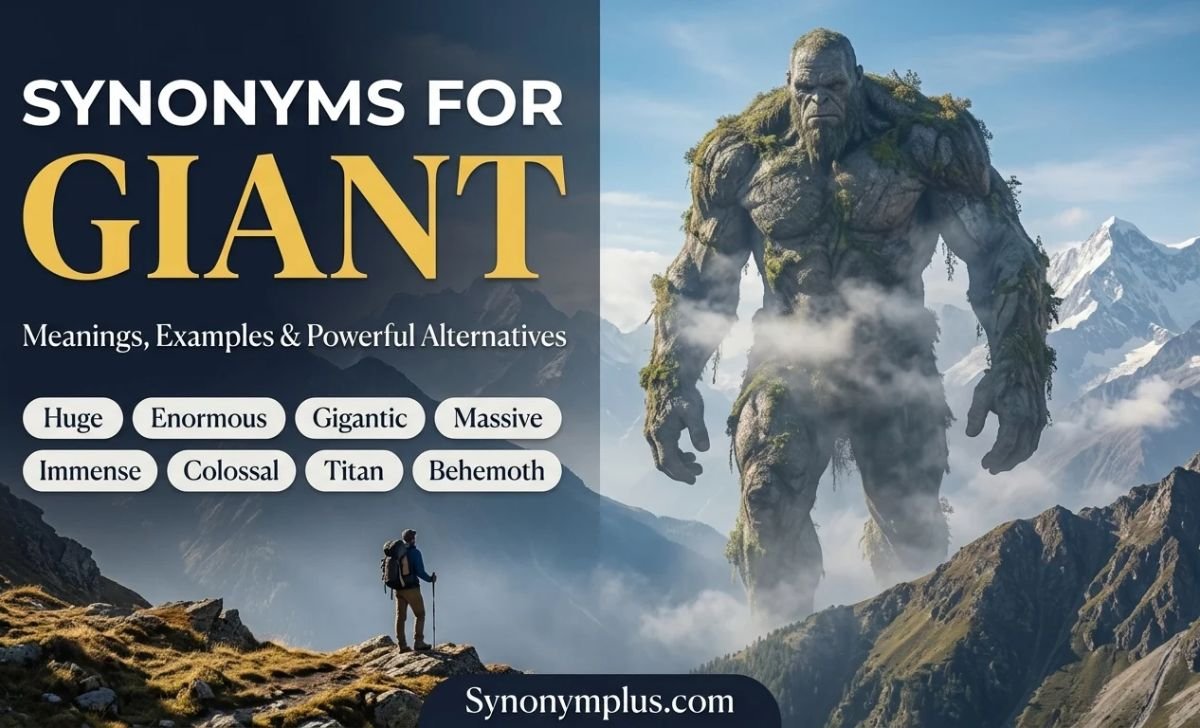
The word giant can describe a person of unusual height, an enormous object, or a company with great influence. However, using the same word in every sentence can make your writing repetitive.
A more precise alternative can help readers picture a scene, understand a description, or recognize the importance of a person or organization.
The best synonyms for giant depend on what you want to describe. Huge works well in everyday conversation, colossal emphasizes extraordinary size, and titan can describe a highly influential person. Some alternatives also have humorous, literary, or professional uses.
This guide explores common synonyms, words for giant people, funny expressions, and alternatives for business and creative writing. You will also learn their meanings, see natural examples, compare similar words, and discover the right opposite for each context.
Meaning of “Giant”
A giant is someone or something exceptionally large. The word can also describe a person, company, or organization with unusual strength, importance, or influence.
Part of speech: Giant is both a noun and an adjective.
- Noun: A giant appeared in the old fairy tale.
- Adjective: A giant tree shaded the garden.
- Figurative noun: She became a giant in the world of science.
Pronunciation: /ˈdʒaɪ.ənt/ — JY-uhnt.
Origin: The word comes through Old French from Latin gigas, meaning a giant, and ultimately from Greek gigas.
In simple English, a giant is something much bigger or more powerful than usual. The meaning depends on the sentence. A giant person is physically large, while a giant company is especially influential or successful.
Top Synonyms of “Giant”
Not every alternative has exactly the same meaning. Some describe physical size, others emphasize scale or strength, and a few refer to influence rather than dimensions. The following groups help you choose a word that fits your sentence.
1. Common synonyms for giant
These are useful alternatives for everyday English, general descriptions, and most vocabulary exercises.
| Word | Meaning | Example |
|---|---|---|
| Huge | Very large | A huge crowd gathered outside the stadium. |
| Enormous | Extremely large | An enormous ship entered the harbor. |
| Gigantic | Exceptionally large | A gigantic pumpkin won the competition. |
| Massive | Very large, heavy, or substantial | A massive rock blocked the path. |
| Immense | Extremely large in size or extent | They admired the immense lake. |
| Colossal | Remarkably large | The builders completed a colossal statue. |
| Mammoth | Extremely large or extensive | The team faced a mammoth task. |
| Gargantuan | Exceptionally large; emphatic | He ordered a gargantuan sandwich. |
| Tremendous | Very great in size, amount, or degree | The project required tremendous effort. |
| Humongous | Extremely large; informal | A humongous box filled the doorway. |
How to choose: Huge is a flexible everyday choice. Massive often suggests weight or bulk, while immense can describe size, distance, or scale. Humongous sounds casual and playful.
2. Synonyms that emphasize size and height
These words are useful when describing buildings, people, animals, trees, or other physical objects.
| Word | Meaning | Example |
|---|---|---|
| Towering | Extremely tall | A towering pine stood behind the house. |
| Oversized | Larger than the usual size | He carried an oversized suitcase. |
| Jumbo | Extra-large, often in products or portions | We ordered a jumbo pizza. |
| Voluminous | Taking up a great deal of space | She wore a voluminous winter coat. |
| Substantial | Considerable in size or amount | The building has a substantial stone entrance. |
| Elephantine | Extremely large or heavy | The elephantine sculpture dominated the hall. |
| Titanic | Enormous or exceptionally powerful | The explorers faced a titanic challenge. |
| Monumental | Exceptionally large or important | A monumental arch marked the entrance. |
| Giant-sized | Made or described as exceptionally large | The children played with a giant-sized ball. |
| Vast | Extremely extensive in area or scope | The expedition crossed a vast desert. |
These words are not interchangeable in every sentence. Towering focuses on height, oversized means bigger than a standard size, and vast usually describes extensive areas, quantities, or scope.
3. Synonyms for a giant person
When describing a very tall or large person, choose an expression that fits the situation and tone.
| Word or phrase | Meaning | Example |
|---|---|---|
| Colossus | An exceptionally large or impressive person | The wrestler was a colossus in the ring. |
| Titan | A person of extraordinary power or importance | The scientist became a titan of modern physics. |
| Goliath | A very large or formidable person | The young boxer faced a Goliath of an opponent. |
| Towering figure | A person who is extremely tall or prominent | A towering figure walked through the doorway. |
| Gentle giant | A large person with a kind nature | Despite his size, he was a gentle giant. |
| Big man | A large man; meaning depends on context | The big man ducked beneath the low beam. |
| Giant of a man | An informal description of a very large man | A giant of a man helped move the piano. |
Usage tip: Gentle giant highlights personality as well as size. Titan often refers to achievement or influence, so it is not always suitable when you simply mean a tall person.
4. Synonyms for a giant company or influential person
In business, science, sports, and technology, giant often refers to influence, power, or market position rather than physical size.
| Word | Meaning | Example |
|---|---|---|
| Behemoth | An enormous or powerful entity | The retail behemoth expanded into new markets. |
| Powerhouse | A highly productive or influential force | The studio became a creative powerhouse. |
| Industry titan | A leading and influential industry figure or company | The industry titan announced a new investment. |
| Colossus | An entity of exceptional scale or importance | The corporation grew into a global colossus. |
| Juggernaut | A powerful force that is difficult to stop | The team became a marketing juggernaut. |
| Heavyweight | A leading figure with considerable influence | She is a heavyweight in international finance. |
| Market leader | A business with a leading position in its market | The market leader introduced a cheaper product. |
| Mogul | A powerful or wealthy businessperson | The media mogul acquired another company. |
Behemoth and juggernaut can suggest overwhelming size or power. Market leader is more precise when the point is a company’s competitive position. Mogul describes a person, not the company itself.
5. Literary and mythological alternatives
Some words for giants come from mythology or literature. They can make creative writing more vivid, but they do not all mean the same thing.
| Word | Meaning | Example |
|---|---|---|
| Titan | A powerful mythological being; also a highly influential person | The story described a titan guarding the mountain. |
| Ogre | A fictional creature, often portrayed as frightening | An ogre lived in the forest in the old tale. |
| Cyclops | A mythical being traditionally depicted with one eye | The hero escaped the cyclops’s cave. |
| Gargantua | A name associated with an exceptionally large fictional figure | The author used Gargantua as a symbol of excess. |
| Leviathan | A huge sea creature in biblical tradition; also a vast power or institution | The novel portrayed the empire as a leviathan. |
| Giantess | A female giant | The giantess guarded the enchanted bridge. |
These are context-specific alternatives, not exact synonyms. An ogre is a particular kind of fictional creature, while giantess specifically refers to a female giant.
6. Funny synonyms and playful expressions for giant
If you want a humorous description for a person, pet, object, or oversized meal, these expressions can add personality.
| Expression | Meaning or tone | Example |
|---|---|---|
| Bigfoot | A humorous reference to a legendary large, hairy creature | My brother’s muddy boots look like Bigfoot’s shoes. |
| Walking mountain | A playful description of a very large person | The basketball player looked like a walking mountain. |
| Human skyscraper | A joke about someone’s exceptional height | At seven feet tall, he looked like a human skyscraper. |
| Jumbo-sized | Extra-large, with a casual tone | She brought a jumbo-sized bag of popcorn. |
| Gentle behemoth | A humorous description of someone large but kind | Our gentle behemoth carried all the shopping bags. |
| Mega-monster | An exaggerated, playful description | That mega-monster burger barely fit on the plate. |
These expressions are creative descriptions rather than standard dictionary synonyms. Use them in jokes, casual conversation, fiction, or playful captions, not in formal reports.
Context-Specific Synonyms for Giant
The best alternative depends on what you are describing and who will read your writing.
Professional and academic writing
Choose words that communicate scale or importance precisely.
- Immense: for scale, distance, or extent.
- Substantial: for a considerable amount or size.
- Colossal: for exceptionally large structures or projects.
- Monumental: for something very important or significant.
- Titan: for a highly influential person in a field.
Example: The research team made substantial progress on the project.
Here, substantial communicates the amount of progress. Giant progress would sound unnatural.
Business and marketing
Use industry titan, powerhouse, behemoth, or market leader when describing businesses and influential organizations.
Example: The technology giant introduced a new cloud computing service.
You could replace technology giant with technology powerhouse if you want to emphasize capability and influence. Use market leader only when the company’s leading market position is relevant.
Everyday conversation
These alternatives sound natural in casual speech:
- Huge
- Big
- Enormous
- Gigantic
- Humongous
Example: We saw a huge dog at the park.
Huge is a natural choice here. Humongous makes the description more playful.
Creative writing
Writers can use towering, colossal, titanic, gargantuan, or elephantine to create a stronger image.
Example: A towering shadow stretched across the village.
This sentence creates a visual impression without directly calling the shadow giant.
Antonyms of Giant
The opposite of giant depends on whether you mean physical size, height, or importance. These words describe small size, but some have narrower meanings.
| Antonym | Meaning | Example |
|---|---|---|
| Small | Not large | A small bird landed on the fence. |
| Tiny | Extremely small | A tiny seed fell from the flower. |
| Little | Small in size or amount | A little box sat on the shelf. |
| Miniature | A small-scale version of something | He collected miniature cars. |
| Minuscule | Extremely small | The label contained minuscule lettering. |
| Microscopic | Extremely small, often requiring magnification to see | Microscopic organisms live in the water. |
| Diminutive | Unusually small | The diminutive puppy slept in a basket. |
| Petite | Small and delicately built, often describing a person | The petite athlete wore a lightweight uniform. |
| Lilliputian | Extremely small; literary or humorous | The model village contained Lilliputian houses. |
For most everyday sentences, small or tiny is the simplest opposite of giant. Microscopic is much more specific, while petite is commonly used for a person’s small build.
Example Sentences
These examples show how to use giant and its alternatives in different situations.
Daily conversation
- We found a huge pumpkin at the farmers’ market.
- A gigantic dog stood beside its owner.
- That is an enormous slice of cake.
- They live in a massive house near the river.
- My little cousin calls every large insect a monster.
Academic and formal English
- The researchers examined an immense collection of historical records.
- The discovery represented a monumental achievement for the team.
- The expedition crossed a vast stretch of desert.
- The university built a colossal research facility.
- The study required a substantial amount of funding.
Business English
- The technology giant invested in renewable energy.
- The company became a powerhouse in digital entertainment.
- The retail behemoth opened stores in three new countries.
- She is a titan of the publishing industry.
- The market leader introduced a more affordable service.
Creative and informal writing
- A towering figure appeared at the castle gate.
- The hero battled a gargantuan creature.
- My friend ordered a humongous burger.
- The old tree looked like a giant guarding the garden.
- A walking mountain of a man entered the room.
Notice that these words emphasize different qualities. Vast suggests extensive space, powerhouse conveys influence, and towering emphasizes height. Choosing the right term makes the sentence more precise.
Difference Between Similar Words
Some synonyms for giant are close in meaning, but they are not interchangeable in every situation.
| Word pair | Main difference | Example |
|---|---|---|
| Giant vs. huge | Giant can describe a mythical being or an influential organization; huge is a general size adjective. | A giant in business; a huge building. |
| Giant vs. gigantic | Gigantic is an adjective that emphasizes exceptional physical size. | A giant statue; a gigantic statue. |
| Huge vs. massive | Huge focuses on size; massive often suggests bulk, weight, or solid structure. | A huge crowd; a massive stone wall. |
| Colossal vs. immense | Colossal often sounds dramatic; immense can describe broad extent or scale. | A colossal monument; immense distances. |
| Behemoth vs. titan | Behemoth often describes an enormous entity; titan often emphasizes power, achievement, or influence. | A corporate behemoth; a titan of science. |
A useful rule is to consider what you want the reader to notice.
Best Alternative Words
Use these recommendations when you need a synonym for a specific purpose.
| Context | Best alternatives | Why they fit |
|---|---|---|
| Everyday conversation | Huge, big, enormous | Familiar and natural |
| Academic writing | Immense, substantial, vast | Precise descriptions of scale or amount |
| Business writing | Industry titan, powerhouse, market leader | Communicate influence or market position |
| Professional reports | Massive, immense, substantial | Describe scale without unnecessary exaggeration |
| Creative writing | Towering, colossal, gargantuan | Create vivid imagery |
| Funny descriptions | Humongous, walking mountain, jumbo-sized | Add humor and exaggeration |
| Mythology and fantasy | Titan, giantess, ogre | Refer to specific fictional or legendary beings |
| Physical height | Towering, giant, exceptionally tall | Focus on a person’s or object’s height |
For formal writing, prefer a word that states the intended meaning directly. For example, a substantial increase is clearer than a giant increase in many professional reports.
Grammar Tips
Understanding how giant works in a sentence helps you use its alternatives correctly.
1. Use giant as a noun
As a noun, giant refers to a large being or an exceptionally influential person or organization.
- The giant lived in a cave.
- She became a giant in the fashion industry.
The plural form is giants.
2. Use giant as an adjective
Before a noun, giant describes something exceptionally large.
- A giant wave hit the shore.
- They planted a giant sunflower.
Unlike giant, the adjective gigantic usually emphasizes extreme size.
3. Understand compound words
Some expressions combine giant with another word:
- Giant-sized: an exceptionally large size.
- Giant-like: resembling a giant.
- Giant-killer: a person or team that defeats a much stronger opponent.
Example: The underdog became a giant-killer after defeating the champions.
4. Choose natural word combinations
English often uses certain adjectives with specific nouns.
- A giant leap
- A huge crowd
- A massive structure
- A vast landscape
- A towering building
- An industry giant
These combinations sound more natural than replacing every adjective with giant.
Common Mistakes
1. Using a noun where an adjective is needed
Incorrect: The company built a titan factory.
Better: The company built a huge factory.
Titan usually refers to a powerful being or influential person. It is not a standard adjective for physical size.
2. Treating every synonym as an exact replacement
Incorrect: The titan mountain was covered in snow.
Better: The gigantic mountain was covered in snow.
Titan and gigantic have different grammatical roles and meanings.
3. Using “giant” when describing only height
Less precise: A giant tower stood over the town.
More precise: A towering tower stood over the town.
The second sentence emphasizes height, although towering tower may sound repetitive. A more natural option is A towering structure stood over the town.
4. Confusing “giant” with “giants”
Incorrect: The giant of the industry announced their results.
Correct: The giants of the industry announced their results.
Use giants when referring to multiple people or organizations.
5. Using informal expressions in formal writing
Less suitable for a formal report: The company made a humongous profit.
Better: The company made an enormous profit.
Humongous is informal. Enormous is suitable for a wider range of contexts.
6. Assuming “massive” always means heavy
Massive can refer to physical bulk, but it can also describe scale or extent.
- A massive stone door.
- A massive increase in demand.
The second example refers to a large increase, not a heavy object.
Pro Writing Tips
- Identify the meaning first. Decide whether you mean size, height, strength, or influence.
- Match the tone. Use huge in conversation and immense or substantial in suitable formal contexts.
- Be precise about people. Towering describes height, while titan often suggests importance or achievement.
- Avoid exaggerated language. Colossal and gargantuan can sound dramatic. Use them when the scale justifies it.
- Choose natural collocations. Say a vast landscape or a massive building when those phrases fit better.
- Keep your audience in mind. A funny expression may work in a social post but not in a scientific paper.
- Do not stack synonyms. Phrases such as “a huge, enormous, gigantic building” add little meaning. One accurate adjective is stronger.
Related Words
These words and phrases are connected to giant through size, influence, mythology, and common English usage.
Size and scale
- Enormity: the great scale of something; often used for something very serious or shocking.
- Magnitude: the size, extent, or importance of something.
- Bulk: the large size or mass of an object.
- Expanse: a wide, open area.
- Proportions: the relative dimensions or scale of something.
Power and influence
- Dominance: a position of control or superiority.
- Prestige: respect and admiration associated with achievement or status.
- Powerhouse: a person, team, or organization with great strength or influence.
- Colossus: something or someone exceptionally large or influential.
- Juggernaut: a powerful force that is difficult to stop.
Common collocations
These combinations are useful for writing and vocabulary development:
- Giant leap
- Giant step
- Giant screen
- Giant panda
- Giant wave
- Giant corporation
- Industry giant
- Tech giant
- Giant success
- Giant challenge
Related word forms
- Giant: noun or adjective.
- Giants: plural noun.
- Giant-sized: compound adjective.
- Giant-like: resembling a giant.
- Giantess: a female giant in fiction or mythology.
These forms help you describe size, scale, or influence without relying on the same expression in every sentence.
FAQs
1. What are the best synonyms for giant?
The best synonyms for giant include huge, enormous, gigantic, massive, immense, colossal, and gargantuan. For powerful companies or influential people, use behemoth or titan.
2. What is a simple synonym for giant?
Huge is a simple synonym for giant. Both describe something very large, as in “a giant tree” or “a huge tree.”
3. What is a formal synonym for giant?
Immense, colossal, and vast work well in formal writing. For influential businesspeople, industry titan is also a useful alternative.
4. What are some synonyms for a giant person?
Useful alternatives include colossus, towering figure, giant of a man, and gentle giant. Towering figure emphasizes height, while gentle giant describes a large, kind person.
5. What are some funny synonyms for giant?
Funny expressions include walking mountain, human skyscraper, humongous, and jumbo-sized. These playful alternatives work best in casual conversations, humorous captions, and creative writing.
6. What is the difference between giant and gigantic?
Giant can be a noun or adjective, while gigantic is an adjective. For example, a giant may enter a castle, but a gigantic tree describes something exceptionally large.
7. What is a synonym for behemoth?
Synonyms for behemoth include colossus, mammoth, titan, and juggernaut. For a powerful company, powerhouse may also fit, depending on the intended meaning.
8. What is the opposite of giant?
The most common opposites of giant are small, little, and tiny. Minuscule means extremely small, while miniature describes a smaller-scale version of something.
9. Can giant describe a company or achievement?
Yes, giant can describe an influential company or a major achievement. Use industry titan for a powerful business and monumental for an achievement of great importance.
10. Is giant a noun or an adjective?
Giant functions as both a noun and an adjective. Its plural noun form is giants, while giant-sized and giant-like are related expressions.
Conclusion
The best synonyms for giant depend on whether you are describing physical size, height, strength, or influence. Words such as huge, enormous, and gigantic work well for large objects, while towering emphasizes height.
For powerful people and organizations, titan, behemoth, and powerhouse can communicate influence more clearly. Informal expressions such as humongous and walking mountain add humor, but they are not suitable for every situation.
Remember that a synonym should preserve your intended meaning, not simply make a sentence sound more impressive. Choose the word that fits your context, audience, and tone, and your writing will be clearer and more natural.
Read More Blogs
- Synonyms for Quietly: 40+ Useful Alternatives for Different Contexts
- Synonyms for Bondage: 40+ Alternatives for Different Contexts
- Synonyms for Sometimes: 45 Words to Improve Your English

I am Junaid Tariq, the author of Synonymplus.com, with 3 years of experience in English vocabulary, synonyms, word usage, and writing. I enjoy creating clear and useful content that makes learning English easier and more practical.
My goal is to help readers find the right words, understand their meanings, and use them correctly in everyday communication. I focus on writing simple, accurate, and easy-to-understand content for students, writers, professionals, and anyone looking to improve their English vocabulary.
Through Synonymplus.com, I share helpful guides, synonym lists, word meanings, examples, and practical language tips. With my experience and passion for English, I aim to provide reliable content that helps readers write better, speak more confidently, and expand their vocabulary.