Scarcity describes a situation in which something is difficult to find, obtain, or get in sufficient amounts. It can refer to food, water, money, jobs, resources, information, time, or other things people need or want.
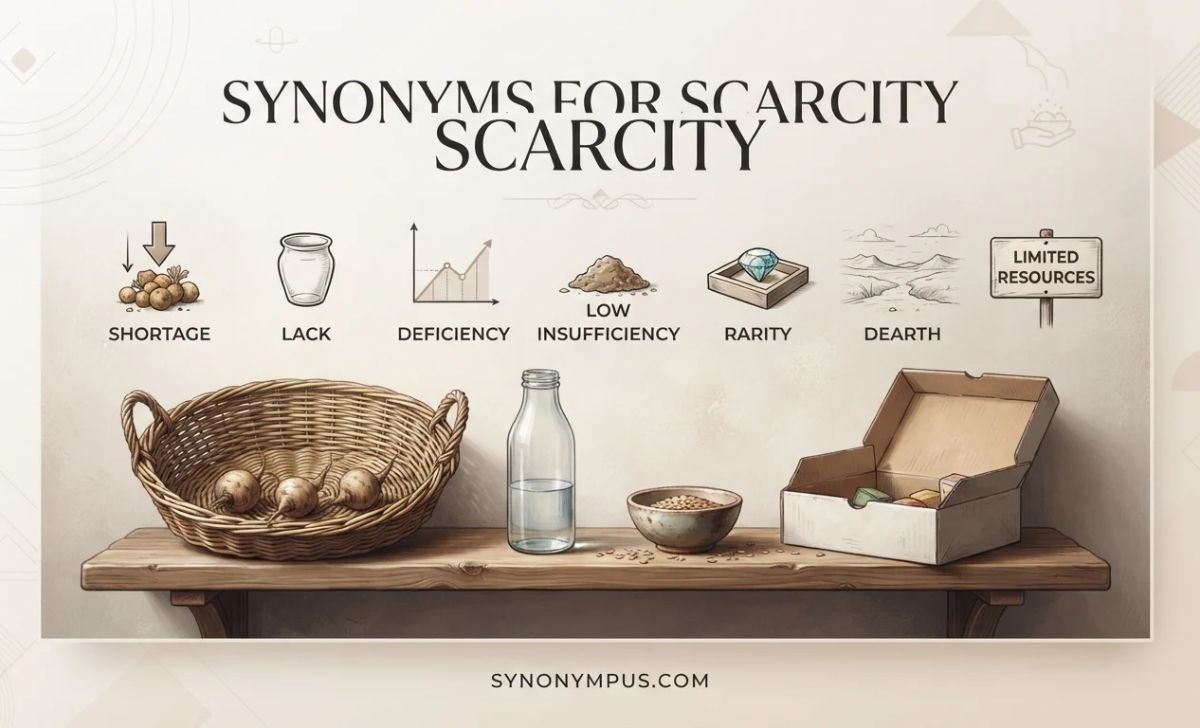
If you need synonyms for scarcity, the best choice depends on the context. Shortage and lack are common everyday alternatives, while dearth and paucity sound more formal.
In economics, terms such as resource constraint and limited supply may be more precise. Some expressions below are close alternatives rather than exact synonyms, so the usage notes explain where each one fits naturally.
What Does Scarcity Mean?
Scarcity is the condition of having too little of something or having something that is difficult to obtain. Oxford defines it as a situation in which there is not enough of something and it is difficult to obtain.
For example:
The scarcity of clean water is a serious problem in the region.
The word is common in everyday, business, academic, and economic writing.
Scarcity can describe:
- Natural resources: water, land, minerals, and energy
- Basic needs: food, medicine, and housing
- Economic resources: money, labor, and materials
- Information: a scarcity of reliable data
- Time: a scarcity of time for research
- Opportunities: a scarcity of jobs or skilled workers
In economics, scarcity also refers to the fact that resources are limited while human wants are not unlimited. This idea is closely connected with supply, demand, allocation, and opportunity cost.
50 Synonyms and Close Alternatives for Scarcity
The following list includes direct synonyms, close alternatives, and useful phrases. They are not all interchangeable in every sentence.
1. Shortage
Meaning: A shortage means there is not enough of something that is needed or wanted.
Best used when: You are talking about supplies, products, workers, or other resources.
Example:
The city is facing a shortage of affordable housing.
Note: This is one of the closest and most natural alternatives to scarcity. Oxford lists shortage as a synonym of scarcity.
2. Lack
Meaning: A lack is the absence or insufficient amount of something.
Best used when: You want a simple, common word.
Example:
The project failed because of a lack of funding.
Note: Lack is often followed by of.
3. Dearth
Meaning: Dearth means a serious lack or an amount that is too small.
Best used when: You want a formal or somewhat literary alternative.
Example:
The industry is experiencing a dearth of skilled workers.
Note: Oxford directly lists scarcity as a synonym of dearth.
4. Paucity
Meaning: Paucity means a very small amount of something, especially less than what is needed.
Best used when: Writing formally or academically.
Example:
Researchers noted a paucity of reliable evidence.
Note: Paucity is formal and commonly refers to information, evidence, research, or other abstract things.
5. Deficiency
Meaning: A deficiency is an amount that is missing or insufficient.
Best used when: Something falls below the amount or level required.
Example:
The report identified a deficiency in the available data.
Note: Deficiency often suggests that something does not meet a required standard.
6. Insufficiency
Meaning: Insufficiency means that there is not enough of something for a particular purpose.
Best used when: You need a formal word for an inadequate amount.
Example:
The study pointed to an insufficiency of evidence.
Note: This word is more formal than lack or shortage.
7. Deficit
Meaning: A deficit is a shortage or amount by which something is below what is needed or expected.
Best used when: Discussing money, resources, supplies, or measurable amounts.
Example:
The company reported a budget deficit.
Note: Deficit is especially common in finance and economics.
8. Shortfall
Meaning: A shortfall is the amount by which something falls below a required or expected level.
Best used when: Comparing an actual amount with a target.
Example:
The school faced a shortfall in its annual budget.
Note: Shortfall often focuses on the gap between what is available and what is needed.
9. Undersupply
Meaning: Undersupply means that the available supply is lower than demand or need.
Best used when: Discussing markets, products, resources, or economics.
Example:
An undersupply of homes has pushed prices higher.
Note: This is more specific than the general word scarcity.
10. Inadequacy
Meaning: Inadequacy refers to a condition in which something is not enough or does not meet a need.
Best used when: The problem is that a supply, resource, or provision is insufficient.
Example:
The report highlighted the inadequacy of local medical services.
Note: It can describe quality as well as quantity, so it is not always a direct synonym.
11. Want
Meaning: Want can mean a lack or absence of something needed.
Best used when: Writing in a formal, literary, or older style.
Example:
The project was delayed for want of funding.
Note: In modern everyday English, want usually means desire, so its “lack” meaning depends strongly on context.
12. Absence
Meaning: Absence means that something is not present.
Best used when: Nothing is available or present rather than when supply is merely limited.
Example:
The absence of reliable information made the decision difficult.
Note: Absence is stronger than scarcity when something is completely missing.
13. Rarity
Meaning: Rarity describes something that is uncommon or found only in small numbers.
Best used when: The focus is on how uncommon something is.
Example:
The rarity of the species makes it difficult to study.
Note: Rarity and scarcity overlap, but they are not identical. Something can be rare without being needed or in short supply.
14. Scantiness
Meaning: Scantiness means that something exists only in a small or insufficient amount.
Best used when: Describing a limited amount, supply, or quantity.
Example:
The scantiness of the evidence made the conclusion uncertain.
Note: This is less common than shortage or lack.
15. Sparsity
Meaning: Sparsity means that something is spread thinly or occurs in small numbers.
Best used when: Talking about data, populations, objects, or things distributed over an area.
Example:
The sparsity of trees makes the landscape look dry.
Note: Sparsity focuses on distribution rather than general shortage.
16. Meagerness
Meaning: Meagerness describes a small or inadequate amount.
Best used when: Talking about supplies, resources, income, or results.
Example:
The meagerness of the harvest worried local farmers.
Note: It can suggest that the amount is disappointingly small.
17. Scant Supply
Meaning: A scant supply is a small amount that may not be enough.
Best used when: You want to describe a limited quantity in a clear way.
Example:
The clinic had only a scant supply of medicine.
Note: This is a phrase rather than a single-word synonym.
18. Limited Supply
Meaning: Limited supply means that only a restricted amount is available.
Best used when: Talking about products, resources, or materials.
Example:
The store has a limited supply of the new model.
Note: This expression can sound neutral and does not always imply a serious problem.
19. Limited Availability
Meaning: Limited availability means that something can be obtained only in small amounts, places, or periods.
Best used when: Discussing products, services, information, or opportunities.
Example:
The medication has limited availability in rural areas.
20. In Short Supply
Meaning: If something is in short supply, there is less of it than people need or want.
Best used when: Speaking naturally about goods, workers, materials, or resources.
Example:
Skilled electricians are in short supply.
Note: This is a very useful everyday alternative to scarce or scarcity.
21. Restricted Supply
Meaning: Restricted supply means that the amount available is limited by circumstances or rules.
Best used when: Supply is controlled, limited, or difficult to increase.
Example:
The product remains in restricted supply.
22. Constrained Supply
Meaning: Constrained supply means that supply is limited by one or more conditions.
Best used when: Writing about business, economics, manufacturing, or markets.
Example:
Constrained supply has affected production costs.
Note: This is a professional and economic expression.
23. Supply Constraint
Meaning: A supply constraint is a factor that prevents enough goods, services, or resources from being supplied.
Best used when: Discussing economics, business, or production.
Example:
A supply constraint delayed the construction project.
24. Resource Constraint
Meaning: A resource constraint is a limitation in the money, people, materials, time, or other resources available.
Best used when: Talking about projects, organizations, economics, or planning.
Example:
Resource constraints forced the team to reduce the project scope.
25. Resource Limitation
Meaning: A resource limitation is a restriction on the amount of a resource available.
Best used when: Writing about natural resources, business, research, or planning.
Example:
Resource limitations can affect long-term development.
26. Limited Resources
Meaning: Limited resources are resources available only in restricted amounts.
Best used when: Discussing economics, education, business, or natural resources.
Example:
The organization must work carefully with its limited resources.
27. Finite Resources
Meaning: Finite resources are resources that exist in a limited amount and cannot be used indefinitely.
Best used when: Discussing natural resources and sustainability.
Example:
Governments must plan carefully when using finite resources.
Note: Finite means limited in total amount, not necessarily scarce at a particular moment.
28. Dwindling Supply
Meaning: A dwindling supply is a supply that is becoming smaller over time.
Best used when: A resource is gradually running out.
Example:
Farmers are concerned about the dwindling water supply.
29. Reduced Supply
Meaning: Reduced supply means that less of something is available than before.
Best used when: Comparing current availability with an earlier level.
Example:
Reduced supply has affected food prices.
30. Low Supply
Meaning: Low supply means that the available amount is small.
Best used when: Writing in a simple, direct style.
Example:
Low supply and strong demand pushed prices higher.
31. Insufficient Supply
Meaning: Insufficient supply means that the available amount is not enough.
Best used when: You want to clearly state that supply fails to meet demand.
Example:
The region has an insufficient supply of clean water.
32. Supply Deficit
Meaning: A supply deficit occurs when supply is below the amount required or demanded.
Best used when: Writing about economics, markets, energy, or business.
Example:
The country faced a supply deficit during the winter.
33. Supply Shortfall
Meaning: A supply shortfall is a gap between the amount available and the amount needed.
Best used when: Discussing production, markets, or planning.
Example:
The manufacturer experienced a supply shortfall after the shipment was delayed.
34. Shortfall in Resources
Meaning: This phrase describes a situation in which fewer resources are available than required.
Best used when: Discussing budgets, staff, materials, or other practical needs.
Example:
A shortfall in resources slowed the research project.
35. Lack of Availability
Meaning: Lack of availability means something is not available in sufficient amounts or places.
Best used when: Talking about services, products, information, or opportunities.
Example:
A lack of availability made the treatment difficult to access.
36. Lack of Supply
Meaning: Lack of supply means that not enough of a product, resource, or service is available.
Best used when: Discussing markets and practical shortages.
Example:
A lack of supply caused delays in production.
37. Lack of Resources
Meaning: Lack of resources means that the available money, people, materials, or other resources are insufficient.
Best used when: Discussing organizations, projects, education, or development.
Example:
The program struggled because of a lack of resources.
38. Shortage of Resources
Meaning: A shortage of resources means that fewer resources are available than needed.
Best used when: Writing about economics, projects, organizations, or communities.
Example:
The shortage of resources affected the quality of public services.
39. Scarce Supply
Meaning: A scarce supply is a supply that is difficult to obtain because only a small amount is available.
Best used when: Emphasizing that a resource is difficult to find.
Example:
The region depends on a scarce supply of fresh water.
40. Scant Supply
Meaning: Scant supply means a very small amount of something.
Best used when: You want to emphasize that the quantity is especially low.
Example:
The library had only a scant supply of recent textbooks.
Note: Scant often carries a stronger sense of insufficiency than limited.
41. Meager Supply
Meaning: A meager supply is a small amount that is barely enough or clearly inadequate.
Best used when: The supply is noticeably poor or insufficient.
Example:
The village survived on a meager supply of food.
42. Thin Supply
Meaning: A thin supply means that only a small amount is available.
Best used when: Describing limited stocks or resources in less formal writing.
Example:
Stores had a thin supply of essential goods after the storm.
Note: Thin supply is less common than short supply.
43. Scarcity of Resources
Meaning: This phrase describes a situation in which resources are limited or difficult to obtain.
Best used when: Discussing economics, development, business, or the environment.
Example:
The scarcity of resources can influence how communities make decisions.
44. Resource Scarcity
Meaning: Resource scarcity refers to limited availability of resources compared with human needs or demand.
Best used when: Writing about economics, sustainability, or environmental issues.
Example:
Resource scarcity can increase competition for water and land.
45. Economic Scarcity
Meaning: Economic scarcity refers to the limited availability of resources compared with unlimited or growing wants.
Best used when: Discussing basic economic principles.
Example:
Economic scarcity forces societies to decide how limited resources should be used.
Note: This is a specific concept rather than a general synonym.
46. Water Scarcity
Meaning: Water scarcity is a condition in which available water is insufficient to meet demand or needs.
Best used when: Discussing environmental issues, drought, agriculture, or public health.
Example:
Water scarcity is becoming a major concern in dry regions.
Note: This is a specific type of scarcity, not a replacement for scarcity in every sentence.
47. Food Scarcity
Meaning: Food scarcity refers to limited access to enough food.
Best used when: Discussing hunger, drought, conflict, agriculture, or food systems.
Example:
Food scarcity can place vulnerable communities at greater risk.
48. Labor Shortage
Meaning: A labor shortage occurs when there are not enough workers to meet demand.
Best used when: Discussing employment, business, or economic conditions.
Example:
The construction industry is facing a labor shortage.
Note: Labor shortage is more specific than scarcity.
49. At a Premium
Meaning: Something that is at a premium is difficult to obtain or available only in limited amounts, often making it more valuable.
Best used when: Discussing resources, space, time, or opportunities.
Example:
Office space is at a premium in the city center.
Note: This expression can describe scarcity with an emphasis on value or demand.
50. Thin on the Ground
Meaning: If something is thin on the ground, there are very few of them in a particular place or situation.
Best used when: Speaking informally about people, opportunities, services, or other things that are difficult to find.
Example:
Affordable apartments are thin on the ground in the city.
Note: This is an idiomatic expression, not a formal synonym. It is more natural in conversational or informal writing.
Formal Synonyms for Scarcity
For formal or academic writing, these choices are usually more suitable:
- dearth
- paucity
- deficiency
- insufficiency
- inadequacy
- shortfall
- deficit
- resource constraint
- limited availability
- undersupply
Paucity and dearth are especially useful when discussing limited information, evidence, research, talent, or resources. Both are marked as formal in major dictionaries.
For example:
There is a paucity of evidence supporting the claim.
This sounds more formal than:
There is a lack of evidence supporting the claim.
Simple Synonyms for Scarcity
For everyday English, these words are easier and more natural:
- lack
- shortage
- not enough
- limited supply
- limited availability
- in short supply
For example:
There is a shortage of nurses in the area.
This is more natural in everyday communication than:
There is a paucity of nurses in the area.
Professional and Academic Alternatives
Different fields may use different words for scarcity.
In business, terms such as shortfall, supply constraint, and undersupply can describe limited supply.
Economics often uses terms such as resource scarcity and economic scarcity. Limited resources is also common when resources are not sufficient.
In academic writing, paucity, dearth, insufficiency, and deficiency can be useful. Each word has a slightly different meaning, so the context matters.
Choose the term that best describes the specific type of limitation rather than replacing scarcity with a word that does not fully match the meaning.
Scarcity in Different Contexts
Scarcity of Resources
Resource scarcity means that resources are limited compared with demand or need.
Resource scarcity can affect economic growth and development.
Common related terms include limited resources, resource constraints, and finite resources.
Water Scarcity
Water scarcity describes limited access to enough usable water.
Water scarcity can affect agriculture, public health, and local communities.
Related expressions include water shortage, limited water supply, and water stress.
Food Scarcity
Food scarcity refers to a limited supply or availability of food.
Drought can contribute to food scarcity in agricultural regions.
Depending on the situation, food shortage, food insecurity, or limited food supply may be more precise.
Economic Scarcity
In economics, scarcity is tied to limited resources and competing uses. People and societies must make choices because resources cannot satisfy every possible want.
Economic scarcity forces businesses and governments to make choices about resource allocation.
Scarcity of Time
When time is limited, natural alternatives include:
- lack of time
- limited time
- time constraints
- shortage of time
Because of time constraints, the team postponed the final review.
Scarcity of Jobs
For employment, job shortage or labor-market shortage may be more natural depending on the intended meaning.
The region is experiencing a shortage of well-paid jobs.
Scarcity vs. Lack
Lack is one of the simplest alternatives to scarcity, but it is broader.
There is a lack of information.
This can mean that information is missing or insufficient.
There is a scarcity of reliable information.
This emphasizes that reliable information is difficult to obtain or available in limited amounts.
Scarcity vs. Dearth
Dearth is a formal word meaning a lack or insufficient amount. Oxford lists scarcity as a synonym of dearth.
The company faces a scarcity of skilled workers.
The company faces a dearth of skilled workers.
Both work, but dearth has a more formal tone.
Scarcity vs. Paucity
Paucity refers to a very small amount of something and is formal. Cambridge gives examples involving a paucity of information and research.
There is a paucity of evidence on the subject.
This makes paucity particularly useful in academic and research writing.
Scarcity vs. Rarity
Rarity means that something is uncommon or unusual.
Scarcity means that something is limited or difficult to obtain.
A rare painting may be scarce because few copies exist, but something can be scarce without being rare. For example, clean drinking water may be scarce in a particular area without being rare worldwide.
Quick Comparison of Scarcity Synonyms
| Synonym | Meaning | Tone | Best Used For |
|---|---|---|---|
| Shortage | Not enough of something | Neutral | Supplies and resources |
| Lack | Absence or insufficient amount | Neutral | Everyday English |
| Dearth | Serious lack | Formal | Resources, workers, information |
| Paucity | Very small amount | Formal | Evidence, data, research |
| Deficiency | Amount below what is needed | Formal | Resources, nutrients, systems |
| Deficit | Amount below a required level | Professional | Money, resources, supplies |
| Shortfall | Gap between available and needed | Professional | Budgets and targets |
| Rarity | Uncommon occurrence | Neutral | Objects, species, events |
| Limited supply | Restricted amount available | Neutral | Products and resources |
| In short supply | Less available than needed | Conversational | Goods, workers, materials |
The main takeaway is simple: shortage and lack are usually the easiest replacements, while dearth and paucity add a formal tone. Terms such as deficit and shortfall are more specific and work best when there is a measurable gap.
Common Collocations With Scarcity
Some combinations sound especially natural in English:
- scarcity of resources
- scarcity of water
- scarcity of food
- scarcity of information
- scarcity of data
- scarcity of jobs
- scarcity of labor
- scarcity of land
- scarcity of energy
- scarcity of time
- resource scarcity
- economic scarcity
- water scarcity
- food scarcity
- growing scarcity
- increasing scarcity
- severe scarcity
- relative scarcity
- scarcity value
- in times of scarcity
For example:
The scarcity of reliable data made the study difficult.
Water scarcity affects both farming and household use.
Oxford also records common combinations such as scarcity of resources, scarcity value, and phrases such as in times of scarcity.
Common Mistakes With Scarcity
Using “scarcity” when you mean complete absence
Scarcity usually means something is limited, not necessarily completely missing.
Better: There is a scarcity of clean water.
If no clean water exists at all, absence may be more accurate.
Treating “rarity” and “scarcity” as identical
A rare item is uncommon. A scarce resource is difficult to obtain or available in limited amounts.
Using “paucity” in casual conversation
Paucity is correct, but it sounds formal.
In everyday speech, lack or shortage is usually more natural.
Using “deficit” for every shortage
A deficit often refers to a measurable gap, especially in finance, supply, or resources. It is not the best replacement in every sentence.
Antonyms of Scarcity
The main opposites of scarcity are:
- abundance
- plenty
- surplus
- sufficiency
- adequacy
- ample supply
- availability
- abundant supply
Cambridge lists abundance and plenty as opposites of scarcity.
For example:
Water scarcity can create serious problems.
The opposite idea would be:
An abundant water supply can meet local demand.
The best antonym depends on the context. Surplus works when there is more than needed, while abundance suggests that something is available in large amounts.
What Is the Adjective Form of Scarcity?
The adjective related to scarcity is scarce.
Scarce means that something is available only in small amounts or is difficult to obtain.
Examples:
Clean water is scarce in some regions.
Skilled workers are becoming scarce.
The word scarcely is an adverb, but it has a different meaning. It usually means barely or almost not.
FAQs
1. What is the best synonym for scarcity?
Shortage is one of the closest and most useful synonyms in everyday English. Lack is also very common. The best choice depends on the sentence and context.
2. What is a formal word for scarcity?
Dearth and paucity are strong formal alternatives. Paucity is especially useful for a small amount of information, evidence, or research.
3. Is shortage the same as scarcity?
They are very close, but not always identical. Shortage usually emphasizes insufficient supply, while scarcity can describe a broader condition of limited availability.
4. What is a simple synonym for scarcity?
Lack is the simplest common alternative. Shortage is another natural choice when something is not available in sufficient quantity.
5. What is the adjective form of scarcity?
The adjective is scarce. For example, “Clean water is scarce in the region.”
6. What is the opposite of scarcity?
Common antonyms include abundance, plenty, and surplus. The correct choice depends on the context.
7. What is the difference between scarcity and rarity?
Scarcity focuses on limited availability or difficulty of obtaining something. Rarity focuses on something being uncommon.
8. What are some synonyms for water scarcity?
Depending on the context, you can use water shortage, limited water supply, water scarcity, or limited availability of water. A more specific term is usually clearer than a general synonym.
Conclusion
The best synonym for scarcity depends on the situation. Shortage and lack work well in everyday English, while dearth and paucity suit more formal writing. Deficit, shortfall, and supply constraint are useful when discussing measurable or economic limitations.
For specific topics, expressions such as water scarcity, resource scarcity, and food scarcity provide greater precision. Instead of choosing a synonym only because it appears in a thesaurus, consider the amount, context, tone, and purpose.
The right word should make the shortage or limitation clearer, whether you are writing an email, essay, article, report, or conversation.
Read More Blogs
- 50 Synonyms for Orchestra: 50 Musical Group Terms Explained
- 50 Synonyms for Wire: Useful Alternatives With Simple Examples
- 50 Synonyms for Conclusions: Useful Alternatives and Examples
- Synonyms for Swanky: Meaning, Examples, and Better Alternatives

I am Junaid Tariq, the author of Synonymplus.com, with 3 years of experience in English vocabulary, synonyms, word usage, and writing. I enjoy creating clear and useful content that makes learning English easier and more practical.
My goal is to help readers find the right words, understand their meanings, and use them correctly in everyday communication. I focus on writing simple, accurate, and easy-to-understand content for students, writers, professionals, and anyone looking to improve their English vocabulary.
Through Synonymplus.com, I share helpful guides, synonym lists, word meanings, examples, and practical language tips. With my experience and passion for English, I aim to provide reliable content that helps readers write better, speak more confidently, and expand their vocabulary.