You are writing a birthday card. You type: “I hope you love your presant.”
The red line appears. Your brain says the word looks fine.
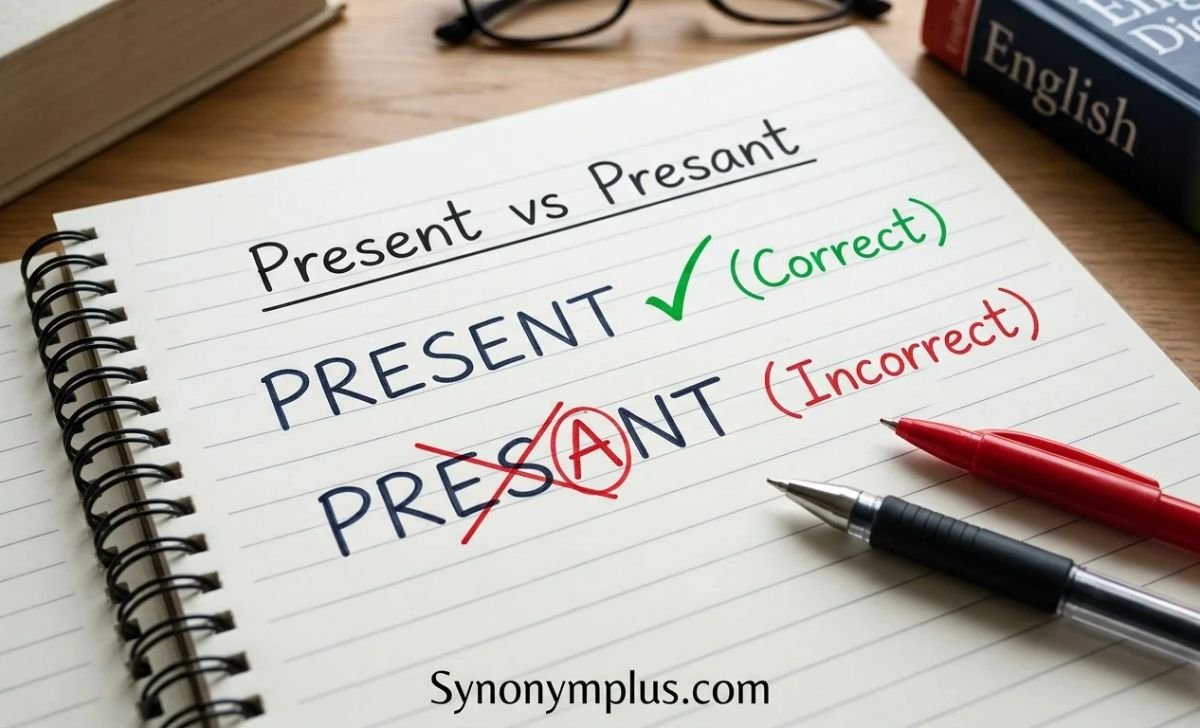
Here is the short answer: “present” is the correct spelling. “Presant” is a misspelling. The word ends in -ent, not -ant.
This guide shows why the mistake happens, how to remember the right spelling, and how one word can mean a gift, the current time, or a speech.
Present vs Presant: The Quick Answer
- Present (correct): the standard modern spelling for every meaning.
- Presant (incorrect): a misspelling in modern English.
If you mean a gift, the time right now, being in a place, or giving a talk, write present.
Is “Presant” a Real Word?
Not today. No modern dictionary lists it as a standard word.
But it has a surprising history.
A Spelling From the Past
Dictionary.com’s word history shows that “presant” appeared as an old Middle English spelling of the noun. People wrote present, presente, and presant centuries ago, before English spelling settled.
That means your “typo” echoes how medieval writers spelled the word. Still, you should not use it now. Readers will treat it as an error.
Why Do People Write “Presant” Today?
Three things cause the slip.
The Weak Vowel Sound
Say the word: PREZ-ent. The second syllable sounds like “unt.” Your ear cannot tell if the vowel is E or A.
Linguists call this a schwa sound. English spells it many different ways.
The Look-Alike Words
Many common words end in -ant: pleasant, important, distant, elegant. Your brain may pick the wrong ending.
In fact, “pleasant” is the closest troublemaker. It starts with a similar sound and ends in -ant.
Fast Typing
The A and E keys sit close together on some keyboards. Quick fingers slip.
How to Spell Present Correctly
Try these simple tricks.
Trick 1: Hide the Word “Sent”
Split it: pre + sent. A present is something sent your way. The word sent ends in E, so present does too.
Trick 2: Find “Resent”
Look inside the word: p-RESENT-. You can spot resent hiding in the middle. It has an E.
Trick 3: Pair It With Current
Present and current both mean “now.” Both end in -ent. Link them in your mind.
Trick 4: Think of Moment
Say “the present moment.” Moment also ends in -ent.
What Does Present Mean?
Present is a flexible word. It works as an adjective, a noun, and a verb.
Present as an Adjective
As an adjective, it means one of two things.
1. Being in a place
- Is everyone present?
- She was present at the wedding.
2. Existing now
- The present situation is stable.
- Present prices may change.
Present as a Noun
As a noun, it has two meanings.
1. The current time
- Live in the present.
- At present, we have no openings.
2. A gift
- She wrapped the present in red paper.
- I bought a small present for my teacher.
The plural for gifts is presents.
Present as a Verb
As a verb, it means to give, show, or introduce something.
- The mayor will present the award.
- I will present my plan on Monday.
- May I present our guest speaker?
- The patient presented with a fever.
The last example shows a medical use. It means the symptoms appeared.
How Do You Pronounce Present?
This is where the word gets tricky. The meaning changes with the stress.
| Use | Pronunciation | Stress | Example |
|---|---|---|---|
| Noun (gift, now) | PREZ-ent | First syllable | A birthday present |
| Adjective | PREZ-ent | First syllable | The present time |
| Verb | pri-ZENT | Second syllable | To present an idea |
Words that are spelled alike but sound different are called heteronyms.
The sentence “I present you with this present” shows the difference clearly.
Other Words That Shift Stress the Same Way
- record (noun) vs record (verb)
- object (noun) vs object (verb)
- permit (noun) vs permit (verb)
- produce (noun) vs produce (verb)
Learn the pattern once, and you will hear it everywhere.
Present vs Presence vs Presents
Three similar words cause extra mix-ups.
| Word | Meaning | Example |
|---|---|---|
| Present | Gift, now, here, or to give | The present was a scarf. |
| Presents | More than one gift | She opened her presents. |
| Presence | The state of being in a place | Your presence is requested. |
If you are talking about being there, you may need presence, not present.
- Right: We appreciate your presence at the event.
- Also right: We are glad you are present at the event.
Present Tense: A Quick Refresher
“Present” also names a grammar tense. It shows actions happening now or regularly.
- Simple present: She walks to work.
- Present continuous: She is walking to work.
- Present perfect: She has walked to work.
The spelling stays present in every case.
Synonyms for Present
Pick the synonym that fits your meaning.
For “Gift”
gift, offering, token, donation, treat
For “Now”
current, existing, today’s, contemporary, ongoing
For “Being Here”
attending, in attendance, on hand, there
For “To Give or Show”
deliver, offer, introduce, show, submit, award
Where Does the Word Present Come From?
The word travels a long way.
It comes from Old French present, which comes from Latin praesens, meaning “being there.” The Latin pieces mean “before” plus “to be.”
The adjective appears in English around the late 1200s. The noun for “gift” appears even earlier, from an old phrase meaning “in presence.” That phrase meant giving something in person.
The sense of “the current time” reached English by about 1425, with Chaucer among the writers who used it.
“Present” in Everyday Writing
Birthday Card
Thank you for the lovely present.
Work Email
I will present the results on Friday.
In a Classroom
The teacher calls your name. You say, “Present!”
In a Resume
Marketing Manager, 2021–Present
This means you still have this job.
Tip for Using “Presently”
“Presently” can mean “now” or “soon.” This may confuse readers. Use “currently” to mean “now.” Use “soon” to mean “in a short time.”ings. It can mean “now” or “soon.” This may confuse readers. To be clear, use “currently” for now and “soon” when talking about the near future.
Common Misspellings of Present
Watch for these:
- presant
- persent
- presnt
- pressent
- presentt
Only present is correct.
Quick Practice: Present or Presant?
Pick the correct spelling.
- I bought you a (present / presant).
- All students must be (present / presant) on Monday.
- She will (present / presant) her research next week.
- Live in the (present / presant).
- Which (presents / presants) did you open?
Answers: 1. present. 2. present. 3. present. 4. present. 5. presents.
FAQs
Is it present or presant?
It is present.
Is presant a word?
No, not in modern English. It was an old Middle English spelling.
What is the plural of present?
The plural is presents.
What does present mean?
It can mean a gift, the current time, being in a place, or to give or show something.
How do you pronounce present?
Say PREZ-ent for the noun and adjective. Say pri-ZENT for the verb.
What is the difference between present and presence?
Present often means gift, now, or here. Presence means the state of being somewhere.
Why does present have two pronunciations?
English often shifts stress to tell nouns and verbs apart.
How do I remember the spelling of present?
Think pre + sent. A present is something sent your way.
Final Thoughts
The rule is short. Present is real. Presant is a slip.
Remember pre + sent, and the E will stay put. Then let the stress guide your pronunciation: PREZ-ent for the gift, pri-ZENT for the action.
Now go write that card. Your friend will love the present, and the spelling too.
Read More Blogs
- Synonyms for Quietly: 40+ Useful Alternatives for Different Contexts
- Synonyms for Bondage: 40+ Alternatives for Different Contexts
- Synonyms for Sometimes: 45 Words to Improve Your English

I am Junaid Tariq, the author of Synonymplus.com, with 3 years of experience in English vocabulary, synonyms, word usage, and writing. I enjoy creating clear and useful content that makes learning English easier and more practical.
My goal is to help readers find the right words, understand their meanings, and use them correctly in everyday communication. I focus on writing simple, accurate, and easy-to-understand content for students, writers, professionals, and anyone looking to improve their English vocabulary.
Through Synonymplus.com, I share helpful guides, synonym lists, word meanings, examples, and practical language tips. With my experience and passion for English, I aim to provide reliable content that helps readers write better, speak more confidently, and expand their vocabulary.