You write an email to a new hire: “We are happy to confirm the position we offerred you.” You pause. Two r’s or one?
Many people stop at this exact spot. “Prefer” becomes “preferred,” so “offer” should follow, right? It does not.
This guide gives you the correct spelling first. Then it explains the rule in plain steps. You will also see real examples, similar words, common mistakes, and a quick checklist.
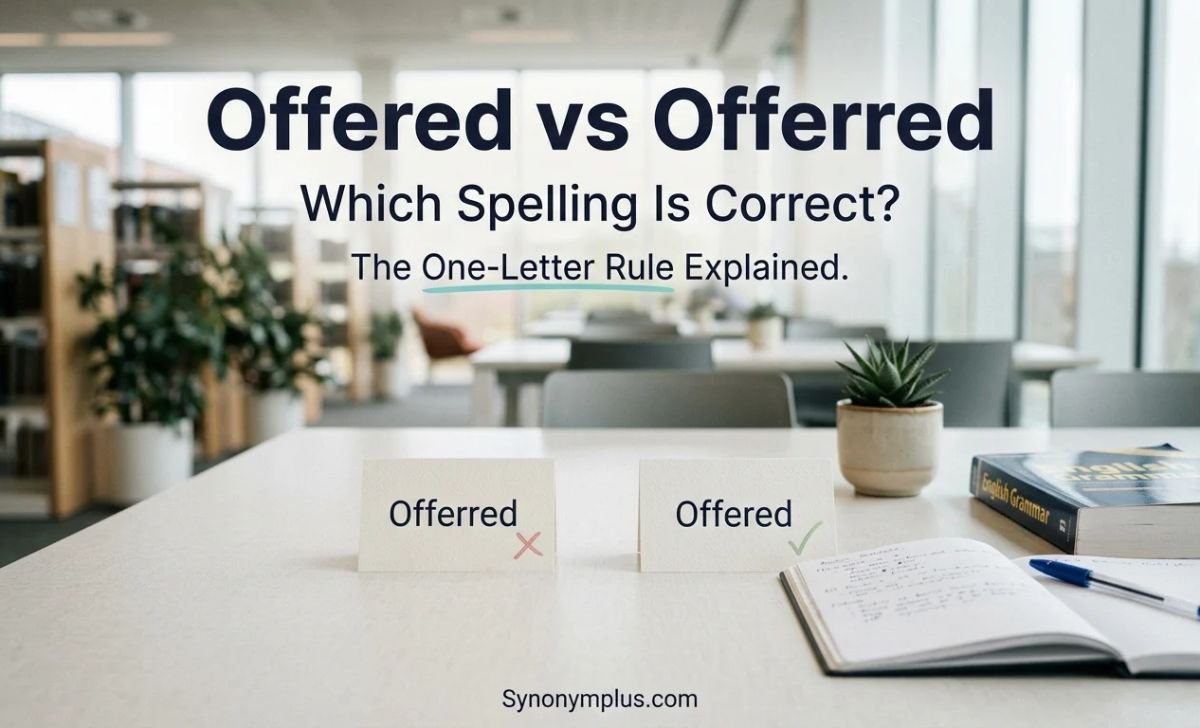
Offered vs Offerred: The Quick Answer
The correct spelling is offered, with one “r.”
“Offerred” is a misspelling. You will not find it in standard dictionaries. Use “offered” for the past tense and for the past participle (“she has offered help”).
What Each Word Means
Let’s define the correct word and the mistake.
What Does “Offered” Mean?
“Offered” is the past tense of “offer.” You use it when you present something for someone to accept or refuse.
A typical example is “I was offered a position at a bank.” You can also use it to show you were willing to help: “Faisal offered to drive us home.”
What Is “Offerred”?
“Offerred” is a spelling mistake. It happens when people copy the pattern of words like “preferred” or “referred.”
What About “Offering”?
“Offering” is the -ing form. It also has one “r.” You write “offering,” not “offerring.”
Why “Offer” Becomes “Offered” and Not “Offerred”
The answer comes down to stress. Say the word out loud.
The Stress Rule
With words of more than one syllable, you double the last letter only when the final syllable is stressed. If the final syllable is not stressed, you do not double it.
Now test “offer.”
- It has two syllables: OF-fer.
- The stress falls on the first syllable (“OF”).
- The last syllable (“fer”) is weak.
So you do not double the “r.” You add “-ed” and get offered.
Why “Prefer” Is Different
Now test “prefer.”
- It has two syllables: pre-FER.
- The stress falls on the last syllable (“FER”).
So you double the “r.” You get preferred. The extra “r” appears in “preferred” and “preferring” for this reason.
Three Steps to Decide Every Time
- Say the word out loud.
- Find the stressed syllable.
- Double the last letter only if the stress is on the last syllable.
Offered vs Preferred: Side by Side
This table makes the rule easy to see.
| Base word | Stress | Past tense |
|---|---|---|
| OF-fer | First syllable | offered |
| pre-FER | Last syllable | preferred |
| re-FER | Last syllable | referred |
| oc-CUR | Last syllable | occurred |
| SUF-fer | First syllable | suffered |
| VIS-it | First syllable | visited |
The pattern repeats. A strong last syllable means a doubled letter. A weak last syllable means a single letter.
All Forms of “Offer” at a Glance
Use this table when you write.
| Form | Spelling | Example |
|---|---|---|
| Base verb | offer | I offer free delivery. |
| He, she, it | offers | She offers free delivery. |
| Past tense | offered | They offered a discount. |
| Past participle | offered | He has offered help. |
| -ing form | offering | We are offering a trial. |
| Noun | offer | That is a great offer. |
| Noun (plural) | offers | We have two offers. |
Notice that every form keeps a single “r.” No form uses “rr.”
Words That Follow the Same Rule as “Offered”
Once you know the rule, you can spell many words.
Words With a Weak Last Syllable (No Doubling)
These words keep a single final letter before “-ed” and “-ing.”
- suffer becomes suffered
- differ becomes differed
- enter becomes entered
- wonder becomes wondered
- answer becomes answered
- remember becomes remembered
- deliver becomes delivered
- proffer becomes proffered
Words With a Strong Last Syllable (Doubling)
These words double the final letter.
- prefer becomes preferred
- refer becomes referred
- occur becomes occurred
- admit becomes admitted
- begin becomes beginning
- forget becomes forgetting
The British and American Exception
Words that end in “l” follow a special rule. Americans apply the stress rule here, so “travel” becomes “traveled.” Britons double the “l” regardless of stress, so it becomes “travelled.” This does not change “offered,” because “offer” ends in “r.”
Real-Life Examples
Rules stick better with real situations.
Example 1: Hira and the Job Offer
Hira gets an email from a company. It says, “We are pleased to confirm the position we offered you.” The word has one “r.” Hira accepts the job.
Example 2: Usman and the Discount
Usman runs a small shop. He offered 10 percent off to new customers last week. This week he is offering 15 percent.
Example 3: Sadia in a Meeting
A client asks for ideas. Sadia offered a plan for a cheaper version. The client referred to her plan in the next meeting. Both words follow the stress rule: “offered” has one “r,” and “referred” has two.
Example 4: Faisal and the Neighbor
Faisal’s neighbor offered to water his plants while he traveled. Faisal thanked her and said he would have preferred a text before he left. One sentence shows both patterns.
“Offered” in Professional Writing
You will use this word often in business writing.
- “We offered a refund within seven days.”
- “The company offered me a contract.”
- “She was offered a promotion.”
Spell it right every time. A small error in a job letter or a client email can look careless.
Mistakes to Avoid
Small errors can hurt your credibility. Watch for these.
- Writing “offerred.” Use “offered.”
- Writing “offerring.” Use “offering.”
- Writing “offerd.” The word needs “ed” at the end.
- Copying “preferred.” The two words follow different stress patterns.
- Doubling every final letter. Check the stress first.
- Mixing up “offer” and “offering.” An “offer” is a proposal. An “offering” is something presented as a gift or a contribution.
Quick Checklist Before You Hit Send
Use this list for emails, reports, and posts.
- Did the action already happen? Use “offered.”
- Is the action in progress? Use “offering.”
- Say the base word out loud.
- Find the stressed syllable.
- Double the last letter only if the stress is on the last syllable.
- Check for “rr” in “offer.” It should never appear.
FAQs
Is “offerred” ever correct?
No. “Offerred” is not a standard spelling. Use “offered.”
What is the past tense of offer?
The past tense is “offered.” The past participle is also “offered.”
Is it “offering” or “offerring”?
It is “offering.” The word has one “r.”
Why does “prefer” double the “r” but “offer” does not?
“Prefer” has stress on the last syllable (pre-FER). “Offer” has stress on the first syllable (OF-fer). Only a stressed last syllable triggers doubling.
Do British and American English spell “offered” differently?
No. Both use “offered.” The difference appears in words like “traveled” and “travelled.”
What is the difference between “offered” and “proffered”?
Both mean presenting something for acceptance. “Proffered” sounds more formal and polite. It also keeps a single “r.”
Final Thoughts
The answer is simple: write offered, with one “r.” “Offerred” is always wrong.
Use the stress test whenever you doubt a spelling. Say the word, find the stress, and check the last syllable. If it is weak, keep a single letter.
Keep the tables close and run the checklist before you send important writing. Soon the right spelling will feel automatic.
Read More Blogs
- Synonyms for Compassionate: Meanings, Examples, Usage Tips
- Mean vs Rude: Synonyms, Meanings, and Examples
- Interconnectedness Synonyms: Meaning, Examples, and Usage

I am Junaid Tariq, the author of Synonymplus.com, with 3 years of experience in English vocabulary, synonyms, word usage, and writing. I enjoy creating clear and useful content that makes learning English easier and more practical.
My goal is to help readers find the right words, understand their meanings, and use them correctly in everyday communication. I focus on writing simple, accurate, and easy-to-understand content for students, writers, professionals, and anyone looking to improve their English vocabulary.
Through Synonymplus.com, I share helpful guides, synonym lists, word meanings, examples, and practical language tips. With my experience and passion for English, I aim to provide reliable content that helps readers write better, speak more confidently, and expand their vocabulary.