You are writing a headline. The word “protester” looks fine. Then “protestor” looks fine too.
Both cannot be wrong. So which one wins?
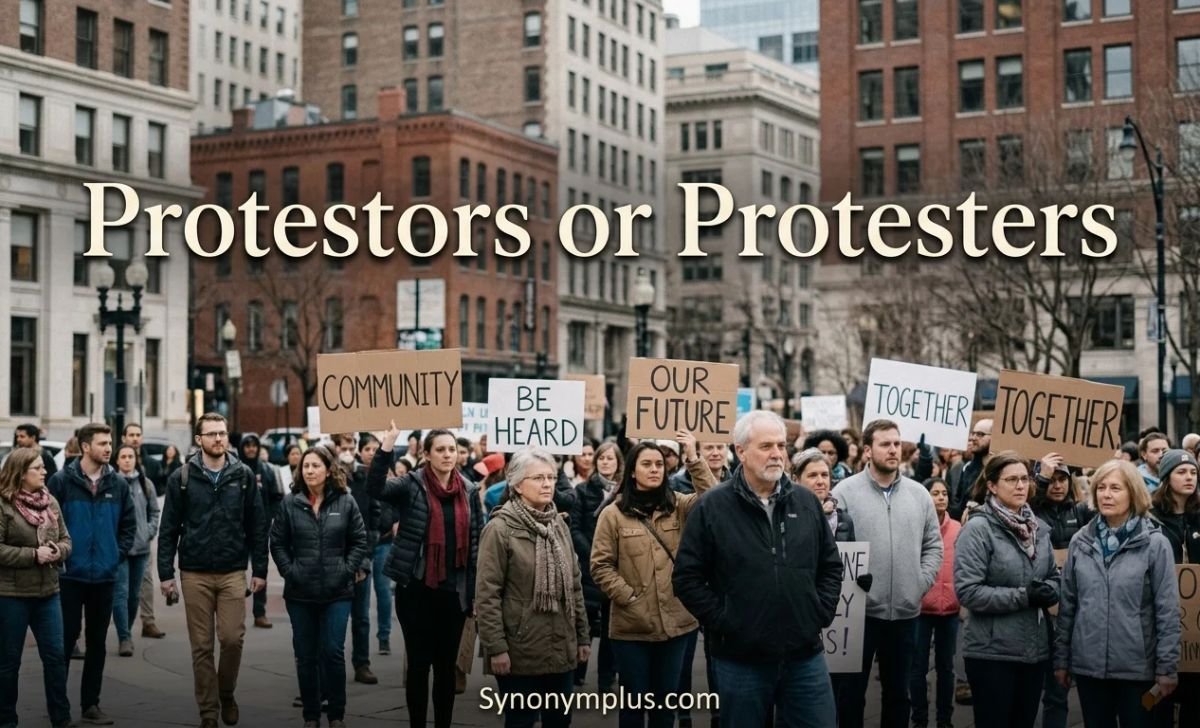
Short answer: use “protester.” It is the standard spelling in news writing and most style guides. “Protestor” is an accepted variant, but it is the less common choice.
This guide explains why, when “protestor” is still okay, and how to avoid mistakes in plurals and possessives.
Protestors or Protesters: The Quick Answer
- Protester: the preferred, standard spelling.
- Protestor: a valid variant, listed by major dictionaries.
Both mean the same thing: a person who takes part in a protest.
Pick one spelling and stick with it across your article, website, or book. Consistency matters more than the choice itself.
Is “Protestor” a Real Word?
Yes. Merriam-Webster lists protestor as a variant of protester. Dictionary.com also says a protester is “also spelled protestor.”
So you will not get marked wrong in a dictionary check. But readers and editors often expect the “-er” version.
A Quick Reality Check
If you write for a newsroom, a university, or a brand, assume editors want protester. Most newsroom style guides follow that rule. Check your own guide to be sure.
Why Do Both Spellings Exist?
English builds “person who does X” nouns in two ways. Some end in -er. Others end in -or.
The -er Pattern
This is the common, everyday pattern. You add -er to a verb.
- teach → teacher
- write → writer
- protest → protester
The -or Pattern
This pattern comes mostly from Latin. Think of actor, doctor, director, and operator.
That is why people ask, “If an operator operates, why isn’t a protestor someone who protests?” It is a fair question. A writing-forum thread asked exactly that.
The honest answer: English has no strict rule here. Habit decides. And for this word, habit chose -er.
Where “Protest” Comes From
The word protest shows up in English in the 1300s. It traces back to Latin roots meaning “to declare publicly.” That Latin link explains why protestor feels natural to some writers.
Still, modern usage favors the plain -er ending.
Protester vs Protestor: Does Region Matter?
Not much. Both American and British writers use protester as the default.
The variant protestor appears here and there in both. You may see it in legal documents, older texts, and informal writing.
One simple rule works everywhere: choose protester, unless a style guide tells you otherwise.
Protesters, Protesters’, and Protester’s: Plurals and Possessives
This is where many writers slip. Keep it simple.
| Form | Use | Example |
|---|---|---|
| protester | one person | The protester held a sign. |
| protesters | more than one person | Protesters filled the square. |
| protester’s | belongs to one person | The protester’s sign was bright red. |
| protesters’ | belongs to many people | The protesters’ chants echoed downtown. |
The same rules apply to protestor. Just swap the ending.
Avoid the common error of adding an apostrophe to a plain plural. Write “protesters,” not “protester’s,” when you mean more than one person.
Protester vs Protestant: Don’t Mix Them Up
These two look alike, but they mean very different things.
- Protester: someone who protests anything.
- Protestant: a member of a branch of Christianity that grew out of the Reformation.
A single typo can change the meaning of a sentence. Proofread this pair with care.
Protester vs Demonstrator vs Activist
Synonyms help you avoid repeating the same word. But they are not perfect twins.
Demonstrator
A demonstrator takes part in a public show of support or opposition. Dictionary.com names it as a close synonym of protester.
Use it when the event feels organized, like a march or rally.
Activist
An activist works for change over time. That can include campaigns, meetings, and fundraising.
A protester may only show up once. An activist usually keeps going.
Objector and Dissenter
These suit formal writing. An objector disagrees on principle. A dissenter breaks from an official view.
Protester vs Rioter: Why Word Choice Matters
People take labels seriously. After the January 6, 2021 events at the US Capitol, many readers argued about the right words. Should people be called protesters, rioters, or something stronger?
Dictionary.com’s guide notes that a protester simply takes part in a protest. It also points out that US laws use protester and protestor without a formal legal definition.
The takeaway for writers: describe what happened. Let facts, not labels, carry your story.
How to Use Protester in a Sentence
Here are clear, natural examples:
- News: Hundreds of protesters gathered outside city hall.
- Climate: A lone protester chained herself to the gate.
- Student life: Student protesters demanded lower fees.
- Quirky: In 2010, protesters in bee costumes stood outside the Scripps National Spelling Bee. They wanted English spelling simplified.
- Everyday: The protester thanked the police for keeping things peaceful.
That last spelling-bee story is real. It reminds us that people protest almost everything, even how we spell “enough.”
How Do You Pronounce Protester?
The verb and the noun stress different syllables.
- Protest (verb): pruh-TEST, with stress on the second syllable.
- Protester (noun): PROH-test-er, with stress on the first syllable.
Both spellings, protester and protestor, sound the same.
Spelling Tips You Can Remember
Want a fast mental shortcut? Try these:
- Think “teacher.” You write teacher, not teachor. Treat protester the same way.
- Match the verb. The verb is protest. Add -er. Done.
- Check your guide. If your publisher uses protestor, follow it.
- Stay consistent. Do not use both spellings in one piece.
FAQs
Which is more correct: protestors or protesters?
Both appear in dictionaries. Protesters is the preferred and more common spelling.
Is protestor wrong in British English?
No. It is a variant. But British writers also favor protester in most published work.
What is the plural of protester?
The plural is protesters. Do not add an apostrophe.
What is the difference between a protester and a demonstrator?
The words overlap a lot. Demonstrator highlights the public act of showing a view. Protester highlights objecting to something.
What does protester mean?
A protester is a person who takes part in a protest, such as a march or rally, to show disagreement.
Do AP and other style guides prefer protester?
Most newsroom style guides prefer protester. Always confirm with the guide your publication follows.
Final Thoughts
The answer is simple. Use protester.
Keep protestor in mind as an accepted variant. If you spot it in someone else’s work, you do not need to “correct” it. Just match the style your editor or client expects.
Pick one. Stay consistent. Then get back to writing a great story.
Read More Blogs
- Synonyms for Sketch: Meanings, Examples, the Right Word to Use
- Machine Learning Synonyms: 50 Related Terms and Alternatives

I am Junaid Tariq, the author of Synonymplus.com, with 3 years of experience in English vocabulary, synonyms, word usage, and writing. I enjoy creating clear and useful content that makes learning English easier and more practical.
My goal is to help readers find the right words, understand their meanings, and use them correctly in everyday communication. I focus on writing simple, accurate, and easy-to-understand content for students, writers, professionals, and anyone looking to improve their English vocabulary.
Through Synonymplus.com, I share helpful guides, synonym lists, word meanings, examples, and practical language tips. With my experience and passion for English, I aim to provide reliable content that helps readers write better, speak more confidently, and expand their vocabulary.