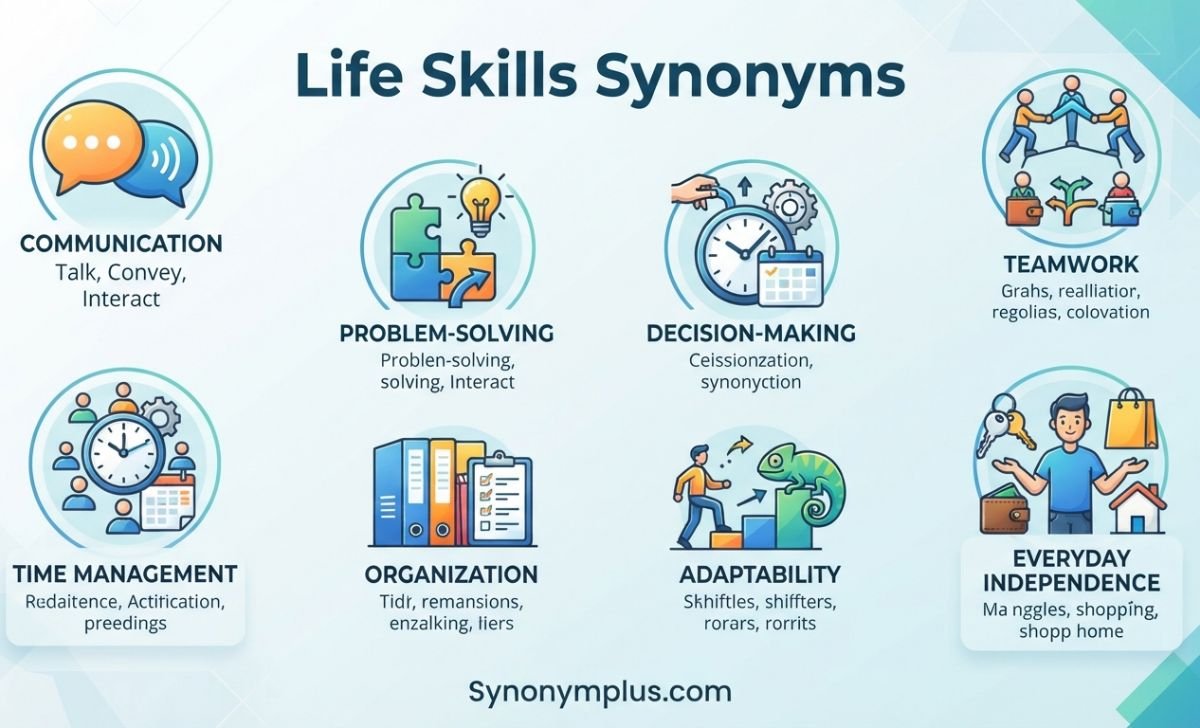
Life skills are the abilities people use to handle everyday tasks, solve problems, communicate with others, manage themselves, and respond to challenges. If you need life skills synonyms, the best choice depends on what you mean.
Practical skills fits hands-on abilities, while interpersonal skills focuses on relationships and communication. Terms such as self-management skills, adaptive skills, and independent living skills describe more specific parts of the broader idea.
This list gives you 50 useful alternatives and closely related terms, with examples and context notes to help you choose the right expression for school, work, emails, resumes, and everyday English.
What Do Life Skills Mean?
A life skill is a skill that helps a person manage daily life effectively. Oxford defines a life skill as something necessary or very useful for managing daily life, with examples such as teamwork, problem-solving, literacy, numeracy, preparing meals, and using household equipment. (Oxford Learner’s Dictionaries)
The term has a broader meaning in education and personal development. UNICEF describes life skills as cognitive, personal, and interpersonal abilities that help people adapt and deal with everyday demands and challenges. These include decision-making, problem-solving, communication, empathy, critical thinking, coping with emotions, and managing stress. (UNICEF Global)
Because life skills covers many types of abilities, there is no single perfect synonym for every situation. Practical skills may work for cooking or household tasks, while interpersonal skills is more suitable for communication and relationships.
Transferable skills works well when discussing abilities that can be used in different settings, such as school and work. UNESCO also lists basic skills and basic life skills as related terms. (Vocabularies)
The 50 terms below therefore include direct alternatives, near synonyms, and specific categories of life skills. They are not all interchangeable.
1. Essential Skills
Meaning: Skills that are important for managing life, learning, work, or everyday responsibilities.
Best used when: You want to emphasize that certain abilities are necessary rather than optional.
Example:
Good communication and decision-making are essential skills for everyday life.
2. Practical Skills
Meaning: Abilities that can be applied to real situations and everyday tasks.
Best used when: Talking about hands-on abilities rather than purely theoretical knowledge.
Example:
Cooking and basic budgeting are practical skills that can make daily life easier.
3. Everyday Skills
Meaning: Skills people use during normal daily activities.
Best used when: You want a simple, conversational alternative to life skills.
Example:
Managing a schedule and preparing simple meals are useful everyday skills.
4. Basic Skills
Meaning: Fundamental abilities needed for daily activities, learning, or functioning independently.
Best used when: Discussing foundational abilities.
Example:
Reading, communication, and basic money management are valuable basic skills.
5. Real-World Skills
Meaning: Skills that can be used in actual situations outside purely academic settings.
Best used when: Comparing practical experience with classroom knowledge.
Example:
Students need real-world skills such as budgeting, communication, and problem-solving.
6. Personal Skills
Meaning: Abilities connected with managing yourself, making choices, and handling personal responsibilities.
Best used when: The focus is on personal development rather than technical ability.
Example:
Self-discipline and self-awareness are important personal skills.
7. Core Skills
Meaning: Fundamental abilities that support other areas of personal, academic, or professional development.
Best used when: Referring to a small group of foundational abilities.
Example:
Communication and problem-solving are core skills in many areas of life.
8. Transferable Skills
Meaning: Skills that can be used across different situations, roles, or environments.
Best used when: Discussing school, work, career development, or skills that move from one setting to another.
Example:
Teamwork and communication are transferable skills that can help at school and work.
Life skills are often described as transferable because they can be applied across different areas of life. (UNICEF Global)
9. Interpersonal Skills
Meaning: Skills used to communicate and interact effectively with other people.
Best used when: The life skill involves relationships, teamwork, communication, or social interaction.
Example:
Listening and empathy are important interpersonal skills.
10. Social Skills
Meaning: Abilities that help people communicate, cooperate, build relationships, and behave appropriately in social situations.
Best used when: The focus is on interaction with other people.
Example:
Children develop social skills by learning to share, listen, and cooperate.
11. Soft Skills
Meaning: Personal and interpersonal abilities that support effective interaction and performance.
Best used when: Talking about education, employment, resumes, or professional development.
Example:
Employers often value soft skills such as communication, teamwork, and adaptability.
Soft skills overlaps with life skills, but the terms are not identical. Soft skills are often discussed in workplace and career contexts.
12. Adaptive Skills
Meaning: Abilities that help a person adjust to situations and manage everyday demands.
Best used when: The emphasis is on adapting to change or functioning effectively in daily life.
Example:
Planning ahead is an adaptive skill that can help when circumstances change.
13. Coping Skills
Meaning: Strategies and abilities used to handle stress, difficult emotions, pressure, or challenging situations.
Best used when: Discussing emotional challenges or stressful circumstances.
Example:
Taking a short walk can be a healthy coping strategy during a stressful day.
14. Psychosocial Skills
Meaning: Skills involving thoughts, emotions, behavior, and interaction with other people.
Best used when: Writing about health, education, youth development, or formal life-skills frameworks.
Example:
Communication and emotional regulation can form part of a person’s psychosocial skills.
UNICEF and WHO-related frameworks use psychosocial and interpersonal abilities when describing life skills. (UNICEF Global)
15. Life Competencies
Meaning: Abilities that help people handle different areas of life successfully.
Best used when: You want a formal alternative that emphasizes competence rather than a single learned skill.
Example:
Decision-making and communication are important life competencies.
16. Personal Competencies
Meaning: Abilities that help a person manage personal behavior, choices, emotions, and responsibilities.
Best used when: Discussing self-development or personal effectiveness.
Example:
Self-awareness is one of the personal competencies that can support better decisions.
17. Core Competencies
Meaning: Fundamental abilities needed to perform effectively in a particular area.
Best used when: Writing in educational, professional, or organizational contexts.
Example:
Problem-solving and communication are core competencies in many workplaces.
18. Personal Effectiveness
Meaning: The ability to manage yourself and use your skills effectively to reach goals and handle responsibilities.
Best used when: Discussing professional development or self-improvement.
Example:
Time management can improve personal effectiveness at work and at home.
19. Self-Management Skills
Meaning: Abilities used to control your behavior, organize your time, manage emotions, and stay focused on responsibilities.
Best used when: The focus is on managing yourself rather than interacting with others.
Example:
Setting priorities is an important self-management skill.
20. Independent Living Skills
Meaning: Skills that help a person manage daily responsibilities and live with greater independence.
Best used when: Discussing daily living, disability support, education, or adult development.
Example:
Cooking, budgeting, and using public transportation can be independent living skills.
21. Daily Living Skills
Meaning: Skills used to complete routine activities and manage everyday needs.
Best used when: Talking about practical routines and personal independence.
Example:
Preparing food and keeping a home clean are daily living skills.
22. Self-Reliance Skills
Meaning: Abilities that help a person handle responsibilities and solve everyday problems independently.
Best used when: Emphasizing independence and personal responsibility.
Example:
Learning how to manage money can strengthen self-reliance skills.
23. Self-Care Skills
Meaning: Skills used to look after personal health, hygiene, safety, and well-being.
Best used when: The topic is personal care rather than general life management.
Example:
Good hygiene and healthy routines are basic self-care skills.
24. Household Skills
Meaning: Practical abilities used to manage tasks around the home.
Best used when: Referring to cooking, cleaning, laundry, maintenance, or other household responsibilities.
Example:
Learning household skills can make independent living easier.
25. Home Management Skills
Meaning: Abilities used to organize and maintain a household.
Best used when: The focus is specifically on running a home.
Example:
Meal planning and keeping track of household expenses are useful home management skills.
26. Financial Skills
Meaning: Abilities related to earning, saving, spending, budgeting, and managing money.
Best used when: Life skills are being discussed in relation to personal finances.
Example:
Financial skills help people make informed choices about spending and saving.
27. Money Management Skills
Meaning: Practical abilities for planning and controlling personal finances.
Best used when: You want a more specific term than financial skills.
Example:
Learning to create a budget is an important money management skill.
28. Decision-Making Skills
Meaning: Abilities used to evaluate choices and select an appropriate course of action.
Best used when: The life skill involves making choices or judging options.
Example:
Good decision-making skills can help students choose how to manage their time.
Decision-making is one of the core life-skill areas identified in WHO-related frameworks. (PubMed Central (PMC))
29. Problem-Solving Skills
Meaning: Abilities used to identify problems, consider possible solutions, and take effective action.
Best used when: Discussing how someone handles challenges.
Example:
Strong problem-solving skills help employees deal with unexpected issues.
30. Communication Skills
Meaning: Abilities used to express ideas clearly and understand other people.
Best used when: The focus is speaking, writing, listening, or exchanging information.
Example:
Clear communication skills are useful in both personal and professional relationships.
31. Relationship Skills
Meaning: Abilities that help people create and maintain healthy relationships.
Best used when: Discussing friendship, family, teamwork, or other personal connections.
Example:
Trust, listening, and empathy can strengthen relationship skills.
32. Emotional Skills
Meaning: Abilities that help people recognize, understand, express, and manage emotions.
Best used when: Discussing emotional awareness and behavior.
Example:
Recognizing frustration before reacting is a useful emotional skill.
33. Emotional Intelligence
Meaning: The ability to understand and manage your own emotions while recognizing emotions in others.
Best used when: Writing about relationships, leadership, personal development, or workplace behavior.
Example:
Emotional intelligence can help a manager respond calmly during a difficult conversation.
This is a related concept rather than a direct synonym for life skills.
34. Self-Awareness Skills
Meaning: Abilities that help a person understand their emotions, strengths, weaknesses, values, and behavior.
Best used when: The topic is personal growth or emotional development.
Example:
Self-awareness skills can help you recognize what affects your decisions.
Self-awareness is included among the core life-skill areas in WHO-related frameworks. (UNICEF Global)
35. Critical Thinking Skills
Meaning: Abilities used to examine information, question assumptions, and make reasoned judgments.
Best used when: Discussing education, decision-making, problem-solving, or information evaluation.
Example:
Critical thinking skills help students evaluate whether a source is reliable.
36. Creative Thinking Skills
Meaning: Abilities used to develop new ideas, approaches, or solutions.
Best used when: The situation requires flexibility or original thinking.
Example:
Creative thinking skills can help a team find a new solution to a difficult problem.
Creative thinking and critical thinking are both recognized as important life-skill areas. (PubMed Central (PMC))
37. Resilience Skills
Meaning: Abilities that help a person recover from setbacks and continue dealing with challenges.
Best used when: Discussing difficult experiences, change, or personal development.
Example:
Resilience skills can help students recover after a disappointing result.
38. Stress Management Skills
Meaning: Techniques and abilities used to manage pressure and reduce the harmful effects of stress.
Best used when: Talking about emotional well-being or challenging situations.
Example:
Regular exercise and good time planning can support stress management.
39. Conflict Resolution Skills
Meaning: Abilities used to address disagreements and work toward a constructive solution.
Best used when: Discussing relationships, teamwork, school, or the workplace.
Example:
Conflict resolution skills can help coworkers discuss disagreements without making them worse.
40. Negotiation Skills
Meaning: Abilities used to discuss differences, reach agreements, and find acceptable solutions.
Best used when: The situation involves competing needs or interests.
Example:
Negotiation skills can help you agree on responsibilities in a group project.
41. Teamwork Skills
Meaning: Abilities that help people cooperate and contribute effectively to a group.
Best used when: Discussing school projects, sports, workplaces, or community activities.
Example:
Teamwork skills are important when several people share responsibility for one project.
42. Collaboration Skills
Meaning: Abilities used to work with others toward a shared goal.
Best used when: You want a professional or academic alternative to teamwork skills.
Example:
Strong collaboration skills helped the students complete the project on time.
43. Leadership Skills
Meaning: Abilities used to guide, support, motivate, or organize other people.
Best used when: Life skills are discussed in relation to responsibility, groups, or professional development.
Example:
Leadership skills can help a student organize a volunteer project.
Leadership is a life-skill example in some educational programs, but it is not a direct synonym for life skills. (UNICEF Global)
44. Organizational Skills
Meaning: Abilities used to arrange tasks, information, time, or resources effectively.
Best used when: Discussing planning, routines, school, or work.
Example:
Good organizational skills make it easier to manage several deadlines.
45. Time Management Skills
Meaning: Abilities used to plan and use time effectively.
Best used when: The focus is on priorities, schedules, deadlines, or routines.
Example:
Time management skills helped her finish her assignments before the deadline.
46. Goal-Setting Skills
Meaning: Abilities used to identify goals, plan steps, and work toward desired results.
Best used when: Discussing personal growth, education, work, or long-term planning.
Example:
Goal-setting skills can turn a general ambition into a clear plan.
Goal-setting is included among the practical life skills identified in UNICEF training materials. (UNICEF Global)
47. Employability Skills
Meaning: Skills that help a person enter, perform in, and progress within the workplace.
Best used when: Discussing careers, employment, or job preparation.
Example:
Communication and teamwork are valuable employability skills.
This term is narrower than life skills because it focuses mainly on employment.
48. Workplace Skills
Meaning: Abilities used to perform effectively in a work environment.
Best used when: The context is specifically professional.
Example:
Communication, organization, and teamwork are useful workplace skills.
49. Career Readiness Skills
Meaning: Abilities that help someone prepare for employment and adapt to workplace expectations.
Best used when: Discussing students, graduates, job preparation, or career education.
Example:
Career readiness skills can help graduates move from education into employment.
50. Survival Skills
Meaning: Skills that help a person stay safe and meet basic needs in difficult or emergency situations.
Best used when: The context involves safety, emergencies, outdoor situations, or basic survival.
Example:
Knowing how to find clean water is an important survival skill.
Survival skills is a much narrower term than life skills, so it should not replace life skills in every sentence.
Life Skills Synonyms by Context
The right alternative depends on what you are describing. A word that works well in a resume may sound too formal in everyday conversation.
| Context | Useful alternatives | Why they fit |
|---|---|---|
| Everyday life | Practical skills, everyday skills, basic skills | Focus on daily tasks |
| Personal development | Personal skills, self-management skills, personal competencies | Focus on managing yourself |
| Relationships | Interpersonal skills, social skills, relationship skills | Focus on interacting with others |
| Education | Core skills, transferable skills, critical thinking skills | Focus on learning and applying abilities |
| Workplace | Soft skills, workplace skills, employability skills | Focus on professional performance |
| Independence | Independent living skills, daily living skills, self-reliance skills | Focus on managing life independently |
| Emotional well-being | Coping skills, emotional skills, resilience skills | Focus on handling emotions and challenges |
| Money | Financial skills, money management skills | Focus on personal finances |
| Problem-solving | Decision-making skills, problem-solving skills, critical thinking skills | Focus on handling choices and challenges |
| Career preparation | Career readiness skills, transferable skills, employability skills | Focus on entering or progressing at work |
The key point is that life skills is the broad term, while many of the alternatives above describe one part of that larger category.
UNICEF groups life skills into cognitive, personal, and interpersonal areas, which helps explain why terms such as problem-solving skills, self-management skills, and interpersonal skills overlap without having exactly the same meaning. (UNICEF Global)
Formal and Professional Alternatives to Life Skills
For formal writing, you can use terms such as life competencies, core competencies, transferable skills, and personal competencies. These terms work best when they match the skill you want to describe.
For professional writing, transferable skills, soft skills, employability skills, and workplace skills are useful choices. They are especially common in resumes and career-related writing.
For everyday English, simpler terms are often better. Practical skills, everyday skills, basic skills, and real-world skills are easy to understand.
Choose the term that best describes the skill. A simple and accurate word is usually better than a more formal one.
Life Skills Examples
Life skills can cover many areas of daily life. Common examples include:
- Making decisions
- Solving problems
- Managing time
- Setting goals
- Communicating clearly
- Listening actively
- Working with others
- Managing emotions
- Coping with stress
- Thinking critically
- Thinking creatively
- Building relationships
- Managing money
- Preparing meals
- Organizing tasks
- Taking responsibility
- Adapting to change
- Handling disagreements
- Caring for personal needs
- Making informed choices
These examples reflect the broad cognitive, personal, and interpersonal nature of life skills described by UNICEF and other educational frameworks. (UNICEF Global)
Life Skills vs. Soft Skills
Life skills is the broader term. It can include personal, social, cognitive, emotional, and practical abilities used across daily life.
Soft skills usually refers to personal and interpersonal qualities that help someone work and communicate effectively. It is especially common in employment and professional contexts.
For example:
- Cooking is a life skill but not normally called a soft skill.
- Teamwork can be both a life skill and a soft skill.
- Emotional regulation can be a life skill without being described as a workplace soft skill.
So, soft skills can overlap with life skills, but they are not exact synonyms.
Life Skills vs. Practical Skills
Practical skills focus on applying knowledge to real situations. They can include cooking, budgeting, repairing things, using equipment, or managing household tasks.
Life skills have a wider scope. They can include practical abilities but also decision-making, communication, emotional regulation, critical thinking, and relationships.
For example, preparing a meal is a practical life skill, while resolving a disagreement is a social or interpersonal life skill.
Life Skills vs. Transferable Skills
Transferable skills are abilities that can be used across different settings. Communication, teamwork, organization, and problem-solving are common examples.
Life skills can also be transferable, but the terms emphasize different things. Life skills focuses on managing life effectively, while transferable skills emphasizes the ability to carry a skill from one setting to another. UNICEF describes life skills as transferable skills that can support school, work, and social life. (UNICEF Global)
Common Mistakes With Life Skills Synonyms
One common mistake is treating every related term as a perfect replacement.
For example, survival skills does not mean exactly the same thing as life skills. Survival skills usually involve staying safe and meeting basic needs in difficult conditions.
Likewise, interpersonal skills focus on interaction with other people, while life skills also include personal and cognitive abilities.
Another mistake is using soft skills whenever you mean life skills. Soft skills are useful in professional and social settings, but they do not cover every practical ability associated with daily life.
A good rule is simple: choose the term that describes the specific skill or context you mean.
Antonyms of Life Skills
There is no single direct antonym for life skills because the phrase describes a broad category of abilities.
Depending on the context, contrasting ideas might include:
- Lack of practical ability
- Inexperience
- Unpreparedness
- Dependence
- Inability to cope
- Poor self-management
- Lack of social skills
These are not strict dictionary antonyms. They describe the absence or weakness of abilities that life skills can provide.
FAQs
1. What is another word for life skills?
There is no single replacement that works in every context. Practical skills, essential skills, everyday skills, personal skills, transferable skills, and life competencies can work depending on what you mean.
2. What are the closest synonyms for life skills?
Some of the closest alternatives are essential skills, practical skills, everyday skills, basic skills, real-world skills, personal skills, and life competencies. Their exact suitability depends on context.
3. What is a professional synonym for life skills?
In professional writing, transferable skills, soft skills, employability skills, workplace skills, and core competencies can be useful. Choose one based on the specific ability you want to describe.
4. What is a simple synonym for life skills?
Practical skills, everyday skills, and basic skills are simple alternatives that most readers can understand easily.
5. Are life skills and soft skills the same?
No. They overlap, but they are not identical. Soft skills usually focus on personal and interpersonal abilities, especially in education and work. Life skills can also include practical, cognitive, emotional, and daily living abilities.
6. Are practical skills the same as life skills?
Not exactly. Practical skills are one part of the broader life-skills concept. Life skills can also include communication, decision-making, emotional regulation, and problem-solving.
7. What are examples of life skills?
Common examples include communication, decision-making, problem-solving, critical thinking, time management, self-awareness, teamwork, stress management, financial management, and relationship skills. (UNICEF Global)
8. What is another word for life skills on a resume?
Depending on the skill, you could use transferable skills, soft skills, employability skills, professional skills, or core competencies. It is usually better to name the specific skills rather than use a broad phrase.
Conclusion
The best life skills synonyms depend on the exact ability and context. Use practical skills for hands-on abilities, interpersonal skills for working with people, self-management skills for managing yourself, and transferable skills when an ability applies across different settings. For professional writing, terms such as soft skills and employability skills may be more specific.
The main goal is not to replace life skills with a bigger or more formal phrase, but to choose wording that tells the reader exactly what kind of ability you mean.
Read More Blogs
- 50 Synonyms of Considerate: Words to Describe Thoughtful People
- 50 Synonyms of Shade: Words for Shadow, Color, Protection
- 50 Synonyms for Critic: Words for Reviewers, Evaluators, and More
- 50 Better Ways to Say “Speedy Recovery” in a Message

I am Junaid Tariq, the author of Synonymplus.com, with 3 years of experience in English vocabulary, synonyms, word usage, and writing. I enjoy creating clear and useful content that makes learning English easier and more practical.
My goal is to help readers find the right words, understand their meanings, and use them correctly in everyday communication. I focus on writing simple, accurate, and easy-to-understand content for students, writers, professionals, and anyone looking to improve their English vocabulary.
Through Synonymplus.com, I share helpful guides, synonym lists, word meanings, examples, and practical language tips. With my experience and passion for English, I aim to provide reliable content that helps readers write better, speak more confidently, and expand their vocabulary.