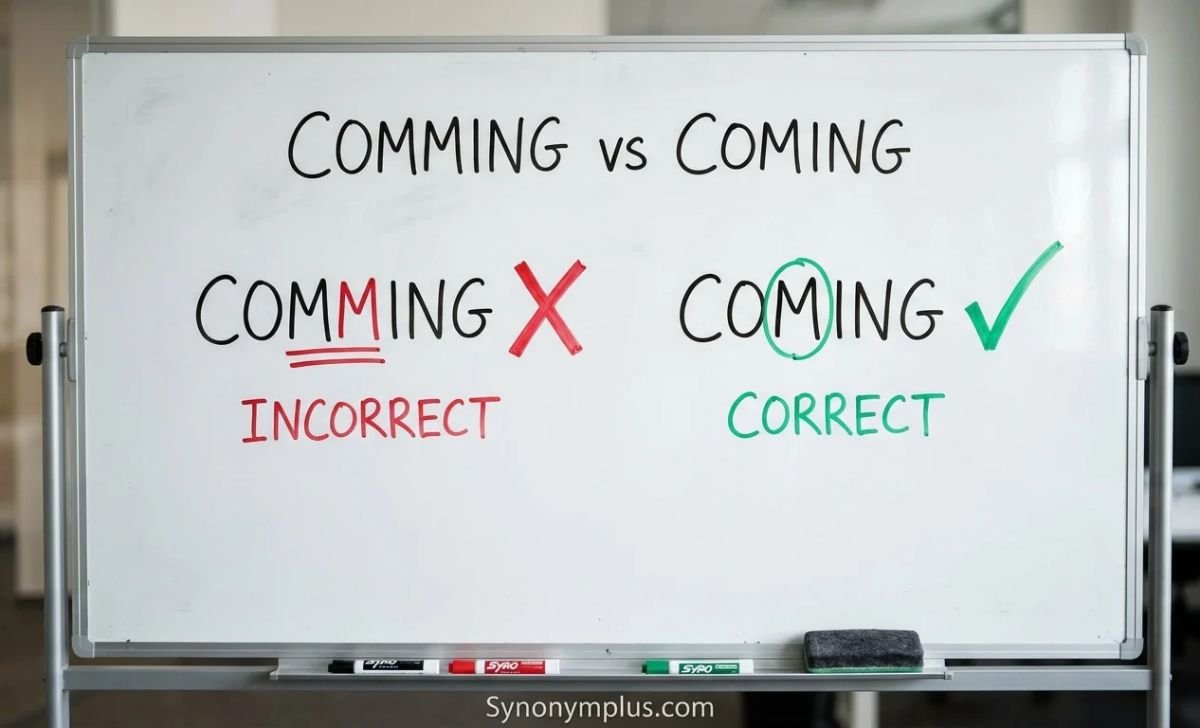
The correct spelling is coming, not comming. Both forms may look plausible because English has words such as running and swimming, which double their final consonants before adding -ing. However, the verb come follows a different spelling rule.
Its final silent e disappears before the ending is added, giving us coming. You will see this word in everyday conversations, work emails, school assignments, announcements, and descriptions of future events.
Understanding the difference between comming vs coming helps you avoid a common spelling mistake and use the word correctly in different grammatical contexts.
Quick Answer
Coming is the correct spelling; comming is incorrect in standard English. The verb come becomes coming by dropping the final silent e and adding -ing. Unlike running or swimming, it does not double the final consonant.
- Correct: I am coming home.
- Incorrect: I am comming home.
- Spelling rule: Come → Coming
Comming vs Coming:
Coming is the correct spelling in standard English. Comming is a misspelling when you intend to use the -ing form of come.
| Spelling | Status | Example |
|---|---|---|
| Coming | Correct | I am coming home tonight. |
| Comming | Incorrect | I am comming home tonight. |
| Comeing | Incorrect | She is comeing to the party. |
The correct form stays the same in American and British English. It does not change based on whether you are writing a casual text, a formal email, or an academic assignment.
Here are more examples of correct usage:
- Are you coming to dinner?
- The bus is coming down the road.
- Our new website is coming soon.
- Thank you for coming to the interview.
- The coming months will bring new challenges.
In each sentence, coming has one m. The extra letter in comming is not part of the standard spelling.
What Does Coming Mean in English?
Coming is the -ing form of the verb come. Its meaning changes slightly with the context. It can describe movement, arrival, participation, or something that is approaching in time.
Coming as a Verb
Use coming to describe someone or something moving toward a place or person. It can also appear in continuous verb forms to describe an action in progress or a planned future arrangement.
Examples:
- My sister is coming home after work.
- The train is coming into the station.
- We are coming to your office tomorrow.
In the first two examples, the word describes movement or arrival. In the last sentence, it describes a future plan.
Coming as an Adjective
Coming can describe a period, event, or stage that is approaching.
Examples:
- We need to plan for the coming year.
- The coming election may affect local policies.
- She is preparing for her coming exams.
Here, coming means approaching or future. In some contexts, upcoming may sound more natural, especially when describing scheduled events.
Coming as a Noun
The word can also function as a noun, often in the phrase the coming of. This usage can sound formal or literary.
Examples:
- The coming of spring brought warmer weather.
- They celebrated the coming of a new era.
In these sentences, coming refers to the arrival or beginning of something.
Why Is Coming Spelled With One M?
The spelling follows a common rule for verbs that end in a silent e. Remove the final e before adding -ing.
The pattern is:
come → remove e → add ing → coming
You do not double the m. The base verb is come, and its correct -ing form is coming.
Other verbs follow the same pattern:
| Base verb | Correct form |
|---|---|
| Make | Making |
| Take | Taking |
| Write | Writing |
| Drive | Driving |
| Give | Giving |
| Hope | Hoping |
| Come | Coming |
This rule helps explain why comeing is also incorrect. You remove the final e rather than keeping it.
Why Do Running and Swimming Have Double Letters?
English uses different spelling patterns when adding -ing. Some verbs double their final consonant, while others drop a silent e.
| Base verb | Correct form | Spelling pattern |
|---|---|---|
| Run | Running | Doubles the final consonant |
| Swim | Swimming | Doubles the final consonant |
| Sit | Sitting | Doubles the final consonant |
| Stop | Stopping | Doubles the final consonant |
| Come | Coming | Drops the final silent e |
| Bake | Baking | Drops the final silent e |
The key is to look at the original verb before adding the ending. Do not apply the doubling rule to every word.
For example, run becomes running, but come becomes coming. Learning these patterns helps with other verbs, too.
Coming Soon, Coming Up, and Coming Along
Coming appears in many common English expressions. The word keeps the same spelling, but the full phrase gives it a more specific meaning.
| Expression | Meaning | Example |
|---|---|---|
| Coming soon | Expected to arrive or become available shortly | Our new product is coming soon. |
| Coming up | Approaching or scheduled for the near future | My final exam is coming up next week. |
| Coming back | Returning to a place or situation | She is coming back on Monday. |
| Coming along | Progressing or accompanying someone, depending on context | Your project is coming along well. |
| Coming together | Joining or developing into a whole | The team is coming together nicely. |
| Coming to an end | Reaching the final stage | The school year is coming to an end. |
These expressions are useful in everyday conversations, workplace messages, and online announcements.
The important distinction is that the phrase determines the meaning. For instance, coming up often refers to an approaching event, while coming back describes a return.
Coming vs Upcoming vs Come vs Came
These words are related, but they have different grammatical roles. Choosing the right one depends on the meaning and sentence structure.
| Word | Meaning or role | Example |
|---|---|---|
| Coming | The -ing form of come; also used as an adjective or noun | I am coming home. |
| Upcoming | An adjective meaning scheduled or expected soon | The upcoming meeting starts at noon. |
| Come | The base form of the verb | Please come inside. |
| Came | The simple past form of come | She came home yesterday. |
Coming vs Upcoming
Both words can describe future events, but they are not interchangeable in every sentence.
- Coming: My cousins are coming to visit us.
- Upcoming: We have an upcoming family event.
The first sentence describes people arriving. The second describes an event that will happen soon.
Coming vs Come
Come is the base form, while coming is its -ing form.
- I will come tomorrow.
- I am coming tomorrow.
Both sentences can refer to the future. The difference lies in the verb construction.
Coming vs Came
Use came for a completed action in the past. Use coming in an -ing construction.
- He came to the office yesterday.
- He is coming to the office today.
The time and grammar of the sentence determine which form you need.
Common Mistakes With Coming
Several spelling and grammar mistakes can occur when using this word. Knowing the difference helps you write more clearly.
1. Writing Comming Instead of Coming
Incorrect: We are comming to the meeting.
Correct: We are coming to the meeting.
The extra m is unnecessary. The correct spelling is coming.
2. Keeping the Final E
Incorrect: I am comeing home.
Correct: I am coming home.
Remove the silent e before adding -ing.
3. Using Came in a Continuous Tense
Incorrect: She is came home.
Correct: She is coming home.
The present continuous uses a form of be followed by the -ing form of the verb.
4. Confusing Coming With Upcoming
Less natural: I am preparing for my coming appointment.
More natural: I am preparing for my upcoming appointment.
Both words can describe the future, but upcoming is often a better fit for scheduled events. The best choice depends on the sentence.
5. Assuming British and American English Use Different Spellings
Incorrect assumption: Comming is British, while coming is American.
Correct: Both varieties use coming.
There is no standard British or American spelling difference here.
FAQs
1. Is Comming Ever Correct in English?
Comming is not the standard spelling of the -ing form of come. You may see it in a username, brand name, or deliberately stylized text, but ordinary English writing requires coming.
2. What Is the Correct Spelling: Comming or Coming?
Coming is correct. For example, write “I am coming to the office,” not “I am comming to the office.”
3. Why Does Come Become Coming?
The verb come ends in a silent e. Remove that letter and add -ing to form coming. The final m is not doubled.
4. Is Coming a Verb, Noun, or Adjective?
Yes, coming can be a verb, noun, or adjective. Its role depends on how you use it in a sentence.
Noun: The coming of spring brings warmer days.
Verb: She is coming home.
Adjective: We are excited about the coming year.
5. Is Coming Spelled the Same in British and American English?
Yes. Both British and American English use coming. Neither standard variety uses comming as the normal spelling of the verb.
6. Should I Write Coming Soon or Comming Soon?
Write coming soon. It is the standard expression used to announce something that will arrive, happen, or become available in the near future.
7. What Is the Difference Between Coming and Came?
Coming is the -ing form of come, while came is its simple past form. Compare “I am coming today” with “I came yesterday.”
8. How Can I Remember the Correct Spelling?
Remember the pattern come → coming. Drop the final e, add -ing, and keep one m. Comparing come → coming with make → making can help you remember the rule.
Conclusion
When choosing between comming vs coming, always use coming in standard English. The word can describe movement, arrival, participation, or an approaching event.
Its spelling follows a simple rule: remove the silent e from come and add -ing. Unlike running and swimming, it does not double the final consonant.
Remember this pattern when writing emails, essays, articles, or everyday messages. Checking the base verb before adding an ending is a useful way to avoid similar spelling mistakes.
Read More Blogs
- Synonyms for Compassionate: Meanings, Examples, Usage Tips
- Mean vs Rude: Synonyms, Meanings, and Examples
- Synonyms for Giant: 40+ Words With Meanings and Examples

I am Junaid Tariq, the author of Synonymplus.com, with 3 years of experience in English vocabulary, synonyms, word usage, and writing. I enjoy creating clear and useful content that makes learning English easier and more practical.
My goal is to help readers find the right words, understand their meanings, and use them correctly in everyday communication. I focus on writing simple, accurate, and easy-to-understand content for students, writers, professionals, and anyone looking to improve their English vocabulary.
Through Synonymplus.com, I share helpful guides, synonym lists, word meanings, examples, and practical language tips. With my experience and passion for English, I aim to provide reliable content that helps readers write better, speak more confidently, and expand their vocabulary.