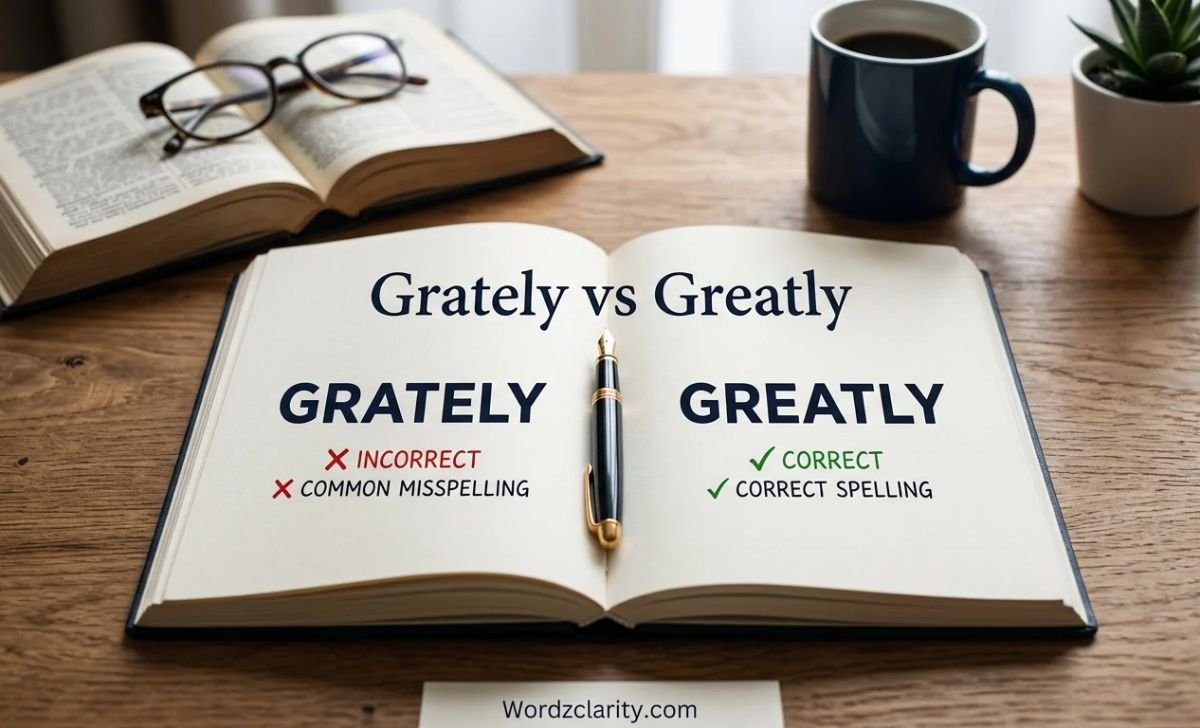
You are closing an email. You type: “Your help is grately appreciated.”
Then you pause. Something looks off.
Your instinct is right. “Greatly” is the correct spelling. “Grately” is not an English word. It is a common typo.
But there is a twist. Many people who type “grately” actually mean a third word: gratefully. This guide untangles all three.
Grately vs Greatly: The Quick Answer
- Greatly (correct): an adverb meaning “very much” or “to a great extent.”
- Grately (incorrect): a misspelling with no dictionary entry.
When you want to say you appreciate something a lot, write “greatly appreciated.”
Is “Grately” a Real Word?
No. Major dictionaries do not list it. It is simply a misspelling of “greatly.”
That is true in American English and in British English.
Why Do People Write “Grately”?
Three things cause the slip.
The Sound Trap
Great and grate are homophones. They sound exactly alike. So when you hear “GRAYT-lee,” your brain may reach for the grate spelling.
The Fast-Typing Trap
The letters E and A swap easily when you type quickly. “Great” becomes “grate” in a blink.
The Word-Building Trap
You know “grate” is a real word. So “grate + ly” feels like a logical combination. It is not.
How to Spell Greatly Correctly
The word is built from two simple parts.
great + ly = greatly
The adverb keeps the full word great. You add -ly. Nothing else changes.
A Memory Trick for the “EA”
Most words with “ea” sound like “ee” (think eat or beach). But three common words sound like “ay”:
- great
- break
- steak
Try this line: “A great steak is a great break.” It reminds you that great uses EA.
What Does “Greatly” Mean?
Greatly is an adverb. It means to a large degree, or very much.
It answers the question: how much?
Examples of Greatly in a Sentence
- We greatly appreciate your patience.
- The new app greatly improved our workflow.
- She greatly admired her coach.
- Sales were greatly reduced last winter.
- The delay greatly affected the schedule.
Synonyms for Greatly
- considerably
- significantly
- enormously
- immensely
- hugely
- vastly
- deeply
- very much
Antonyms of Greatly
- slightly
- barely
- hardly
- a little
How to Use Greatly in Your Writing
A few simple habits make “greatly” sound natural.
Pair It With Verbs
Greatly works best with verbs that show change or feeling: improve, reduce, appreciate, admire, affect, influence, increase.
- The training greatly improved her confidence.
Pair It With Past Participles
It also fits before words like reduced, increased, improved, and appreciated.
- Your support is greatly appreciated.
Be Careful With Plain Adjectives
For basic adjectives, “very” usually sounds better.
- Better: The room was very big.
- Awkward: The room was greatly big.
Also skip “very greatly.” It adds weight but no meaning.
Where to Place It
You have flexibility. Both work:
- I greatly admire your work.
- I admire your work greatly.
The first version is more common in writing.
Common Phrases With Greatly
These pairings show up all the time:
- greatly appreciated
- greatly improved
- greatly reduced
- greatly increased
- greatly affected
- greatly admired
- greatly respected
- greatly influenced
- greatly exaggerated
That last phrase is famous. It comes from a line often credited to Mark Twain about reports of his death.
Greatly vs Gratefully: The Mix-Up Behind “Grately”
Here is the twist. Some people type “grately” when they mean gratefully.
The two words look similar. But they do different jobs.
| Word | Meaning | Example |
|---|---|---|
| Greatly | To a large degree | We greatly appreciate your help. |
| Gratefully | In a thankful way | She gratefully accepted the offer. |
Which One Should You Use?
- Use greatly to show how much you value something.
- Use gratefully to show how someone acts or feels.
Both can express thanks. But they sit in different spots.
- Correct: We greatly appreciate your time.
- Correct: We gratefully accept your invitation.
- Redundant: We gratefully appreciate your time.
Since “appreciate” already carries thanks, “greatly” fits better.
Watch Out for “Greatful” Too
The adjective is grateful, not “greatful.” It comes from the Latin word gratus, meaning pleasing or thankful. It has no link to the word great.
Greatly vs Great
These two also get mixed up.
- Great is an adjective. It describes a noun: a great idea, a great day.
- Greatly is an adverb. It describes a verb: she greatly enjoyed it.
In casual speech, people also say “it works great” or “she sang great.” That informal use is common. In formal writing, pick a clearer option, such as “it works very well.”
Grate vs Great: Quick Comparison
Since “grate” causes the typo, here is how it differs.
| Word | Part of speech | Meaning | Example |
|---|---|---|---|
| Grate | Verb or noun | To shred, or a metal frame | I need to grate some cheese. |
| Great | Adjective | Large or excellent | That was a great meal. |
Is There an Adverb Form of Grate?
Yes, but it is not “grately.” The word gratingly means in an irritating way.
- The speaker’s voice rang gratingly through the hall.
If you want to say something is annoying, use gratingly.
Where Does the Word Greatly Come From?
The adverb greatly appeared in English around the year 1200. It simply joins great and -ly.
The root word great is much older. In Old English, it meant big, thick, or coarse. It later grew into the sense of “important” and “excellent.”
How to Pronounce Greatly
Say it as GRAYT-lee. The stress falls on the first syllable.
It rhymes with lately. The first vowel sounds like “ay” in say.
Greatly in Real-Greatly in Everyday Writing
Thank-You Email
Thank you for your quick reply. I greatly appreciate your help.
Customer Message
Your feedback greatly improved our service.
Resume or Cover Letter
I cut response time by improving our process.
Everyday Conversation
I really enjoyed that book.
“Greatly” shows that something had a strong effect. For example, it can show how much you value someone’s help. In casual conversations, “really” often sounds more natural. Choose the word that best fits your message.
Common Misspellings to Avoid
- grately
- greately
- greatley
- gratley
- greatful (for grateful)
- gratefuly (for gratefully)
Only greatly is correct for the “very much” meaning.
Quick Practice: Greatly, Gratefully, or Great?
Fill in the blank. Answers are below.
- We ______ appreciate your support.
- She ______ accepted the award.
- That was a ______ idea.
- The change ______ improved our results.
- He nodded ______ when she offered help.
Answers: 1. greatly. 2. gratefully. 3. great. 4. greatly. 5. gratefully.
FAQs
Is it grately or greatly?
It is greatly. “Grately” is a typo.
Is grately a word?
No. It does not appear in major dictionaries.
Is it “greatly appreciated” or “grately appreciated”?
It is “greatly appreciated.”
What does greatly mean?
It means very much or to a great extent.
What is the difference between greatly and gratefully?
Greatly shows degree. Gratefully shows a thankful manner.
Is it grateful or greatful?
It is grateful. “Greatful” is a misspelling.
What is the adverb form of great?
The adverb is greatly.
What is a synonym for greatly?
Try considerably, significantly, immensely, or very much.
Final Thoughts
The rule is short. Greatly is real. Grately is not.
Build it from great and -ly. Use the “great steak, great break” trick. And if you mean “thankfully,” reach for gratefully instead.
Now you can close that email with confidence. Your help is greatly appreciated.
Read More Blogs
- Synonyms of Then: 40+ Useful Alternatives With Examples
- Synonyms for Compassionate: Meanings, Examples, Usage Tips
- Synonyms for Giant: 40+ Words With Meanings and Examples

I am Junaid Tariq, the author of Synonymplus.com, with 3 years of experience in English vocabulary, synonyms, word usage, and writing. I enjoy creating clear and useful content that makes learning English easier and more practical.
My goal is to help readers find the right words, understand their meanings, and use them correctly in everyday communication. I focus on writing simple, accurate, and easy-to-understand content for students, writers, professionals, and anyone looking to improve their English vocabulary.
Through Synonymplus.com, I share helpful guides, synonym lists, word meanings, examples, and practical language tips. With my experience and passion for English, I aim to provide reliable content that helps readers write better, speak more confidently, and expand their vocabulary.