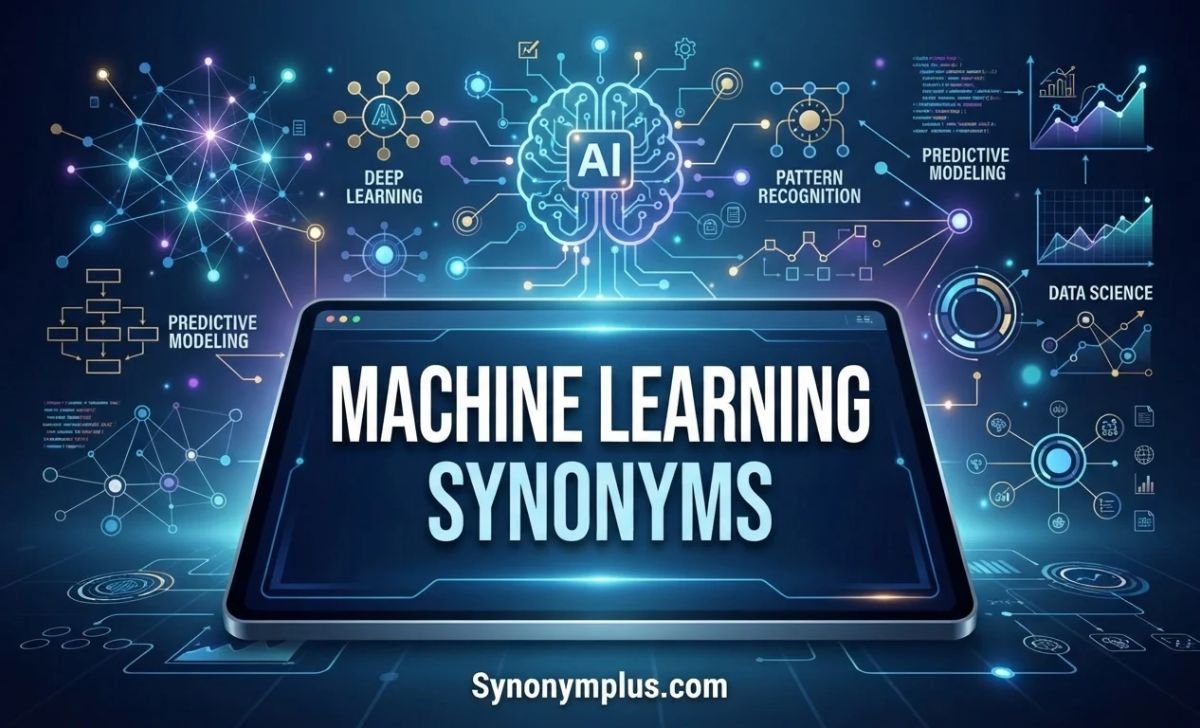
Machine learning refers to a type of artificial intelligence in which computer systems learn patterns from data and use those patterns to make predictions, classifications, or decisions. The phrase is common in technology, research, business, and everyday discussions about AI.
There is no single word that means exactly the same as machine learning. Some alternatives describe the broader field, while others refer to specific approaches, such as deep learning, predictive modeling, or statistical learning.
Choosing the right term depends on what you are describing. A research paper may need a technical term, while a general article may use a broader phrase such as AI-driven learning or data-driven modeling.
What Does Machine Learning Mean?
Machine learning is a branch of artificial intelligence that allows computers to learn from data rather than relying only on explicitly programmed rules.
For example:
A machine-learning model can study past sales data and predict future demand.
Machine learning is used for tasks such as:
- Predicting future outcomes
- Classifying information
- Detecting unusual patterns
- Recognizing images and speech
- Recommending products or content
- Understanding language
- Automating decisions based on data
The term covers several approaches, including supervised learning, unsupervised learning, and reinforcement learning.
50 Machine Learning Synonyms and Related Terms
Because machine learning is a technical field, many of the terms below are near-synonyms or related alternatives rather than exact replacements. The distinction matters when precise technical writing is important.
1. Artificial Intelligence
Meaning: Artificial intelligence (AI) is the broader field of creating systems that perform tasks associated with human intelligence.
Best used when: You are discussing machine learning as part of the larger AI field.
Example:
Machine learning is one of the major technologies used in artificial intelligence.
Note: AI is broader than machine learning, so it should not always replace the phrase.
2. Deep Learning
Meaning: Deep learning is a specialized form of machine learning that uses multi-layered neural networks.
Best used when: Discussing systems involving large neural networks, computer vision, speech, or complex pattern recognition.
Example:
Deep learning has improved image-recognition systems.
Note: Deep learning is a subset of machine learning.
3. Statistical Learning
Meaning: Statistical learning uses statistical methods to learn relationships and patterns from data.
Best used when: Writing about the mathematical or statistical side of machine learning.
Example:
The course introduces statistical learning methods for analyzing large datasets.
4. Predictive Modeling
Meaning: Predictive modeling uses existing data to build models that estimate future or unknown outcomes.
Best used when: The main purpose is prediction.
Example:
Predictive modeling can help a retailer estimate future demand.
5. Data Mining
Meaning: Data mining involves examining large datasets to discover useful patterns, relationships, or information.
Best used when: Talking about discovering patterns in large collections of data.
Example:
Data mining revealed several purchasing patterns among customers.
Note: Data mining and machine learning overlap, but they are not identical.
6. Computational Learning
Meaning: Computational learning refers to the study and development of methods that allow computers to learn from data.
Best used when: Discussing the theoretical or computational aspects of learning systems.
Example:
Computational learning provides a foundation for many automated prediction methods.
7. Automated Learning
Meaning: Automated learning describes systems that learn patterns or rules from data with limited manual programming.
Best used when: Explaining the basic idea of machine learning to a general audience.
Example:
Automated learning allows the system to improve its predictions as more data becomes available.
8. Data-Driven Learning
Meaning: Data-driven learning describes learning processes guided primarily by available data.
Best used when: Emphasizing the role of data rather than hand-coded rules.
Example:
Data-driven learning can identify patterns that are difficult to define manually.
9. Data-Driven Modeling
Meaning: Data-driven modeling builds mathematical or computational models from observed data.
Best used when: Discussing models developed from real-world datasets.
Example:
Data-driven modeling helped researchers estimate energy consumption.
10. Pattern Recognition
Meaning: Pattern recognition is the process of identifying regularities or meaningful patterns in data.
Best used when: Discussing image, speech, text, or signal analysis.
Example:
Pattern recognition helps software identify objects in photographs.
Note: Pattern recognition is closely related to machine learning but has a broader history and scope.
11. Predictive Analytics
Meaning: Predictive analytics uses data, statistical techniques, and computational models to estimate future events or outcomes.
Best used when: Discussing business, marketing, finance, healthcare, or operational predictions.
Example:
Predictive analytics can help companies forecast customer demand.
12. Intelligent Computing
Meaning: Intelligent computing refers broadly to computational systems designed to perform tasks that require adaptive or intelligent behavior.
Best used when: Writing about intelligent technologies at a broad level.
Example:
Intelligent computing is increasingly used to process complex datasets.
Note: This is a broad term, not a direct synonym.
13. Adaptive Computing
Meaning: Adaptive computing involves systems that adjust their behavior in response to changing information or conditions.
Best used when: The ability to adapt is the main focus.
Example:
Adaptive computing allows the system to respond to changing data patterns.
14. Neural Network Learning
Meaning: Neural network learning refers to training artificial neural networks to recognize patterns from data.
Best used when: Specifically discussing neural-network-based methods.
Example:
Neural network learning improved the model’s ability to classify images.
15. Algorithmic Learning
Meaning: Algorithmic learning describes learning processes carried out through computational algorithms.
Best used when: Discussing the algorithms behind automated learning systems.
Example:
Algorithmic learning can uncover relationships within complex datasets.
16. Automated Pattern Recognition
Meaning: Automated pattern recognition uses computational systems to identify meaningful patterns without manually examining every piece of data.
Best used when: Explaining practical applications of machine learning.
Example:
Automated pattern recognition helps security systems identify unusual activity.
17. Intelligent Data Analysis
Meaning: Intelligent data analysis uses computational techniques to extract useful insights from data.
Best used when: Discussing data analysis supported by AI or learning algorithms.
Example:
Intelligent data analysis helped researchers detect trends in the dataset.
18. Computational Intelligence
Meaning: Computational intelligence is a broad area involving adaptive computational methods such as neural networks, fuzzy systems, and evolutionary computation.
Best used when: Writing in a technical or academic context.
Example:
Computational intelligence methods can solve complex optimization problems.
Note: It is related to machine learning but covers more than machine learning alone.
19. Automated Prediction
Meaning: Automated prediction refers to using computational systems to generate predictions from available information.
Best used when: The central task is forecasting or prediction.
Example:
Automated prediction can estimate the likelihood of customer churn.
20. Algorithmic Prediction
Meaning: Algorithmic prediction uses algorithms to estimate future or unknown outcomes.
Best used when: The focus is on prediction performed by computational models.
Example:
Algorithmic prediction is used to estimate traffic conditions.
21. Predictive Modeling Techniques
Meaning: Predictive modeling techniques are methods used to build models that predict outcomes from data.
Best used when: Discussing methods rather than the broader field.
Example:
Several predictive modeling techniques were tested on the dataset.
22. Statistical Modeling
Meaning: Statistical modeling represents relationships between variables using statistical methods.
Best used when: The model relies strongly on statistical analysis.
Example:
Statistical modeling showed a relationship between price and demand.
Note: Not every statistical model uses machine learning.
23. Data Modeling
Meaning: Data modeling involves representing data and relationships in a structured form.
Best used when: Discussing how information is organized or represented.
Example:
Data modeling helped the team understand relationships within the database.
Note: This term is much broader and should not normally replace machine learning.
24. Knowledge Discovery
Meaning: Knowledge discovery refers to finding useful information, relationships, or patterns within data.
Best used when: Discussing the process of extracting valuable knowledge from datasets.
Example:
Knowledge discovery revealed previously unnoticed trends.
25. Knowledge Discovery in Databases
Meaning: Knowledge discovery in databases, often called KDD, describes the broader process of extracting useful knowledge from large datasets.
Best used when: Writing about data science or academic data analysis.
Example:
Knowledge discovery in databases combines several steps for finding useful patterns.
26. Automated Data Analysis
Meaning: Automated data analysis uses software to examine and interpret data with limited manual intervention.
Best used when: Describing systems that automatically analyze datasets.
Example:
Automated data analysis reduced the time needed to review thousands of records.
27. Intelligent Automation
Meaning: Intelligent automation combines automation with technologies that allow systems to interpret information and adapt their actions.
Best used when: Discussing business processes and automated workflows.
Example:
Intelligent automation can streamline repetitive customer-service tasks.
28. AI Learning
Meaning: AI learning is an informal phrase used to describe systems that learn from data as part of artificial intelligence.
Best used when: Writing for a general audience.
Example:
AI learning enables the application to recognize patterns in user behavior.
Note: This is less precise than machine learning in technical writing.
29. Machine Intelligence
Meaning: Machine intelligence refers broadly to the ability of machines or computer systems to perform tasks requiring intelligent behavior.
Best used when: Discussing intelligent machines at a general level.
Example:
Advances in machine intelligence have changed how computers process information.
Note: Machine intelligence is broader than machine learning.
30. Artificial Learning
Meaning: Artificial learning is a broad phrase for learning processes performed by artificial systems.
Best used when: Explaining the concept informally.
Example:
Artificial learning allows software to improve its performance through experience.
Note: Machine learning is the standard technical term.
31. Supervised Learning
Meaning: Supervised learning trains a model using data that includes known answers or labels.
Best used when: The training examples have labeled outcomes.
Example:
Supervised learning can classify emails as spam or legitimate.
Note: It is one type of machine learning, not a complete synonym.
32. Unsupervised Learning
Meaning: Unsupervised learning finds patterns or structures in data without predefined labels.
Best used when: Working with unlabeled datasets.
Example:
Unsupervised learning grouped customers according to similar behaviors.
33. Reinforcement Learning
Meaning: Reinforcement learning trains an agent through rewards and penalties as it interacts with an environment.
Best used when: Discussing decision-making, robotics, games, or sequential actions.
Example:
Reinforcement learning can teach an agent to improve its strategy through repeated interaction.
34. Representation Learning
Meaning: Representation learning allows a system to learn useful ways of representing data for a particular task.
Best used when: Discussing neural networks and feature learning.
Example:
Representation learning can help a model identify useful features in complex images.
35. Feature Learning
Meaning: Feature learning allows an algorithm to discover useful characteristics or features from raw data.
Best used when: Explaining how models automatically identify informative aspects of data.
Example:
Feature learning reduced the need to manually define image characteristics.
36. Transfer Learning
Meaning: Transfer learning uses knowledge learned from one task or dataset to help with another related task.
Best used when: Discussing pretrained models and efficient model development.
Example:
Transfer learning allowed the researchers to train an image classifier with less labeled data.
37. Generative Modeling
Meaning: Generative modeling involves creating models that learn the underlying patterns of data and can generate new examples.
Best used when: Discussing systems that create text, images, audio, or other content.
Example:
Generative modeling can produce new examples that resemble the training data.
Note: Generative modeling is a machine-learning approach, not a synonym for the whole field.
38. Predictive Machine Intelligence
Meaning: Predictive machine intelligence describes computational systems that use learned patterns to make predictions.
Best used when: Explaining prediction-focused intelligent systems in general terms.
Example:
Predictive machine intelligence can support demand forecasting.
39. Learning Algorithms
Meaning: Learning algorithms are algorithms designed to learn patterns or parameters from data.
Best used when: Referring to the methods used to train machine-learning models.
Example:
Different learning algorithms produced different levels of accuracy.
40. Learning Systems
Meaning: Learning systems are computer systems that improve or adapt through data, experience, or feedback.
Best used when: Discussing the overall system rather than one algorithm.
Example:
Learning systems can adapt as new information becomes available.
41. Adaptive Algorithms
Meaning: Adaptive algorithms adjust their behavior or parameters as new information is received.
Best used when: Adaptation over time is important.
Example:
Adaptive algorithms can respond to changes in incoming data.
42. Data-Based Prediction
Meaning: Data-based prediction uses available information to estimate an unknown or future result.
Best used when: Writing for a general audience that may not know technical terminology.
Example:
Data-based prediction helped the company estimate next month’s sales.
43. Automated Decision-Making
Meaning: Automated decision-making uses computational systems to make or support decisions based on predefined information or learned patterns.
Best used when: Discussing practical applications of AI and machine learning.
Example:
Automated decision-making is used to assess some routine applications.
Note: Not all automated decision-making uses machine learning.
44. Data-Driven Intelligence
Meaning: Data-driven intelligence describes intelligent behavior or insights produced through analysis of data.
Best used when: Discussing business systems, analytics, or broad AI applications.
Example:
Data-driven intelligence helped the company identify changing customer preferences.
45. Automated Pattern Learning
Meaning: Automated pattern learning describes computational systems that learn recurring structures from data.
Best used when: Explaining machine learning to readers without a technical background.
Example:
Automated pattern learning allows the software to detect recurring signals.
46. Statistical Machine Learning
Meaning: Statistical machine learning combines statistical ideas with algorithms that learn from data.
Best used when: Discussing the statistical foundations of machine learning.
Example:
Statistical machine learning provides useful tools for prediction and classification.
47. Predictive Learning
Meaning: Predictive learning focuses on learning patterns that can be used to predict outcomes.
Best used when: Prediction is the main goal of the learning process.
Example:
Predictive learning can estimate future customer behavior from historical data.
48. Computational Pattern Learning
Meaning: Computational pattern learning refers to using algorithms to learn meaningful patterns from data.
Best used when: Explaining pattern-based learning in technical or educational writing.
Example:
Computational pattern learning can help classify complex signals.
49. Machine-Based Learning
Meaning: Machine-based learning is a plain-language variation describing learning performed by computer systems.
Best used when: Explaining the concept to a general reader.
Example:
Machine-based learning allows software to improve its predictions using past data.
Note: Machine learning is the established and preferred term.
50. Data-Learning Systems
Meaning: Data-learning systems describes systems that use data to develop useful patterns, predictions, or behavior.
Best used when: Writing broadly about systems that learn from datasets.
Example:
Data-learning systems can become more useful as additional training information becomes available.
Note: This is a descriptive phrase rather than a standard technical synonym.
A Quick Comparison of Machine Learning Terms
| Term | Meaning | Tone | Best Used For |
|---|---|---|---|
| Artificial intelligence | Broad field of intelligent computer systems | General | Broad technology discussions |
| Deep learning | Machine learning using deep neural networks | Technical | Neural-network applications |
| Predictive modeling | Building models to predict outcomes | Professional | Forecasting |
| Statistical learning | Learning based on statistical methods | Academic | Statistics and research |
| Data mining | Discovering patterns in datasets | Technical | Large-scale data analysis |
| Pattern recognition | Identifying meaningful patterns | Technical | Images, speech, signals |
| Supervised learning | Learning from labeled data | Technical | Classification and prediction |
| Unsupervised learning | Finding structure in unlabeled data | Technical | Clustering and exploration |
| Reinforcement learning | Learning through rewards and feedback | Technical | Sequential decisions |
| Data-driven modeling | Building models from observed data | Professional | Research and analytics |
The key point is that machine learning is the broad term for a field, while many alternatives above describe a particular method, purpose, or related discipline. Using the more specific term can make technical writing more accurate.
Formal and Professional Alternatives to Machine Learning
In professional or academic writing, these terms can work when they match the intended meaning:
- Statistical learning
- Predictive modeling
- Data-driven modeling
- Computational learning
- Computational intelligence
- Predictive analytics
- Data mining
- Representation learning
- Statistical machine learning
- Learning algorithms
For example, instead of saying:
The company uses machine learning to forecast sales.
you might write:
The company uses predictive modeling to forecast sales.
The second version is more specific about the purpose of the system.
Machine Learning: Related Terms by Context
The right term depends on what you mean. Some terms are close to machine learning, while others describe a specific method or area.
For AI:
Artificial intelligence is the broader field that includes machine learning. Machine intelligence is another related term.
For prediction:
Predictive modeling focuses on predicting future or unknown results. Predictive analytics also focuses on making predictions from data.
For finding patterns:
Pattern recognition focuses on identifying patterns in data. Data mining helps discover useful patterns and information.
For neural networks:
Deep learning is a type of machine learning that uses deep neural networks. Representation learning focuses on learning useful features from data.
For academic writing:
Statistical learning and computational learning are useful in technical discussions. Statistical machine learning is another term used in research and academic writing.
For general readers:
Use data-driven learning or learning from data to explain the basic idea in simple terms. Machine learning is still the standard term.
These terms are related, but they do not all have the same meaning. Choose the one that best matches your context.
Machine Learning vs. Artificial Intelligence
Machine learning and artificial intelligence are closely related, but they are not interchangeable.
Artificial intelligence is the broader concept. It includes methods for creating systems that perform tasks associated with intelligent behavior. Machine learning is one major approach used to build such systems.
For example:
Artificial intelligence → broad field
Machine learning → major AI approach
Deep learning → specialized machine-learning approach
This hierarchy helps prevent a common mistake: using AI as though it always means machine learning.
Machine Learning vs. Deep Learning
Deep learning is a type of machine learning based mainly on deep neural networks.
Machine learning can use many different techniques, including decision trees, linear models, support vector machines, clustering methods, and neural networks.
Deep learning is therefore more specific.
Machine learning is the broader term, while deep learning refers to a particular family of approaches within it.
Machine Learning vs. Data Mining
Data mining focuses on discovering useful patterns and relationships in data. Machine learning focuses on algorithms and models that learn from data to perform tasks such as prediction, classification, or pattern discovery.
The two areas overlap, but their goals are not always identical.
For example, a data-mining project may seek interesting customer patterns, while a machine-learning project may train a model to predict which customers are likely to leave.
Machine Learning vs. Predictive Modeling
Predictive modeling is concerned specifically with predicting an outcome from available information.
Machine learning can be used for predictive modeling, but it can also be used for other purposes, such as clustering, recommendation, representation learning, or generative tasks.
So predictive modeling is best used when prediction is the central purpose.
Common Mistakes With Machine Learning Terms
One common mistake is treating every related term as an exact synonym.
For example:
❌ Deep learning is another name for all machine learning.
A more accurate statement is:
Deep learning is a subset of machine learning.
Another common mistake is assuming that AI, data mining, and predictive analytics always mean the same thing. They overlap with machine learning but describe different concepts.
When writing about technology, use the most specific term that matches the method or purpose you are describing.
Antonyms of Machine Learning
There is no single direct antonym for machine learning.
However, depending on the intended contrast, useful expressions include:
- Rule-based programming
- Manual programming
- Hard-coded logic
- Fixed rules
- Explicit programming
- Non-adaptive systems
For example, a traditional rule-based system may follow instructions written directly by a programmer instead of learning patterns from training data.
The contrast is therefore usually between learning from data and following explicitly programmed rules, rather than between two single opposite words.
Related Terms to Know
Several terms frequently appear alongside machine learning:
- Algorithm
- Model
- Training data
- Test data
- Features
- Labels
- Neural network
- Training
- Inference
- Classification
- Regression
- Clustering
- Natural language processing
- Computer vision
- Reinforcement learning
- Deep learning
- Generative AI
- Artificial intelligence
These terms describe different parts, methods, or applications of the wider machine-learning ecosystem.
FAQs
1. What is another word for machine learning?
There is no perfect one-word synonym. Depending on context, statistical learning, computational learning, predictive modeling, and data-driven learning can describe related ideas.
2. Is AI a synonym for machine learning?
No. Artificial intelligence is broader than machine learning. Machine learning is one important approach within AI.
3. Is deep learning the same as machine learning?
No. Deep learning is a subset of machine learning that primarily uses deep neural networks.
4. What is a formal synonym for machine learning?
Statistical learning, computational learning, and statistical machine learning can be suitable in academic or technical contexts when they accurately describe the subject.
5. What is a simple way to explain machine learning?
You can describe it as a method that allows computers to learn patterns from data and use those patterns to perform tasks or make predictions.
6. Can predictive modeling replace machine learning?
Not always. Predictive modeling describes the goal of predicting outcomes, while machine learning describes a broader set of learning methods. Machine learning can be used for predictive modeling.
7. What is the difference between machine learning and data mining?
Machine learning develops algorithms and models that learn from data, while data mining focuses on discovering useful patterns and information within datasets. The two fields often overlap.
8. What are the main types of machine learning?
The commonly discussed types are supervised learning, unsupervised learning, and reinforcement learning. Other learning approaches, such as self-supervised learning, are also important in modern machine-learning research and applications.
Conclusion
Choosing an alternative to machine learning depends on what you actually mean. Artificial intelligence describes the wider field, deep learning identifies a specific machine-learning approach, and predictive modeling highlights prediction as the main goal.
Terms such as statistical learning, data mining, and pattern recognition describe related areas with their own meanings.
For everyday writing, machine learning remains the clearest general term. In technical, academic, or professional writing, a more specific expression can make your meaning much clearer.
Read More Blogs
- Synonyms for Whispered: 50 Words for Speaking Softly
- Synonyms of Transcontinental for Travel, Geography,Global Writing
- Synonyms for Swanky: Meaning, Examples, and Better Alternatives
- Synonyms for Expressed: Formal, Casual, and Natural Alternatives

I am Junaid Tariq, the author of Synonymplus.com, with 3 years of experience in English vocabulary, synonyms, word usage, and writing. I enjoy creating clear and useful content that makes learning English easier and more practical.
My goal is to help readers find the right words, understand their meanings, and use them correctly in everyday communication. I focus on writing simple, accurate, and easy-to-understand content for students, writers, professionals, and anyone looking to improve their English vocabulary.
Through Synonymplus.com, I share helpful guides, synonym lists, word meanings, examples, and practical language tips. With my experience and passion for English, I aim to provide reliable content that helps readers write better, speak more confidently, and expand their vocabulary.