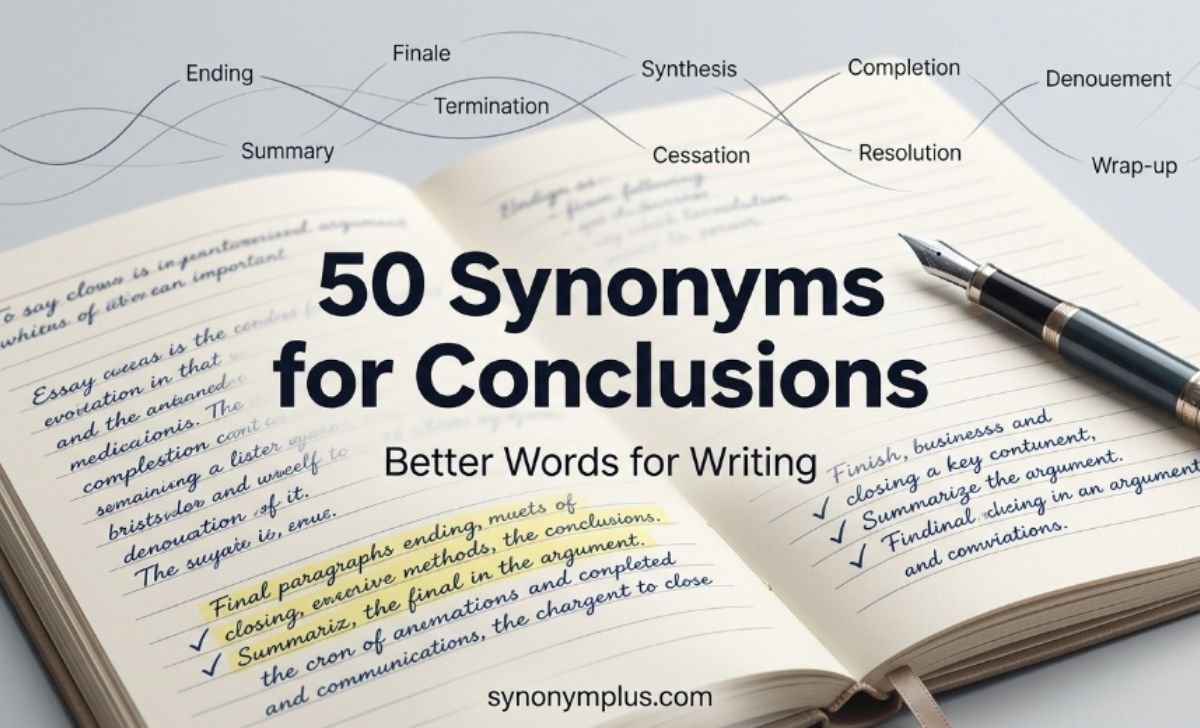
Have you ever finished an essay and felt stuck on the last few lines? You know what you want to say, but the word conclusion feels too plain. That is where synonyms for conclusions can help.
A conclusion is the final part of something, such as an essay, report, discussion, or argument. It can also mean a decision or idea reached after thinking about facts. For example, a student may write a final paragraph to bring an essay to an end.
Learning synonyms for conclusions gives you more ways to express that final idea. These words are useful for students, bloggers, content writers, and anyone who wants clearer English. Knowing synonyms for conclusions can also help you avoid using the same word again and again.
1. Ending
Meaning: An ending is the final part of something.
Examples:
- The story has a happy ending.
- I liked the ending of the book.
2. End
Meaning: An end is the point where something stops.
Examples:
- We reached the end of the lesson.
- The movie came to an end.
3. Finish
Meaning: A finish is the point where something is completed.
Examples:
- The finish of the race was exciting.
- We are near the finish of the project.
4. Closing
Meaning: A closing is the final part of a speech, essay, meeting, or event.
Examples:
- Her closing was short and clear.
- He gave a strong closing at the meeting.
5. Closure
Meaning: Closure is a final point that brings something to an end.
Examples:
- The letter gave the story some closure.
- We need closure before moving on.
6. Wrap-Up
Meaning: A wrap-up is a short final summary of the main points.
Examples:
- The teacher gave a quick wrap-up.
- Let us have a wrap-up before lunch.
7. Summary
Meaning: A summary gives the main points in a shorter form.
Examples:
- The report ends with a short summary.
- I wrote a summary of the main ideas.
8. Recap
Meaning: A recap briefly tells the main things that happened or were discussed.
Examples:
- Let me give you a quick recap.
- The host gave a recap of the show.
9. Outcome
Meaning: An outcome is the final result of an event or action.
Examples:
- We were happy with the outcome.
- The meeting had a good outcome.
10. Result
Meaning: A result is what happens because of an action or event.
Examples:
- The result surprised everyone.
- We waited for the test result.
11. Resolution
Meaning: A resolution is a final answer or solution to a problem.
Examples:
- The team found a resolution.
- We need a fair resolution.
12. Finding
Meaning: A finding is an important fact discovered through study or research.
Examples:
- The report includes an important finding.
- The researcher shared her main finding.
13. Inference
Meaning: An inference is an idea formed from facts or clues.
Examples:
- That was a fair inference from the facts.
- His inference was based on the evidence.
14. Deduction
Meaning: A deduction is an answer reached by using facts and careful thinking.
Examples:
- Her deduction was correct.
- The detective made a quick deduction.
15. Judgment
Meaning: A judgment is an opinion or decision formed after thinking about something.
Examples:
- The judge made a final judgment.
- Use good judgment before acting.
16. Decision
Meaning: A decision is a choice made after thinking about something.
Examples:
- We made our final decision.
- Her decision ended the debate.
17. Verdict
Meaning: A verdict is an official decision, especially in a court case.
Examples:
- The jury reached a verdict.
- Everyone waited for the verdict.
18. Determination
Meaning: A determination is a firm decision about something.
Examples:
- The committee made its determination.
- We are waiting for their determination.
19. Assessment
Meaning: An assessment is a careful judgment about something.
Examples:
- The teacher gave an assessment of my work.
- His assessment was fair.
20. Evaluation
Meaning: An evaluation is a careful review of how good or useful something is.
Examples:
- The manager completed an evaluation.
- We need an evaluation of the plan.
21. Interpretation
Meaning: An interpretation is an explanation of what something means.
Examples:
- Her interpretation was easy to understand.
- The poem allows more than one interpretation.
22. Opinion
Meaning: An opinion is what someone thinks about something.
Examples:
- My opinion has not changed.
- She gave her opinion at the meeting.
23. Takeaway
Meaning: A takeaway is the main idea or lesson you remember from something.
Examples:
- My main takeaway was simple.
- The talk gave me one useful takeaway.
24. Final Thought
Meaning: A final thought is an idea shared at the end of a discussion or piece of writing.
Examples:
- My final thought is simple.
- She ended with one final thought.
25. Final Statement
Meaning: A final statement is something said or written at the end.
Examples:
- He prepared a final statement.
- Her final statement was very clear.
26. Final Remarks
Meaning: Final remarks are the last words spoken about a topic.
Examples:
- The speaker gave his final remarks.
- Her final remarks thanked the whole team.
27. Closing Remarks
Meaning: Closing remarks are words used to finish a speech, meeting, or event.
Examples:
- The director gave closing remarks.
- His closing remarks were brief.
28. Final Words
Meaning: Final words are the last things someone says or writes.
Examples:
- She saved her final words for the audience.
- His final words were kind and calm.
29. Last Word
Meaning: The last word is the final statement or decision on a subject.
Examples:
- The manager had the last word.
- Her report gives the last word on the issue.
30. Final Section
Meaning: A final section is the last part of a document, article, or report.
Examples:
- Read the final section carefully.
- The final section explains the main result.
31. Final Paragraph
Meaning: A final paragraph is the last paragraph of a piece of writing.
Examples:
- Keep your final paragraph short.
- The final paragraph restates the main idea.
32. Closing Paragraph
Meaning: A closing paragraph brings a piece of writing to an end.
Examples:
- The closing paragraph is easy to follow.
- Add your main point to the closing paragraph.
33. Concluding Paragraph
Meaning: A concluding paragraph is the paragraph that finishes an essay or other text.
Examples:
- Her concluding paragraph was strong.
- The concluding paragraph links the main ideas.
34. Completion
Meaning: Completion means that something has been fully finished.
Examples:
- The project is close to completion.
- We celebrated the completion of the work.
35. Finale
Meaning: A finale is the final part of a performance, event, or story.
Examples:
- The concert had a great finale.
- Everyone enjoyed the show’s finale.
36. Epilogue
Meaning: An epilogue is a final section that comes after the main part of a story.
Examples:
- The novel has a short epilogue.
- I enjoyed reading the epilogue.
37. Aftermath
Meaning: The aftermath is what happens after an important or difficult event.
Examples:
- The town faced problems in the aftermath.
- We discussed the aftermath of the storm.
38. Consequence
Meaning: A consequence is something that happens because of an action.
Examples:
- Every choice has a consequence.
- He accepted the consequence of his mistake.
39. Effect
Meaning: An effect is a change caused by an action or event.
Examples:
- The new rule had a clear effect.
- We studied the effect of the change.
40. End Result
Meaning: The end result is the final result of an action or process.
Examples:
- The end result was better than expected.
- We are pleased with the end result.
41. Final Result
Meaning: A final result is the result reached after everything is finished.
Examples:
- The final result came yesterday.
- Everyone accepted the final result.
42. Final Outcome
Meaning: A final outcome is what happens at the end of a process or event.
Examples:
- The final outcome was positive.
- We cannot predict the final outcome.
43. Main Finding
Meaning: A main finding is the most important fact discovered in research or study.
Examples:
- The main finding was surprising.
- The report explains its main finding.
44. Key Finding
Meaning: A key finding is an important fact found during research or investigation.
Examples:
- The study has one key finding.
- The key finding changed our plans.
45. Final Assessment
Meaning: A final assessment is the last careful judgment about something.
Examples:
- The doctor gave a final assessment of the case.
- Our final assessment is ready.
46. Overall Assessment
Meaning: An overall assessment is a general judgment based on all the important facts.
Examples:
- Her overall assessment was positive.
- The report gives an overall assessment of the plan.
47. Bottom Line
Meaning: The bottom line is the most important final point.
Examples:
- The bottom line is that we need more time.
- What is the bottom line of the report?
48. Final Observation
Meaning: A final observation is a last comment based on what someone has noticed.
Examples:
- He added one final observation.
- Her final observation was useful.
49. Final Message
Meaning: A final message is the last idea or information given to someone.
Examples:
- The speaker shared a final message.
- Her final message was easy to remember.
50. Closing Thought
Meaning: A closing thought is a final idea shared at the end of something.
Examples:
- He ended with a thoughtful closing thought.
- My closing thought is that practice matters.
FAQs
1. What are the best synonyms for conclusions?
Some useful alternatives are end, ending, closing, summary, outcome, result, resolution, finding, inference, deduction, and final thought. The best choice depends on the meaning and context.
2. What is another word for conclusion?
Ending, closing, result, outcome, summary, resolution, and final thought can be used instead of conclusion in different contexts.
3. What is another word for conclusion in an essay?
For an essay, useful alternatives include closing paragraph, concluding paragraph, final paragraph, summary, final thought, and closing statement. However, “conclusion” remains the most common academic term.
4. What are conclusion synonyms for essays?
Common conclusion synonyms for essays include final paragraph, concluding paragraph, closing paragraph, final section, summary, takeaway, and final thought. Some describe the section itself, while others describe what the section does.
5. What is a formal synonym for conclusion?
Resolution, determination, finding, assessment, evaluation, inference, and final statement can work in formal writing when their meanings fit the sentence.
6. What is another way to say “in conclusion”?
You can use phrases such as to sum up, in summary, overall, to conclude, finally, in closing, or ultimately. Choose one that fits the tone of your writing.
7. What is the difference between a conclusion and a summary?
A summary briefly repeats the main points, while a conclusion usually brings those points together and gives the reader a final idea, judgment, or takeaway.
8. What is the difference between a conclusion and an outcome?
A conclusion can be a final idea or judgment reached after thinking. An outcome is what happens as the final result of an event, action, or process.
9. What is the difference between a conclusion and an inference?
An inference is an idea reached from facts or clues. A conclusion can be broader and may include a final judgment based on those facts.
10. What is the difference between a conclusion and a deduction?
A deduction is a result reached through logical thinking. A conclusion is a broader term that can describe the final idea reached after considering information.
Conclusion
Learning synonyms for conclusions gives you more choices in writing and speaking. Words such as ending, summary, outcome, finding, resolution, and final thought can make your message clearer.
Students can use them in essays, while bloggers and content writers can use them to avoid repeated wording. Practice these words in emails, essays, blog posts, and daily conversations. The more you use them, the easier it becomes to choose the right word for each situation.
Read More Blogs:

I am Junaid Tariq, the author of Synonymplus.com, with 3 years of experience in English vocabulary, synonyms, word usage, and writing. I enjoy creating clear and useful content that makes learning English easier and more practical.
My goal is to help readers find the right words, understand their meanings, and use them correctly in everyday communication. I focus on writing simple, accurate, and easy-to-understand content for students, writers, professionals, and anyone looking to improve their English vocabulary.
Through Synonymplus.com, I share helpful guides, synonym lists, word meanings, examples, and practical language tips. With my experience and passion for English, I aim to provide reliable content that helps readers write better, speak more confidently, and expand their vocabulary.