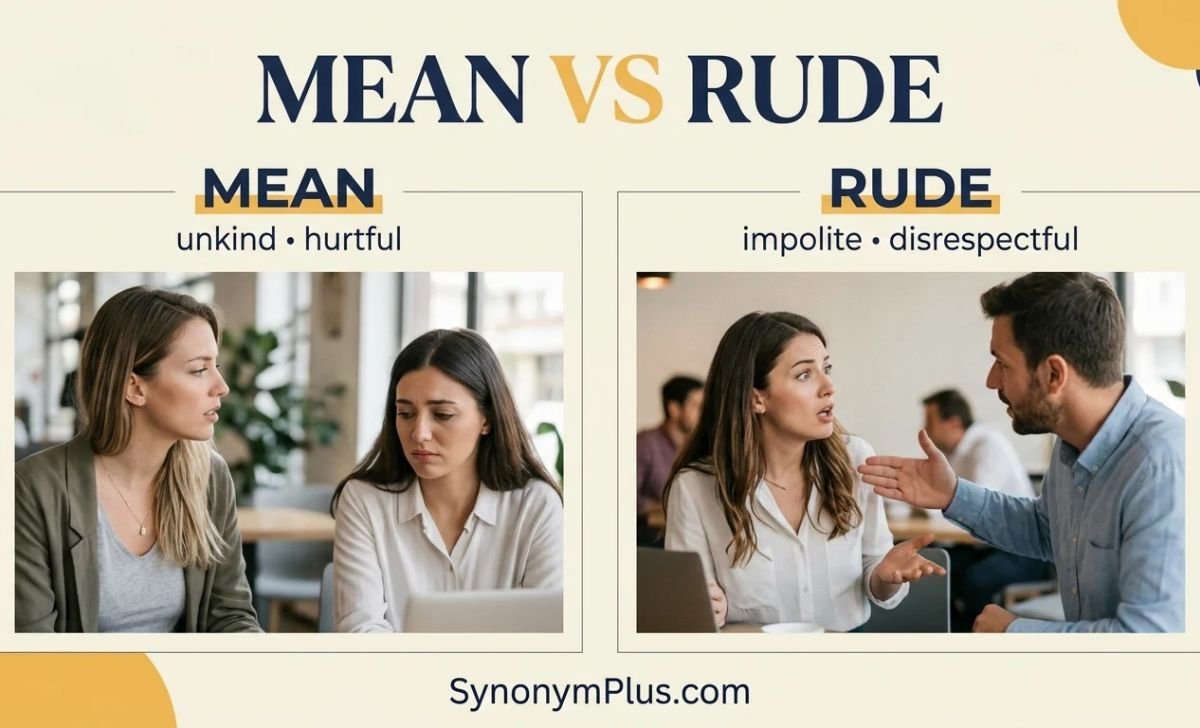
Some people hurt others with unkind words, while others show poor manners or speak without respect. Both behaviors can be described as mean or rude, but the words are not always interchangeable.
A person who makes a cruel remark may be mean, while someone who interrupts a conversation may simply be rude.
Understanding synonyms for mean and rude helps you describe these behaviors more accurately. Words such as unkind, cruel, impolite, discourteous, and disrespectful each carry a slightly different meaning. Some describe hurtful intentions, while others focus on manners or the way someone speaks.
This guide explains useful alternatives, their meanings, and natural examples. You will also learn the differences between similar words, discover suitable antonyms, and find out which expressions work best in everyday conversations, professional writing, and formal situations.
Meaning of Mean and Rude
What Does Mean Mean?
Mean is an adjective when it describes an unkind or hurtful person. It can refer to words, actions, or behavior that cause distress or show little concern for others.
- Simple meaning: Unkind, hurtful, or deliberately unpleasant.
- Pronunciation: /miːn/ — sounds like “meen.”
- Example: It was mean of him to laugh at her mistake.
The word can also describe someone who is unwilling to spend money, as in “a mean person.” In mathematics, mean is a noun that refers to an average. This article focuses on its use when describing people and behavior.
What Does Rude Mean?
Rude is an adjective that describes behavior that breaks accepted standards of politeness or shows disrespect.
- Simple meaning: Impolite, discourteous, or disrespectful.
- Pronunciation: /ruːd/ — sounds like “rood.”
- Example: It was rude to check your phone while she was speaking.
Rudeness can appear in conversations, emails, public behavior, and workplace interactions. A person may be rude without intending to hurt anyone. For example, interrupting someone can be rude even when the interruption is not meant as an insult.
What Is the Difference Between a Mean and a Rude Person?
A mean person often behaves in ways that hurt others, sometimes deliberately. A rude person ignores manners or fails to show proper respect.
Consider two situations:
- Someone makes fun of a classmate’s appearance to embarrass them. This is mean and potentially cruel.
- Someone cuts in front of others in a queue without acknowledging them. This is rude and inconsiderate.
The behaviors can overlap. A person can be both mean and rude, but the words emphasize different aspects of their behavior.
Top Synonyms for Mean and Rude
The best synonym depends on what the person does and how their behavior affects others. Some words describe a lack of kindness. Others describe bad manners, insults, or a disrespectful attitude.
1. Synonyms for Mean: Unkind and Hurtful Behavior
These alternatives work when someone causes emotional pain, shows little kindness, or treats others badly.
| Synonym | Meaning | Example |
|---|---|---|
| Unkind | Not kind or considerate | It was unkind to ignore her request for help. |
| Hurtful | Causing emotional pain | His hurtful comment stayed with her all day. |
| Cruel | Causing suffering without sufficient concern | The cruel joke upset the entire class. |
| Nasty | Very unpleasant or spiteful | She received a nasty message online. |
| Mean-spirited | Showing a desire to hurt or belittle others | His mean-spirited remark spoiled the celebration. |
| Spiteful | Intending to upset someone, often out of resentment | She made a spiteful comment about his success. |
| Malicious | Intending to cause harm | Someone spread malicious rumors about the new employee. |
| Heartless | Showing little sympathy for suffering | His heartless response made the situation worse. |
| Callous | Insensitive to other people’s feelings | The manager gave a callous reply to her concerns. |
| Harsh | Unnecessarily severe or unkind | His harsh criticism discouraged the beginner. |
| Vicious | Extremely hostile or deliberately harmful | The online discussion turned into a vicious attack. |
| Thoughtless | Failing to consider how actions affect others | It was thoughtless to cancel without telling anyone. |
These words vary in strength. Thoughtless can describe an unintentional mistake, while malicious suggests a harmful intention. Cruel and vicious generally express stronger disapproval than unkind.
2. Synonyms for Rude: Impolite and Bad-Mannered Behavior
Use these words when someone ignores social manners, behaves discourteously, or fails to show basic consideration.
| Synonym | Meaning | Example |
|---|---|---|
| Impolite | Not showing good manners | It is impolite to interrupt repeatedly. |
| Discourteous | Failing to show courtesy | The customer received a discourteous response. |
| Ill-mannered | Behaving without proper manners | The ill-mannered guest interrupted the speaker. |
| Bad-mannered | Showing poor social behavior | His bad-mannered conduct upset the hosts. |
| Uncivil | Lacking politeness or courtesy | The discussion became uncivil after the disagreement. |
| Unmannerly | Not behaving with proper manners | Her unmannerly reply surprised the group. |
| Boorish | Rough, insensitive, and socially rude | His boorish behavior made dinner uncomfortable. |
| Churlish | Rude, unfriendly, or ungracious | She received a churlish answer to a simple question. |
| Uncouth | Lacking refinement or social grace | His uncouth remarks embarrassed his colleagues. |
| Inconsiderate | Failing to think about other people’s needs | Playing loud music late at night is inconsiderate. |
| Tactless | Speaking or acting without sensitivity | It was tactless to ask about his salary in public. |
| Uncivilized | Lacking accepted standards of civilized conduct | The argument became an uncivilized shouting match. |
Impolite is a neutral, everyday alternative. Discourteous sounds more formal, while boorish and uncouth express stronger criticism of someone’s manners or social conduct.
3. Synonyms for Rude: Disrespectful and Insulting Behavior
These alternatives are useful when someone talks down to others, uses insulting language, or shows open disrespect.
| Synonym | Meaning | Example |
|---|---|---|
| Disrespectful | Showing a lack of respect | His disrespectful response offended the team. |
| Insolent | Boldly and rudely disrespectful | The student gave an insolent reply to the teacher. |
| Impudent | Showing inappropriate boldness or disrespect | She made an impudent remark during the meeting. |
| Impertinent | Rude or improperly intrusive | His impertinent question made her uncomfortable. |
| Insulting | Expressing disrespect or contempt | The insulting comment damaged their friendship. |
| Offensive | Likely to upset or offend someone | The speaker apologized for the offensive joke. |
| Contemptuous | Showing that you consider someone unworthy of respect | He gave a contemptuous laugh at her suggestion. |
| Scornful | Showing strong disrespect or disdain | She responded with a scornful expression. |
| Derisive | Expressing ridicule or mockery | The audience reacted to his derisive comments. |
| Abusive | Using insulting, threatening, or harmful language or behavior | The employee reported abusive messages. |
| Mocking | Making fun of someone or something | His mocking tone made the child feel small. |
| Sarcastic | Using irony, often to criticize or mock | Her sarcastic reply ended the conversation. |
Not every sarcastic remark is rude. Sarcasm can be playful between friends, but it can also sound insulting when used to embarrass or belittle someone. Insolent and impudent often suggest disrespect toward someone whose authority or position is being challenged.
4. Synonyms for Mean and Rude: Harsh or Unpleasant Personalities
Some words describe a person’s general manner rather than one isolated action.
| Synonym | Meaning | Example |
|---|---|---|
| Abrasive | Having a harsh or difficult manner | His abrasive communication style caused tension. |
| Brusque | Brief and abrupt in a way that may seem rude | The receptionist gave a brusque answer. |
| Curt | Using very few words in an unfriendly way | She sent a curt reply to the invitation. |
| Gruff | Rough or stern in voice or manner | The guard sounded gruff but answered the question. |
| Blunt | Speaking directly without softening the message | He was blunt about the problems in the report. |
| Unfriendly | Not warm or welcoming | The staff seemed unfriendly when we arrived. |
| Hostile | Showing strong opposition or aggression | The conversation became hostile very quickly. |
| Antagonistic | Acting in a way that provokes opposition or conflict | His antagonistic attitude made cooperation difficult. |
These alternatives are not exact substitutes in every sentence. A blunt person may be honest rather than mean. Someone who is gruff may sound unfriendly but still be helpful. Hostile and antagonistic suggest more conflict than ordinary rudeness.
5. Words for a Selfish or Spiteful Person
These words describe behavior connected to self-interest, resentment, or unfair treatment. They are useful alternatives only when that specific meaning applies.
| Word | Meaning | Example |
|---|---|---|
| Selfish | Mainly concerned with personal interests | It was selfish to take all the supplies. |
| Spiteful | Intending to upset or hurt someone | He made a spiteful remark after losing. |
| Petty | Focusing on small matters in an unkind or resentful way | She made a petty complaint about his success. |
| Stingy | Unwilling to spend or share money | He was stingy when the group split the bill. |
| Unfair | Not treating people justly | The unfair decision upset the players. |
| Vindictive | Wanting revenge after feeling wronged | His vindictive response prolonged the dispute. |
Selfish does not automatically mean rude, and stingy usually refers to money or sharing. Choose these words only when the behavior matches their specific meanings.
Context-Specific Synonyms for Mean and Rude
The setting often determines which alternative sounds most natural. A word suitable for casual conversation may sound too emotional in a workplace report.
In Everyday Conversation
Use familiar words that communicate the problem clearly.
- Mean: unkind, nasty, hurtful.
- Rude: impolite, disrespectful, bad-mannered.
- Both: nasty, disrespectful, mean-spirited, depending on the behavior.
Example: “That was unkind of him to laugh at your mistake.”
In Professional Writing
Workplace communication usually benefits from specific, measured descriptions instead of personal attacks.
- Discourteous: when someone fails to show professional courtesy.
- Inconsiderate: when someone’s actions disregard others’ needs.
- Disrespectful: when a person undermines another person’s dignity.
- Abrasive: when someone’s communication style repeatedly causes friction.
- Inappropriate: when behavior does not suit the situation.
Example: “The employee’s response was discourteous and did not address the customer’s concern.”
In Academic Writing
Choose words that explain the behavior or argument precisely.
- Hostile: aggressive or strongly opposed.
- Contemptuous: expressing disdain for someone or something.
- Derisive: mocking a person or idea.
- Malicious: intended to cause harm.
- Tactless: insensitive to the situation or another person’s feelings.
Example: “The speaker used a derisive tone that weakened the discussion.”
In Emails and Formal Complaints
Describe the action rather than labeling someone’s entire personality.
Instead of “Your staff member was mean and rude,” consider:
- “The response was discourteous.”
- “The message came across as disrespectful.”
- “The interaction was unnecessarily hostile.”
- “The wording was inappropriate for a professional exchange.”
These alternatives sound measured and make it easier to explain what needs to change.
Antonyms of Mean and Rude
The opposite of mean or rude depends on the behavior you want to describe.
| Word | Opposite of | Meaning | Example |
|---|---|---|---|
| Kind | Mean | Caring and considerate | She was kind to the nervous student. |
| Compassionate | Cruel or heartless | Showing concern for suffering | The nurse was compassionate toward the family. |
| Thoughtful | Thoughtless | Considering others’ needs | It was thoughtful to check on your neighbor. |
| Gentle | Harsh or cruel | Mild and considerate in manner | He gave gentle feedback to the learner. |
| Polite | Rude or impolite | Showing good manners | The receptionist remained polite throughout the call. |
| Courteous | Discourteous | Showing respect and consideration | The staff gave us courteous service. |
| Respectful | Disrespectful | Treating others with regard | She was respectful during the disagreement. |
| Tactful | Tactless | Sensitive to other people’s feelings | He gave a tactful answer to a difficult question. |
| Gracious | Churlish or ungracious | Warm, polite, and considerate | She was gracious even after losing the contest. |
| Friendly | Unfriendly | Warm and approachable | Our new neighbor was friendly and welcoming. |
Notice the distinction: kind is a natural opposite of mean when mean refers to unkindness, while polite is a direct opposite of rude when rude refers to poor manners.
Example Sentences Using Mean and Rude Synonyms
These examples show how to use the words naturally in different situations.
Daily Conversation
- It was unkind of Mia to leave her friend out of the game.
- Please do not be rude when someone is trying to help you.
- His nasty comment made everyone uncomfortable.
- She sounded curt when she answered my question.
- It was thoughtless to cancel our plans without telling me.
- The child made a hurtful remark about his classmate’s drawing.
School and Academic English
- The student’s insolent response surprised the teacher.
- The essay criticized the politician’s malicious remarks.
- His derisive comments discouraged students from sharing their ideas.
- The debate became hostile when both speakers stopped listening.
- A tactless question can make a sensitive discussion uncomfortable.
Business and Professional English
- The customer complained about the employee’s discourteous service.
- Her abrasive communication style created tension within the team.
- The manager addressed the disrespectful behavior during the meeting.
- His blunt feedback identified the problem but lacked tact.
- The company apologized for the offensive message.
Formal and Creative Writing
- The character’s vindictive actions revealed his desire for revenge.
- Her contemptuous expression showed how little she valued his opinion.
- The host remained gracious despite the guest’s churlish behavior.
- The novel portrays a callous official who ignores the suffering of ordinary people.
Difference Between Similar Words
Some synonyms overlap in meaning but differ in intention, intensity, or tone. Understanding these distinctions helps you avoid choosing a word that changes your message.
1. Mean vs. Rude
| Mean | Rude |
|---|---|
| Focuses on unkind or hurtful behavior. | Focuses on poor manners or disrespect. |
| May involve an intention to hurt. | May happen without an intention to hurt. |
| Example: Mocking someone’s insecurity. | Example: Interrupting someone repeatedly. |
A person can be both mean and rude. However, calling someone rude does not necessarily mean they intended to cause emotional pain.
2. Rude vs. Impolite
| Rude | Impolite |
|---|---|
| Can suggest disrespect or offensive behavior. | Usually focuses on a lack of good manners. |
| Can sound stronger in some contexts. | Often sounds neutral or less severe. |
| Example: Making an insulting remark. | Example: Forgetting to say “please.” |
Both words can describe poor manners. Rude often conveys stronger disapproval, depending on the situation.
3. Unkind vs. Cruel
| Unkind | Cruel |
|---|---|
| Describes a lack of kindness or consideration. | Suggests causing suffering or showing serious disregard for it. |
| Can describe a minor hurtful action. | Usually conveys stronger moral criticism. |
| Example: Ignoring a friend’s message. | Example: Deliberately humiliating someone who is already distressed. |
An unkind action is not necessarily cruel. The second word generally suggests greater severity.
4. Discourteous vs. Insolent
| Discourteous | Insolent |
|---|---|
| Means lacking courtesy or good manners. | Means boldly disrespectful or offensively defiant. |
| Often suits professional situations. | Often describes disrespect toward authority. |
| Example: Ending a customer call abruptly. | Example: Responding to a supervisor with an openly defiant insult. |
Use discourteous for a lack of courtesy. Choose insolent when the behavior shows a stronger, defiant form of disrespect.
5. Tactless vs. Blunt
| Tactless | Blunt |
|---|---|
| Suggests poor judgment about what to say or when to say it. | Means speaking directly without softening the message. |
| Often carries negative judgment. | Can be positive, neutral, or negative. |
| Example: Asking about someone’s private loss in public. | Example: Saying, “This report needs more evidence.” |
A blunt person is not always rude. Direct language becomes tactless when it ignores the situation or another person’s feelings.
Best Alternative Words for Mean and Rude
Use this quick reference when you need a suitable word for a particular situation.
| Situation | Best alternatives | Why they fit |
|---|---|---|
| Someone deliberately hurts another person | Cruel, malicious, spiteful | Emphasize harmful behavior or intent. |
| Someone says something hurtful | Unkind, nasty, hurtful | Describe the effect or tone of the words. |
| Someone has poor manners | Impolite, ill-mannered | Focus on social behavior. |
| Someone shows disrespect | Disrespectful, insolent | Emphasize a lack of respect. |
| Someone speaks too harshly | Abrasive, harsh, brusque | Describe an unpleasant communication style. |
| Someone ignores others’ needs | Inconsiderate, thoughtless | Focus on a lack of consideration. |
| Someone mocks another person | Derisive, mocking, scornful | Describe ridicule or contempt. |
| Someone acts selfishly | Selfish, petty | Describe self-centered or small-minded behavior. |
| Someone behaves badly at work | Discourteous, inappropriate | Offer measured language for professional contexts. |
| Someone speaks directly | Blunt, frank | Describe directness without automatically implying rudeness. |
For a formal report, discourteous or inappropriate may be more suitable than mean. For a personal conversation, unkind or hurtful may communicate your concern more naturally.
Grammar Tips
1. Mean and Rude Are Adjectives
Both words describe people, actions, remarks, or behavior.
- She is mean to her younger brother.
- That was a rude question.
- His comments were mean and rude.
Use is or was when describing a person or action. Use seems or sounds when describing how the behavior appears.
2. Use Adverbs to Describe How Someone Acts
The adverbs are meanly and rudely, although meanly is less common in everyday speech.
- He spoke rudely to the receptionist.
- She treated her colleague unkindly.
- He responded harshly to the suggestion.
In many sentences, a more natural expression is “acted in a mean way” rather than “acted meanly.”
3. Learn the Related Noun Forms
| Adjective | Related noun | Example |
|---|---|---|
| Rude | Rudeness | His rudeness upset the guests. |
| Impolite | Impoliteness | The complaint concerned his impoliteness. |
| Cruel | Cruelty | The story explores cruelty and forgiveness. |
| Discourteous | Discourtesy | The customer reported the discourtesy. |
| Disrespectful | Disrespect | Disrespect toward colleagues can harm teamwork. |
| Unkind | Unkindness | She regretted her unkindness. |
These nouns name the behavior or quality rather than describing the person directly.
4. Use Natural Sentence Patterns
Common patterns include:
- Mean to someone: He was mean to his brother.
- Rude to someone: She was rude to the waiter.
- Rude about something: They were rude about his appearance.
- A mean thing to do: It was a mean thing to say.
- A rude remark: He made a rude remark during lunch.
The preposition to is common when identifying the person who receives the behavior.
Common Mistakes
1. Treating Mean and Rude as Exact Synonyms
Incorrect assumption: Every rude action is mean.
Better understanding: Rude behavior may involve poor manners, while mean behavior often involves unkindness or emotional harm.
Example: Forgetting to greet someone may seem rude, but it does not automatically make you mean.
2. Using Cruel for Every Unkind Action
Incorrect: “She was cruel because she forgot to reply to my message.”
Better: “She was inconsiderate because she forgot to reply to my message.”
Cruel is usually too strong for a minor mistake unless there is evidence of serious or deliberate harm.
3. Confusing Blunt With Rude
Incorrect assumption: Anyone who speaks directly is rude.
Better understanding: Blunt describes direct speech. Rude describes behavior that lacks politeness or shows disrespect.
Example: “Your proposal needs more research” is blunt feedback, but it is not necessarily rude.
4. Using Discourteous in Casual Conversations
Awkward: “My friend was discourteous when he took my snack.”
More natural: “My friend was rude when he took my snack.”
Discourteous is correct, but rude usually sounds more natural in everyday conversation.
5. Confusing Insolent With Merely Impolite
Incorrect assumption: Forgetting to say thank you is always insolent.
Better understanding: Insolent suggests a stronger form of disrespect, often involving defiance. Impolite is more suitable for ordinary failures of manners.
Pro Writing Tips
- Identify the behavior first. Decide whether you mean unkindness, poor manners, disrespect, or hostility.
- Choose the right intensity. Use unkind for mild behavior and cruel for more serious harm.
- Consider your audience. Rude works in everyday speech; discourteous often suits formal complaints.
- Describe actions instead of labeling people. “His response was disrespectful” is more specific than “He is a bad person.”
- Avoid unnecessary exaggeration. Do not use malicious unless the context supports an implication of harmful intent.
- Check the tone. Words such as blunt and sarcastic can be neutral or negative, depending on the situation.
- Prefer clarity over complexity. A familiar, accurate word is usually better than an obscure synonym.
Related Words
These related terms help you discuss mean and rude behavior with greater precision.
| Category | Related words and expressions |
|---|---|
| Kindness | Kind, caring, compassionate, considerate, thoughtful |
| Poor manners | Rudeness, impoliteness, discourtesy, bad manners |
| Disrespect | Insolence, contempt, disrespect, defiance |
| Hurtful behavior | Cruelty, spite, hostility, malice |
| Communication style | Blunt, brusque, tactless, abrasive, sarcastic |
| Positive behavior | Politeness, courtesy, respect, tact, graciousness |
Common expressions include a rude remark, a mean comment, bad manners, hurtful words, a disrespectful attitude, a lack of courtesy, and a spiteful response.
These phrases can be more natural than using a single adjective, especially when describing a specific incident.
FAQs
1. What are the best synonyms for mean and rude?
Common synonyms include unkind, nasty, hurtful, impolite, discourteous, and disrespectful. Choose the word that best describes the behavior.
2. What is another word for a mean and rude person?
You can use nasty, mean-spirited, ill-mannered, or disrespectful. Abrasive describes someone with a consistently harsh manner.
3. What does rude mean?
Rude means impolite or disrespectful. It often describes poor manners, offensive comments, or behavior that shows little consideration.
4. What does discourteous mean?
Discourteous means lacking politeness or consideration. It is a more formal alternative to rude, especially in professional situations.
5. What does insolent mean?
Insolent means boldly or offensively disrespectful. It often describes defiant behavior toward someone in authority.
6. What is the difference between mean and rude?
Mean usually describes hurtful or unkind behavior, while rude refers to poor manners or disrespect. A person can be both.
7. What are the antonyms of rude?
Common antonyms include polite, courteous, respectful, well-mannered, and gracious. Each describes a different aspect of good behavior.
8. What is a polite way to describe someone who is mean?
Use words such as unkind, insensitive, or inconsiderate. Describing the specific behavior can sound more professional than labeling the person.
9. Is blunt another word for rude?
Not always. Blunt means direct in speech, while rude suggests poor manners or disrespect. Direct feedback can still be respectful.
10. What is the opposite of a mean person?
Kind, caring, considerate, and compassionate are common alternatives. These words describe people who treat others with empathy and respect.
Conclusion
Synonyms for mean and rude help you describe unkindness, poor manners, and disrespect more precisely. Words such as unkind, cruel, nasty, and spiteful focus on hurtful behavior, while impolite, discourteous, and ill-mannered emphasize a lack of courtesy.
Other terms, including insolent, tactless, and abrasive, describe more specific attitudes or communication styles.
The key is to consider the person’s behavior, the context, and the level of seriousness before choosing an alternative. A rude action is not always mean, and direct speech is not always disrespectful.
When you select the word that best matches the situation, your English becomes clearer, more accurate, and more natural.
Read More Blogs
- Synonyms for Skillset: Useful Alternatives for Different Contexts
- Synonyms for Foes: 40+ Alternatives for Enemies and Opponents
- Synonyms of Then: 40+ Useful Alternatives With Examples

I am Junaid Tariq, the author of Synonymplus.com, with 3 years of experience in English vocabulary, synonyms, word usage, and writing. I enjoy creating clear and useful content that makes learning English easier and more practical.
My goal is to help readers find the right words, understand their meanings, and use them correctly in everyday communication. I focus on writing simple, accurate, and easy-to-understand content for students, writers, professionals, and anyone looking to improve their English vocabulary.
Through Synonymplus.com, I share helpful guides, synonym lists, word meanings, examples, and practical language tips. With my experience and passion for English, I aim to provide reliable content that helps readers write better, speak more confidently, and expand their vocabulary.