A person’s skillset includes more than the tasks they can perform. It can reflect their knowledge, practical abilities, experience, and professional strengths. However, the best way to describe those qualities depends on the situation.
A resume may call for competencies or proficiencies, while a casual conversation may sound more natural with skills or abilities.
Learning the right synonyms for skillset helps you avoid repetition and express your meaning more clearly. Some alternatives describe general abilities, while others suggest advanced knowledge, natural talent, or proven expertise.
These differences matter in job applications, academic writing, business communication, and everyday English.
This article explores useful alternatives, explains their meanings, compares closely related terms, and provides practical examples to help you choose the right expression for your sentence.
Meaning of “Skillset”
A skillset is a collection of skills, abilities, and knowledge that someone uses to perform tasks or handle particular responsibilities.
For example, a project manager’s skillset might include planning, communication, leadership, budgeting, and problem-solving.
Part of speech
Skillset is a noun. It refers to a combination of skills rather than one individual ability.
- Singular: skillset or skill set
- Plural: skillsets or skill sets
Both the one-word and two-word spellings are used in English. The two-word form, skill set, is also a widely accepted choice.
Pronunciation
- IPA: /ˈskɪl.set/
- Simple pronunciation: SKIL-set
Origin and common usage
The term combines skill, meaning an ability developed through learning or practice, with set, meaning a collection of things considered together.
People commonly use it in employment, education, training, technology, and professional development. It can also describe the abilities needed for a hobby, sport, or creative activity.
In simple terms, your skillset is the combination of things you know how to do.
Top Synonyms of “Skillset”
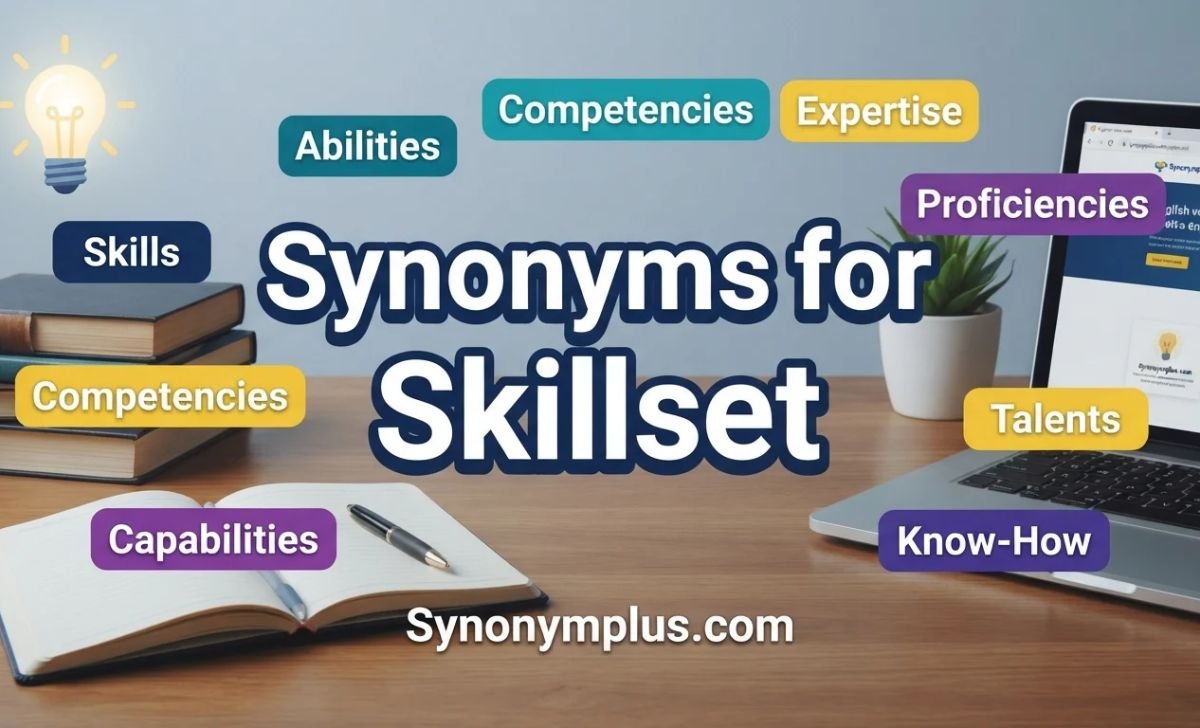
The best synonym depends on what you want to emphasize. Skills is the simplest alternative. Competencies suits professional settings, while expertise suggests advanced knowledge or ability in a particular field.
1. General synonyms for skillset
These words describe what someone can do, understand, or perform.
| Word | Meaning | Example sentence |
|---|---|---|
| Skills | Abilities developed through learning or practice | Her skills include writing, editing, and research. |
| Abilities | Things a person can do | His abilities make him suitable for the role. |
| Capabilities | The capacity to perform tasks or achieve results | The team has the capabilities to manage the project. |
| Competencies | Skills and knowledge needed to perform a role effectively | Communication is one of her core competencies. |
| Proficiencies | Areas in which someone has demonstrated skill | The job requires proficiencies in several software tools. |
| Aptitudes | Natural abilities or an ease in learning something | He has an aptitude for mathematics. |
| Talents | Natural or developed abilities | Her artistic talents became clear at an early age. |
| Strengths | Areas in which someone performs particularly well | Problem-solving is one of his main strengths. |
| Know-how | Practical knowledge of how to do something | The business needs someone with technical know-how. |
| Expertise | Advanced knowledge or skill in a subject | She brings expertise in digital marketing. |
These alternatives are not identical. Aptitude often refers to potential or natural ability, whereas proficiency indicates an ability to perform a task competently. Choose the word that matches the person’s actual strengths.
2. Professional and formal synonyms
These alternatives are particularly useful in resumes, cover letters, performance reviews, and workplace communication.
| Word | Meaning | Example sentence |
|---|---|---|
| Qualifications | Credentials or attributes that suit someone for a role | Her qualifications meet the position’s requirements. |
| Professional competence | The ability to perform work to an acceptable standard | The training helped improve his professional competence. |
| Technical proficiency | The ability to use specific tools, systems, or techniques | The role requires technical proficiency in data analysis. |
| Specialization | A particular area of concentrated study or work | Cybersecurity is his area of specialization. |
| Acumen | The ability to make sound judgments in a specific field | Her business acumen helped the company identify new opportunities. |
| Mastery | A high level of command over a subject or activity | Years of practice gave him mastery of the instrument. |
| Experience | Knowledge gained through work or practical involvement | Her experience includes managing international teams. |
| Professional strengths | Abilities that support effective work performance | Leadership and organization are his professional strengths. |
| Functional expertise | Specialized knowledge related to a business function | The department needs functional expertise in finance. |
| Technical capabilities | The ability to carry out technical tasks | The new employee has strong technical capabilities. |
Which should you choose? Use competencies when discussing the combination of knowledge and abilities needed for a role. Choose qualifications when credentials or suitability matter. Use expertise when you want to highlight specialized knowledge.
3. Synonyms for a person with a broad skillset
Sometimes, the intended meaning is not the collection of skills itself. You may want to describe a person who can perform different tasks or work across several areas.
| Word or phrase | Meaning | Example sentence |
|---|---|---|
| Multiskilled | Having skills in several areas | We need a multiskilled employee for this small team. |
| Versatile | Able to adapt to different tasks or situations | She is a versatile designer who also understands marketing. |
| All-rounder | Someone capable in several activities or roles | He is an all-rounder who can handle planning and customer support. |
| Generalist | Someone with broad knowledge across different areas | As a generalist, she works across recruitment and employee development. |
| Polymath | Someone with extensive knowledge in several fields | The polymath combined an interest in science with a love of art. |
| Adaptable | Able to adjust to changing tasks or conditions | An adaptable worker can respond well to shifting priorities. |
| Resourceful | Skilled at finding practical ways to solve problems | The resourceful employee found a solution with limited equipment. |
| Cross-functional professional | Someone who works across different business functions | The cross-functional professional understands both sales and operations. |
These expressions describe people, not the skillset itself. For example, say “She is a versatile professional,” rather than “Her skillset is a versatile.”
4. Synonyms related to advanced skill and ability
Use these terms when the goal is to communicate depth, quality, or a particular kind of strength.
| Word | Meaning | Example sentence |
|---|---|---|
| Prowess | Impressive ability in a particular activity | His technical prowess helped solve the complex problem. |
| Dexterity | Skill and coordination, especially in physical tasks | The craft requires manual dexterity. |
| Mastery | A very high level of skill | Her mastery of the subject impressed the panel. |
| Aptitude | An ability or potential to learn something well | He showed an aptitude for programming. |
| Accomplishment | Something successfully achieved | Building the application was a major accomplishment. |
| Practical knowledge | Understanding gained through real application | The internship gave her practical knowledge of accounting. |
| Craftsmanship | Skill and care shown in making or creating something | The quality of his craftsmanship was evident in every detail. |
| Savvy | Practical understanding and good judgment | She has strong digital savvy. |
Accomplishment is related to skill but is not a direct synonym for a skillset. It describes an achievement. Similarly, craftsmanship applies most naturally to skilled work that involves making, building, or creating something.
5. Synonyms for specific types of skillsets
For technical, interpersonal, and transferable abilities, a more specific expression can be clearer than the general word skillset.
| Word or phrase | Meaning | Example sentence |
|---|---|---|
| Technical skills | Abilities used to perform specialized or technical tasks | The role requires technical skills in database management. |
| Soft skills | Personal and interpersonal abilities | Her soft skills help her work effectively with clients. |
| Transferable skills | Abilities that apply across different jobs or settings | Communication and organization are transferable skills. |
| Core competencies | The main abilities needed for a role or organization | Project planning is one of the team’s core competencies. |
| Specialized skills | Abilities focused on a particular field | The position requires specialized skills in medical imaging. |
| Interpersonal abilities | Skills used to communicate and interact with others | Strong interpersonal abilities help resolve workplace conflicts. |
| Leadership capabilities | Abilities that help someone guide people or teams | His leadership capabilities grew as he managed larger projects. |
| Problem-solving abilities | Skills used to identify and resolve challenges | Her problem-solving abilities proved valuable during the launch. |
These expressions are often better than a broad synonym because they tell the reader exactly what kind of abilities are involved.
Context-Specific Alternatives to Skillset
The most suitable alternative depends on your audience, purpose, and level of formality.
Professional writing
Use competencies, capabilities, expertise, or professional strengths when discussing job performance. These terms work well in performance reviews, company profiles, and career documents.
Example: “The role requires strong analytical competencies and project management experience.”
Resume and CV writing
Use skills, core competencies, technical proficiencies, or areas of expertise. These expressions help employers understand what you can contribute.
Example: “Core competencies include data analysis, team leadership, and process improvement.”
Avoid replacing every instance of skills with a more complicated word. A clear heading such as “Technical Skills” is often more effective than “Technical Competencies and Proficiencies.”
Academic writing
Use competencies, abilities, proficiencies, or subject knowledge, depending on what you mean.
Example: “The assessment measures students’ research competencies and analytical abilities.”
Use knowledge when discussing what someone understands, and skills when describing what they can do.
Business English
Use capabilities, expertise, competencies, or organizational strengths.
Example: “The company is expanding its digital capabilities to support new services.”
Email writing
Choose direct, natural language. Skills, experience, and expertise usually work better than technical-sounding alternatives.
Example: “My experience in customer support and data reporting matches the needs of your team.”
Everyday conversation
Use skills, abilities, talents, or strengths.
Example: “He has a wide range of skills and learns new tasks quickly.”
Creative writing
Use talent, craft, prowess, or a specific ability when it suits the scene.
Example: “Her talent for storytelling made even ordinary events fascinating.”
Antonyms of Skillset
Skillset does not have one exact opposite because it describes a collection of abilities. The closest opposite depends on whether you mean a lack of skills, limited experience, or an inability to perform a task.
| Opposite or contrasting term | Meaning | Example sentence |
|---|---|---|
| Incompetence | Lack of the ability needed to perform a task properly | The report revealed incompetence in handling basic procedures. |
| Inability | Lack of capacity to do something | His inability to use the system delayed the project. |
| Inexperience | Lack of practical experience | Her inexperience with the software meant she needed training. |
| Unskilled | Lacking the training or ability required for a particular task | The task was unsuitable for an unskilled worker. |
| Ineptitude | Lack of skill or effectiveness | Poor planning showed the team’s ineptitude in project management. |
| Incapacity | Lack of ability or capacity to perform a particular function | His incapacity to perform the task led to a reassignment. |
These words are not interchangeable. Inexperience means someone has limited practical exposure, not necessarily limited ability. Incompetence is more negative because it suggests that someone cannot perform a task adequately.
Example Sentences
The following examples show how to use skillset alternatives in different situations.
Daily conversation
- “Her skills include cooking, gardening, and basic home repairs.”
- “He has the ability to learn new tasks quickly.”
- “My brother is a versatile person who enjoys trying different activities.”
- “She has a natural talent for explaining difficult ideas.”
- “His strengths include patience, creativity, and problem-solving.”
Business and professional English
- “The company needs someone with expertise in customer relationship management.”
- “Her core competencies include budgeting, communication, and team leadership.”
- “The new manager has the capabilities required to lead the department.”
- “We are looking for a candidate with strong technical proficiency.”
- “His business acumen helped the team make better decisions.”
Academic English
- “The course develops students’ research skills and analytical abilities.”
- “The assessment measures each student’s proficiency in written English.”
- “Practical experience can strengthen theoretical knowledge.”
- “The program aims to improve learners’ critical-thinking competencies.”
Resume and job applications
- “My professional strengths include project coordination and clear communication.”
- “I have experience in data analysis, reporting, and process improvement.”
- “My transferable skills include teamwork, organization, and time management.”
- “My technical capabilities include database management and software testing.”
Formal and creative writing
- “The engineer demonstrated considerable technical prowess during the project.”
- “Years of practice helped the musician develop mastery of the instrument.”
Notice how the best alternative changes with the subject. A resume may benefit from competencies, an academic assessment may use proficiency, and a casual conversation may simply call these abilities skills.
Difference Between Similar Words
Several words associated with skillset have related meanings, but each emphasizes a different quality.
| Word pair | Main difference | Example |
|---|---|---|
| Skillset vs. skills | A skillset is a collection; a skill is one ability or a general category of abilities. | “Her skillset includes writing and editing.” |
| Skillset vs. expertise | A skillset can cover many abilities; expertise emphasizes advanced knowledge in a particular area. | “He has expertise in cybersecurity.” |
| Skillset vs. competencies | A skillset is a broad collection of abilities; competencies usually relate to effective performance in a role. | “Leadership is a core competency.” |
| Skillset vs. qualifications | A skillset concerns abilities; qualifications may include degrees, certificates, training, or relevant experience. | “The position requires professional qualifications.” |
| Skillset vs. aptitude | A skillset describes abilities someone has; aptitude suggests natural potential or an ease in learning. | “She has an aptitude for mathematics.” |
Which distinction matters most?
The difference between skills and competencies is especially useful in professional writing. Skills often refer to individual abilities, such as coding or presenting. Competencies may combine skills, knowledge, judgment, and behavior to describe effective performance.
Likewise, a qualification does not automatically prove expertise. A certificate may show that someone completed training, while expertise usually implies deeper knowledge or experience.
Best Alternative Words for Skillset
Use this quick reference when you need a replacement for a particular situation.
| Context | Recommended alternatives |
|---|---|
| Resume or CV | Skills, core competencies, technical proficiencies |
| Cover letter | Relevant skills, experience, expertise |
| Job interview | Strengths, abilities, professional experience |
| Business report | Capabilities, competencies, areas of expertise |
| Academic essay | Abilities, competencies, proficiencies |
| Technical role | Technical skills, specialized expertise, technical capabilities |
| Team description | Collective strengths, combined expertise, shared capabilities |
| Everyday conversation | Skills, abilities, talents |
| Creative work | Talent, craft, artistic ability |
| Learning and development | Competencies, learning abilities, practical skills |
For most situations, skills remains the clearest choice. Use a more specific term when you need to emphasize a particular quality, such as advanced knowledge, formal qualifications, or the ability to perform a job effectively.
Grammar Tips
1. Skillset is a noun
Use skillset to name a collection of abilities.
- Correct: “Her skillset suits the position.”
- Correct: “The course helps students develop their skillsets.”
2. Skillset and skill set are both used
The one-word and two-word spellings are established in English. For a professional article or website, choose one form and use it consistently. If your organization has a style guide, follow its preferred spelling.
3. Use the correct plural
Both skillsets and skill sets are possible plural forms.
- “The applicants have different skillsets.”
- “The training program develops several skill sets.”
4. Distinguish a skill from a skillset
A skill is one ability or a general type of ability. A skillset is the combination of abilities someone possesses.
- “Writing is one of her skills.”
- “Writing, editing, and research form part of her skillset.”
5. Use natural collocations
Some words commonly appear together in professional English:
- Develop a skillset
- Expand your skillset
- Broaden your skill set
- Build technical skills
- Demonstrate proficiency
- Gain expertise
- Develop core competencies
- Strengthen professional capabilities
Choose the phrase that matches the action. You generally gain experience, develop skills, and demonstrate proficiency.
Common Mistakes
1. Treating expertise as an exact synonym
Less precise: “My expertise includes writing, customer service, and basic computer use.”
Better: “My skills include writing, customer service, and basic computer use.”
Expertise often suggests advanced knowledge. Use it when the level of knowledge justifies the word.
2. Confusing skills with qualifications
Incorrect meaning: “My qualifications include teamwork and communication.”
Clearer: “My skills include teamwork and communication.”
The first sentence is not always grammatically wrong, but qualifications often refers to credentials or broader evidence of suitability. Skills is more direct when listing abilities.
3. Using aptitude to describe an established skill
Less precise: “She has an aptitude in project management after ten years in the role.”
Better: “She has extensive experience in project management.”
Aptitude often describes potential or an ease in learning. Use experience, proficiency, or expertise when discussing developed abilities.
4. Calling a person a skillset
Incorrect: “She is a strong skillset.”
Correct: “She has a strong skillset.”
To describe the person, say “She is versatile,” “She is multiskilled,” or “She is an experienced professional.”
5. Choosing impressive words over clear ones
Less natural: “My professional dexterity includes customer service and reporting.”
Better: “My professional skills include customer service and reporting.”
Dexterity usually refers to coordination or skill in handling tasks, often physical ones. It is not a general replacement for every use of skills.
6. Writing skillset when you mean one skill
Less precise: “My skillset is public speaking.”
Clearer: “One of my skills is public speaking.”
If you mean several abilities, list them or describe the broader combination.
Pro Writing Tips
- Identify the exact meaning. Decide whether you mean ability, knowledge, experience, or potential.
- Match the audience. A resume may call for competencies, while a casual conversation usually needs skills.
- Be specific. “Data analysis skills” tells readers more than “a strong skillset.”
- Avoid exaggeration. Do not use mastery or expertise unless the person’s ability supports that claim.
- Keep wording natural. A familiar word is better than an unusual phrase that sounds forced.
- Use evidence. Pair a skill with a result, qualification, or example when writing professionally.
- Check the whole sentence. A synonym may fit the meaning but still sound awkward in its grammatical position.
Related Words
These terms help describe specific abilities and the ways people develop or apply them.
Associated words
- Knowledge: Information and understanding gained through study or experience.
- Experience: Practical involvement in a task, role, or activity.
- Training: Instruction and practice that develop ability.
- Qualifications: Credentials or attributes relevant to a position.
- Proficiency: Demonstrated ability to perform something competently.
- Expertise: Advanced knowledge or skill in a field.
- Aptitude: Natural potential or an ease in learning something.
Word family and related forms
| Word | Part of speech | Example |
|---|---|---|
| Skill | Noun | Communication is a valuable skill. |
| Skilled | Adjective | She is a skilled editor. |
| Skillfully | Adverb | He handled the discussion skillfully. |
| Skillful | Adjective | The team made a skillful adjustment. |
| Competence | Noun | The role requires technical competence. |
| Competent | Adjective | She is competent in financial reporting. |
| Proficient | Adjective | He is proficient in spreadsheet software. |
| Proficiency | Noun | Her proficiency in English has improved. |
Common collocations and expressions
- A broad skill set
- A diverse range of skills
- A well-rounded professional
- A strong foundation of knowledge
- A combination of skills and experience
- A specialized area of expertise
- A transferable set of abilities
- A demonstrated level of proficiency
- A core area of competence
- A capacity for continuous learning
These expressions help you describe a person’s abilities more precisely without repeating skillset throughout a document.
FAQs
1. What are the best synonyms for skillset?
The best synonyms include skills, abilities, capabilities, competencies, proficiencies, and expertise. Each has a slightly different meaning. Skills is the simplest general alternative, while competencies often suits professional settings. Expertise is best when discussing advanced knowledge in a particular field. Choose the term that accurately describes the abilities you want to communicate.
2. What does skillset mean?
A skillset is a collection of abilities, knowledge, and practical skills that someone uses to complete tasks or perform a role. For example, a teacher’s skillset may include communication, lesson planning, classroom management, and subject knowledge. A skillset can develop through education, practice, work experience, and professional training.
3. What is a simple synonym for skillset?
Skills is usually the simplest synonym. It is familiar, direct, and suitable for most situations. For example, “My skillset includes writing and research” can become “My skills include writing and research.” Use abilities when emphasizing what someone can do rather than the specific skills they have learned.
4. What is a formal synonym for skillset?
Competencies, capabilities, and areas of expertise are useful formal alternatives. In a resume, core competencies can describe abilities relevant to a position. In a business report, capabilities may describe what an individual or team can accomplish. The best choice depends on whether you are discussing individual skills, job performance, or specialized knowledge.
5. What is the difference between skillset and expertise?
A skillset refers to a collection of skills and abilities. Expertise usually means advanced knowledge or a high level of skill in a particular area. For example, a designer’s skillset might include illustration, typography, and communication. Their expertise might specifically be in user-interface design. Someone can have a broad skillset without being an expert in every area.
6. What is the difference between skillset and competencies?
A skillset is a general collection of abilities. Competencies often describe the skills, knowledge, and behaviors needed to perform a role effectively. For example, a salesperson’s skillset may include negotiation and communication. Their competencies may include customer relationship management, product knowledge, and the ability to meet agreed performance standards.
7. What do you call a person with multiple skills?
A person with multiple skills may be called multiskilled, versatile, or an all-rounder. A generalist usually has broad knowledge across several areas, while a polymath has extensive knowledge in multiple fields. The right expression depends on the person’s abilities and experience. For a professional resume, “versatile professional” is often a natural choice.
8. Is skillset one word or two?
Both skillset and skill set are used in English. The two-word spelling is well established, and the one-word form is also common, especially in professional writing. Choose the form that fits your publication’s style guide and use it consistently. The plural can be written as skillsets or skill sets.
9. What is the opposite of skillset?
There is no single exact antonym for skillset because it describes a collection of abilities. Depending on the intended meaning, incompetence, inability, inexperience, or lack of skills may express the contrast. Use inexperience when someone lacks practical exposure, and incompetence when someone cannot perform a task adequately.
10. How do you describe your skillset on a resume?
Describe your skills in terms that match the position. You might write, “Core competencies include project coordination, data analysis, and stakeholder communication.” Where possible, support these claims with examples of your work or achievements. Avoid vague statements such as “I have a great skillset.” Specific abilities give employers a clearer understanding of your suitability for the role.
Conclusion
The best synonyms for skillset depend on the abilities you want to describe and the context in which you use them. Skills and abilities work well in everyday English, while competencies and capabilities often suit professional writing.
Use expertise for advanced knowledge, proficiency for demonstrated ability, and aptitude for natural potential.
When writing a resume, preparing an essay, or describing someone’s strengths, choose words that communicate the intended meaning clearly.
Avoid using impressive-sounding alternatives that exaggerate a person’s abilities. A precise, natural expression will always serve readers better than an unnecessarily complicated one.
Read More Blogs
- Synonyms for Mercantilism: 50 Related Terms and Alternatives
- 50 Words Similar to Legislature: Meanings, Uses, and Examples
- Synonyms for Fervent: 50 Useful Alternatives for Different Contexts

I am Junaid Tariq, the author of Synonymplus.com, with 3 years of experience in English vocabulary, synonyms, word usage, and writing. I enjoy creating clear and useful content that makes learning English easier and more practical.
My goal is to help readers find the right words, understand their meanings, and use them correctly in everyday communication. I focus on writing simple, accurate, and easy-to-understand content for students, writers, professionals, and anyone looking to improve their English vocabulary.
Through Synonymplus.com, I share helpful guides, synonym lists, word meanings, examples, and practical language tips. With my experience and passion for English, I aim to provide reliable content that helps readers write better, speak more confidently, and expand their vocabulary.