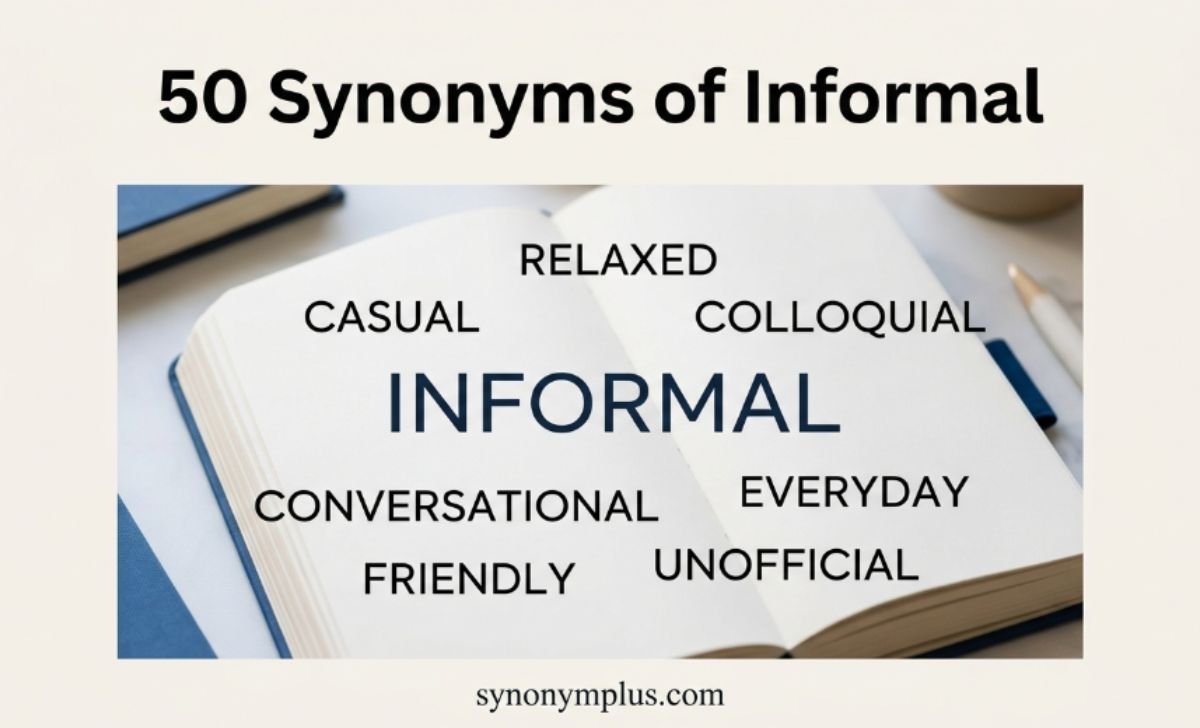
Have you ever wanted to say something in a relaxed way instead of using very formal English? The word informal is useful when talking about language, clothes, events, or behavior that feels relaxed and natural.
For example, you might use informal language when chatting with a friend, but choose formal language for a job application.
Learning synonyms of informal can help you choose the right word for each situation. Students can use them to improve essays and vocabulary.
Bloggers and content writers can make their writing sound more natural. Daily English users can also speak with more variety. In this guide, you will find 50 synonyms of informal, with simple meanings and real-life examples.
1. Casual
Meaning: Casual means relaxed and not formal.
Examples:
- I wore casual clothes to the picnic.
- We had a casual chat after lunch.
2. Relaxed
Meaning: Relaxed means calm, easy, and free from strict rules.
Examples:
- The meeting had a relaxed mood.
- He used a relaxed style in his email.
3. Colloquial
Meaning: Colloquial describes words or expressions used in everyday speech.
Examples:
- “Kids” is a colloquial word for children.
- Her writing has a friendly, colloquial tone.
4. Conversational
Meaning: Conversational means sounding like normal speech between people.
Examples:
- The article uses a conversational style.
- I like his conversational way of explaining ideas.
5. Unofficial
Meaning: Unofficial means not formal or not officially approved.
Examples:
- We had an unofficial meeting at the café.
- This is an unofficial version of the plan.
6. Familiar
Meaning: Familiar means friendly and comfortable rather than formal.
Examples:
- She used a familiar tone with her old friend.
- His message sounded warm and familiar.
7. Easygoing
Meaning: Easygoing means relaxed and not strict.
Examples:
- Our teacher has an easygoing style.
- He is easygoing about small mistakes.
8. Unceremonious
Meaning: Unceremonious means done without formal actions or ceremony.
Examples:
- He gave an unceremonious goodbye.
- The guests left in an unceremonious way.
9. Laid-back
Meaning: Laid-back means very relaxed and calm.
Examples:
- My boss has a laid-back attitude.
- We enjoyed a laid-back evening at home.
10. Informalized
Meaning: Informalized means made less formal or more relaxed.
Examples:
- The company informalized its office dress rules.
- The editor informalized the tone of the article.
11. Relaxed-Style
Meaning: Relaxed-style describes something presented in an easy and casual way.
Examples:
- The website uses a relaxed-style design.
- Her relaxed-style writing feels friendly.
12. Natural
Meaning: Natural means easy and normal rather than stiff or formal.
Examples:
- Try to use natural language in your message.
- His natural speaking style makes people comfortable.
13. Unceremonial
Meaning: Unceremonial means without formal ceremony or special preparation.
Examples:
- They had an unceremonial lunch together.
- His departure was quick and unceremonial.
14. Familiarized
Meaning: Familiarized can describe a style made more familiar or less distant.
Examples:
- The writer familiarized the tone for younger readers.
- The editor familiarized the language for the audience.
15. Unrestrained
Meaning: Unrestrained means free from strict control or limits.
Examples:
- They enjoyed an unrestrained conversation.
- His unrestrained humor made everyone laugh.
16. Free
Meaning: Free can describe behavior that is not controlled by strict rules.
Examples:
- We had a free discussion after class.
- The group enjoyed a free exchange of ideas.
17. Loose
Meaning: Loose can mean relaxed and not strictly controlled.
Examples:
- The team follows a loose schedule.
- We made a loose plan for the weekend.
18. Flexible
Meaning: Flexible means able to change without strict rules.
Examples:
- The office has flexible dress rules.
- Our teacher uses a flexible approach.
19. Unstructured
Meaning: Unstructured means not arranged according to strict rules or a fixed plan.
Examples:
- We had an unstructured discussion.
- The workshop included some unstructured activities.
20. Unregulated
Meaning: Unregulated means not controlled by formal rules.
Examples:
- The group had an unregulated discussion.
- The informal market was largely unregulated.
21. Spontaneous
Meaning: Spontaneous means happening naturally without a formal plan.
Examples:
- We had a spontaneous dinner together.
- Her spontaneous comment made us laugh.
22. Offhand
Meaning: Offhand means said or done casually without much thought or preparation.
Examples:
- He made an offhand remark about the weather.
- I gave an offhand answer during the chat.
23. Familiar-tone
Meaning: Familiar-tone describes language that sounds friendly and close.
Examples:
- The letter uses a familiar tone.
- A familiar tone works well for this audience.
24. Chatty
Meaning: Chatty means friendly and similar to ordinary conversation.
Examples:
- Her blog has a chatty style.
- I prefer a chatty email for close friends.
25. Friendly
Meaning: Friendly means warm, kind, and easy to talk to.
Examples:
- He sent a friendly message.
- The website has a friendly writing style.
26. Approachable
Meaning: Approachable means easy and comfortable to talk to or understand.
Examples:
- The teacher has an approachable manner.
- Her writing is clear and approachable.
27. Unceremoniousness
Meaning: Unceremoniousness means a lack of formal ceremony or procedure.
Examples:
- The unceremoniousness of the event surprised us.
- His unceremoniousness made the meeting feel relaxed.
28. Homely
Meaning: Homely can describe something simple, comfortable, and familiar.
Examples:
- The café has a homely atmosphere.
- We enjoyed a homely dinner with friends.
29. Domestic
Meaning: Domestic can describe something related to ordinary home life.
Examples:
- They enjoyed a domestic evening together.
- The novel focuses on domestic life.
30. Everyday
Meaning: Everyday means common, normal, and used in daily life.
Examples:
- These are everyday words.
- The article explains everyday English.
31. Common
Meaning: Common means usual and widely used.
Examples:
- This is a common expression in English.
- She used a common phrase in her message.
32. Ordinary
Meaning: Ordinary means normal and not special or formal.
Examples:
- He wore ordinary clothes to the event.
- We had an ordinary conversation after work.
33. Simple
Meaning: Simple means easy, plain, and without unnecessary formality.
Examples:
- Use simple language in your email.
- She gave a simple explanation.
34. Plain
Meaning: Plain means clear and direct without fancy or formal language.
Examples:
- He prefers plain English.
- The instructions use plain words.
35. Direct
Meaning: Direct means clear and straightforward without extra formality.
Examples:
- Her direct message was easy to understand.
- I prefer a direct style in short emails.
36. Down-to-earth
Meaning: Down-to-earth means natural, practical, and easy to talk to.
Examples:
- The author has a down-to-earth writing style.
- Our manager is friendly and down-to-earth.
37. Unpretentious
Meaning: Unpretentious means simple and not trying to appear important.
Examples:
- The restaurant has an unpretentious atmosphere.
- His writing is clear and unpretentious.
38. Unceremonious-style
Meaning: Unceremonious-style describes something done in a simple way without ceremony.
Examples:
- The event had an unceremonious-style ending.
- We chose an unceremonious-style meeting.
39. Unconventional
Meaning: Unconventional means different from usual rules or traditional ways.
Examples:
- She uses an unconventional writing style.
- They chose an unconventional way to present the idea.
40. Nonformal
Meaning: Nonformal means not following a formal style or system.
Examples:
- The course includes nonformal learning activities.
- We had a nonformal discussion after class.
41. Nonofficial
Meaning: Nonofficial means not formally recognized or approved.
Examples:
- He shared a nonofficial update.
- This was a nonofficial meeting.
42. Relaxing
Meaning: Relaxing means making something feel calm and free from pressure.
Examples:
- The group had a relaxing conversation.
- We chose a relaxing setting for the meeting.
43. Carefree
Meaning: Carefree means free from worry, rules, or serious concerns.
Examples:
- They spent a carefree afternoon together.
- His carefree attitude made everyone smile.
44. Unbuttoned
Meaning: Unbuttoned means relaxed, open, and not very formal.
Examples:
- The interview had an unbuttoned atmosphere.
- His unbuttoned style made the guests comfortable.
45. Open
Meaning: Open can describe communication that is free, friendly, and not restricted.
Examples:
- We had an open conversation about the problem.
- She has an open way of speaking.
46. Free-flowing
Meaning: Free-flowing means moving naturally without strict control.
Examples:
- The meeting became a free-flowing discussion.
- We enjoyed a free-flowing conversation over dinner.
47. Unscripted
Meaning: Unscripted means not prepared or written in advance.
Examples:
- The interview included several unscripted moments.
- His unscripted answer sounded very natural.
48. Improvised
Meaning: Improvised means created or done without preparation.
Examples:
- We had an improvised meeting in the hallway.
- Her improvised speech was surprisingly good.
49. Casualized
Meaning: Casualized means changed to make something more casual or less formal.
Examples:
- The company casualized its dress policy.
- The editor casualized the language for younger readers.
50. Colloquialized
Meaning: Colloquialized means changed to sound more like everyday speech.
Examples:
- The editor colloquialized the dialogue.
- The writer colloquialized the text for a younger audience.
FAQs
1. What is the best synonym for informal?
Casual is one of the best general synonyms for informal. It works well when describing clothes, conversations, events, or behavior.
2. What is another word for informal language?
Colloquial and conversational are useful alternatives for informal language. Both describe language that sounds like everyday speech.
3. What is the opposite of informal?
The main opposite of informal is formal. Formal language is usually more careful, polite, and suitable for professional or official situations.
4. Is casual the same as informal?
Casual and informal are very close in meaning. However, casual often suggests a relaxed style, while informal can have a wider meaning.
5. What is a synonym for informal in writing?
Conversational is a useful choice when writing sounds like natural speech. Colloquial is also suitable for everyday words and expressions.
6. What is a synonym for informal communication?
Words such as casual, friendly, conversational, and relaxed can describe informal communication.
7. What is a simple word for informal?
Casual is probably the simplest and most common alternative to informal.
8. Can informal words be used in academic writing?
Sometimes, but they should be used carefully. Academic writing usually needs a more formal tone.
9. Which synonym of informal is best for everyday speech?
Conversational and colloquial are especially useful when talking about everyday speech.
10. Why should I learn synonyms of informal?
Learning synonyms helps you avoid repeating the same word. It also helps you choose language that fits different situations.
Conclusion
Learning synonyms of informal can make your English more flexible and natural. Words such as casual, relaxed, conversational, colloquial, friendly, and everyday can help you describe different kinds of informal language and behavior.
The best synonym depends on the situation. Practice these words in emails, essays, blog posts, and daily conversations. Over time, you will become better at choosing the right word for the right audience.
A wider vocabulary can also make your writing clearer, more interesting, and easier to understand.

I am Junaid Tariq, the author of Synonymplus.com, with 3 years of experience in English vocabulary, synonyms, word usage, and writing. I enjoy creating clear and useful content that makes learning English easier and more practical.
My goal is to help readers find the right words, understand their meanings, and use them correctly in everyday communication. I focus on writing simple, accurate, and easy-to-understand content for students, writers, professionals, and anyone looking to improve their English vocabulary.
Through Synonymplus.com, I share helpful guides, synonym lists, word meanings, examples, and practical language tips. With my experience and passion for English, I aim to provide reliable content that helps readers write better, speak more confidently, and expand their vocabulary.