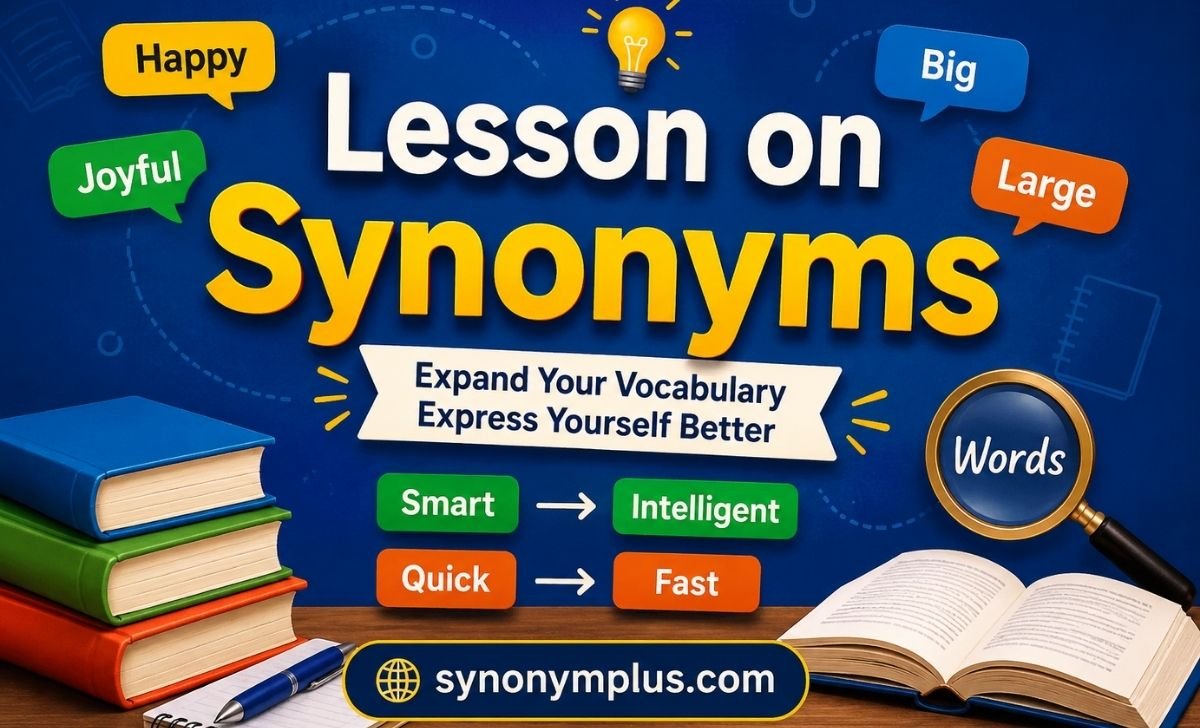
Have you ever used the same word again and again because you could not think of another one? That is where a lesson on synonyms can help. Synonyms are words that have the same or almost the same meaning. For example, happy, glad, and joyful can describe someone who feels good.
A lesson on synonyms teaches you how to find these words and use them in the right way. It can make your writing more interesting and your speech more natural. Students can use synonyms in essays and schoolwork.
Bloggers and content writers can use them to avoid repeated words. Daily English users can use them to express ideas more clearly.
The following 50 terms can help you understand different ways to describe a synonym lesson and vocabulary practice.
1. Synonym Lesson
Meaning: A synonym lesson teaches words that have the same or similar meanings.
Examples:
- We had a synonym lesson in English class.
- The teacher made the synonym lesson fun.
2. Synonyms Lesson
Meaning: A synonyms lesson helps students learn and practice words with similar meanings.
Examples:
- Our synonyms lesson starts today.
- I found a useful synonyms lesson online.
3. English Synonym Lesson
Meaning: An English synonym lesson teaches similar words used in the English language.
Examples:
- We need an English synonym lesson for beginners.
- The English synonym lesson was easy to follow.
4. Vocabulary Lesson
Meaning: A vocabulary lesson teaches new words and their meanings.
Examples:
- I enjoyed today’s vocabulary lesson.
- The vocabulary lesson taught us ten new words.
5. Vocabulary Class
Meaning: A vocabulary class is a class where learners study and practice words.
Examples:
- My vocabulary class is on Monday.
- We learned useful words in vocabulary class.
6. Word Lesson
Meaning: A word lesson helps learners understand and use words correctly.
Examples:
- The word lesson was short and simple.
- We had a word lesson before the test.
7. Word Study
Meaning: Word study means learning how words look, sound, and work.
Examples:
- Our teacher gave us a word study task.
- Word study helped me learn new terms.
8. Vocabulary Study
Meaning: Vocabulary study is the practice of learning new words.
Examples:
- I spend ten minutes on vocabulary study each day.
- Vocabulary study can improve your English.
9. Word Practice
Meaning: Word practice helps you use new words until they become familiar.
Examples:
- We did some word practice after lunch.
- Daily word practice helped her remember the terms.
10. Synonym Practice
Meaning: Synonym practice helps learners find and use words with similar meanings.
Examples:
- We did synonym practice in class.
- Synonym practice made the exercise easier.
11. Vocabulary Practice
Meaning: Vocabulary practice gives you a chance to use and remember new words.
Examples:
- I need more vocabulary practice.
- This activity gives students good vocabulary practice.
12. Word Building
Meaning: Word building means learning more words and ways to use them.
Examples:
- Reading helps with word building.
- Our teacher uses games for word building.
13. Vocabulary Building
Meaning: Vocabulary building means growing the number of words you know.
Examples:
- Reading every day supports vocabulary building.
- Synonyms are useful for vocabulary building.
14. Word Skills
Meaning: Word skills are the skills needed to understand and use words well.
Examples:
- Good word skills help students write better.
- She is working on her word skills.
15. Vocabulary Skills
Meaning: Vocabulary skills help you understand, remember, and use words.
Examples:
- Strong vocabulary skills can help with reading.
- The activity builds vocabulary skills.
16. English Vocabulary Practice
Meaning: English vocabulary practice helps learners improve their knowledge of English words.
Examples:
- I do English vocabulary practice every morning.
- This book has useful English vocabulary practice.
17. English Word Practice
Meaning: English word practice gives learners a way to use English words correctly.
Examples:
- We had English word practice before the quiz.
- English word practice helped me remember the new terms.
18. Similar Words Lesson
Meaning: A similar words lesson teaches words that have close meanings.
Examples:
- The teacher gave us a similar words lesson.
- I learned a lot from the similar words lesson.
19. Similar Meaning Words
Meaning: Similar meaning words are words that share the same or a close meaning.
Examples:
- Small and little are similar meaning words.
- We made a list of similar meaning words.
20. Words With Similar Meanings
Meaning: Words with similar meanings can express the same or nearly the same idea.
Examples:
- Fast and quick are words with similar meanings.
- The worksheet asks us to match words with similar meanings.
21. Alternative Words
Meaning: Alternative words are different words you can use instead of another word.
Examples:
- The writer looked for alternative words.
- Try using alternative words in your essay.
22. Word Alternatives
Meaning: Word alternatives are other words that can replace a word in some situations.
Examples:
- The app gives useful word alternatives.
- I searched for word alternatives before finishing my article.
23. Word Choices
Meaning: Word choices are the words you decide to use when speaking or writing.
Examples:
- Good word choices make writing clearer.
- Her word choices made the story more interesting.
24. Better Word Choices
Meaning: Better word choices can make your message clearer and more natural.
Examples:
- The editor suggested better word choices.
- Better word choices improved my paragraph.
25. Word Choice Lesson
Meaning: A word choice lesson teaches you how to select the best words for your message.
Examples:
- We had a word choice lesson today.
- The word choice lesson helped me avoid weak words.
26. Vocabulary Guide
Meaning: A vocabulary guide gives help with words, meanings, and usage.
Examples:
- I used a vocabulary guide for my homework.
- The vocabulary guide explained each word clearly.
27. Synonym Guide
Meaning: A synonym guide helps you find words with the same or similar meanings.
Examples:
- This synonym guide is easy to use.
- I checked the synonym guide before writing.
28. Word Guide
Meaning: A word guide gives useful information about words and how to use them.
Examples:
- The word guide helped me understand the term.
- Keep a word guide near your desk.
29. Thesaurus Lesson
Meaning: A thesaurus lesson teaches learners how to find similar words in a thesaurus.
Examples:
- Our teacher gave us a thesaurus lesson.
- The thesaurus lesson showed us how to find better words.
30. Thesaurus Practice
Meaning: Thesaurus practice helps learners find and compare similar words.
Examples:
- We did thesaurus practice during class.
- Thesaurus practice helped me expand my vocabulary.
31. Synonym Activity
Meaning: A synonym activity is an exercise that helps learners work with similar words.
Examples:
- The teacher planned a fun synonym activity.
- We completed the synonym activity in pairs.
32. Vocabulary Activity
Meaning: A vocabulary activity helps learners learn and use new words.
Examples:
- The vocabulary activity was easy.
- Students enjoyed the vocabulary activity.
33. Word Activity
Meaning: A word activity is an exercise that focuses on learning or using words.
Examples:
- We started class with a word activity.
- The word activity took ten minutes.
34. Synonym Exercise
Meaning: A synonym exercise gives practice with words that have similar meanings.
Examples:
- I finished the synonym exercise quickly.
- The synonym exercise helped me learn new words.
35. Vocabulary Exercise
Meaning: A vocabulary exercise gives practice with new or useful words.
Examples:
- The teacher gave us a vocabulary exercise.
- I completed the vocabulary exercise at home.
36. Word Exercise
Meaning: A word exercise gives learners practice with word meaning or usage.
Examples:
- This word exercise is good for beginners.
- We did one word exercise before the test.
37. Synonym Worksheet
Meaning: A synonym worksheet contains tasks that help students practice similar words.
Examples:
- The teacher printed a synonym worksheet.
- I finished my synonym worksheet before dinner.
38. Vocabulary Worksheet
Meaning: A vocabulary worksheet contains exercises for learning and practicing words.
Examples:
- We received a vocabulary worksheet in class.
- The vocabulary worksheet has simple questions.
39. Word Worksheet
Meaning: A word worksheet gives learners written practice with words.
Examples:
- The students completed the word worksheet.
- I kept the word worksheet for later practice.
40. Synonym Training
Meaning: Synonym training gives repeated practice with words that have similar meanings.
Examples:
- Synonym training can improve word knowledge.
- She does synonym training every week.
41. Vocabulary Training
Meaning: Vocabulary training helps learners improve their knowledge and use of words.
Examples:
- Vocabulary training can make reading easier.
- He joined a vocabulary training course.
42. English Vocabulary Lesson
Meaning: An English vocabulary lesson teaches useful English words and their meanings.
Examples:
- We had an English vocabulary lesson this morning.
- The English vocabulary lesson was easy to understand.
43. English Word Lesson
Meaning: An English word lesson helps learners understand and use English words.
Examples:
- The English word lesson focused on common terms.
- I took notes during the English word lesson.
44. Language Lesson
Meaning: A language lesson teaches part of a language, such as words, grammar, or speaking.
Examples:
- Today’s language lesson was about vocabulary.
- I never miss my language lesson.
45. Vocabulary Learning
Meaning: Vocabulary learning is the process of learning and remembering new words.
Examples:
- Reading is useful for vocabulary learning.
- Vocabulary learning takes regular practice.
46. Word Learning
Meaning: Word learning is the process of understanding and remembering new words.
Examples:
- Games can make word learning more fun.
- Word learning is easier when you use new terms.
47. Synonym Learning
Meaning: Synonym learning is the process of learning words with the same or similar meanings.
Examples:
- Synonym learning can improve your writing.
- We use short games for synonym learning.
48. Vocabulary Development
Meaning: Vocabulary development means improving the number and range of words you know.
Examples:
- Reading plays a big role in vocabulary development.
- Writing often supports vocabulary development.
49. English Vocabulary Development
Meaning: English vocabulary development means improving your knowledge of English words.
Examples:
- Books are useful for English vocabulary development.
- Daily reading supports English vocabulary development.
50. Synonym Vocabulary Lesson
Meaning: A synonym vocabulary lesson teaches similar words while building useful vocabulary.
Examples:
- The synonym vocabulary lesson was made for beginners.
- We used examples during the synonym vocabulary lesson.
FAQs
1. What is a lesson on synonyms?
A lesson on synonyms teaches words that have the same or almost the same meaning. For example, big and large are synonyms.
2. Why should students learn synonyms?
Students can use synonyms to improve their vocabulary and make their writing less repetitive. They also learn more ways to express an idea.
3. What is an easy example of a synonym?
A simple example is happy and glad. Both words can describe someone who feels good.
4. Are synonyms always exactly the same?
No. Many synonyms have close meanings but are not exactly the same. Their best use can depend on the sentence and context.
5. How can I practice synonyms?
You can read short texts, make synonym lists, complete worksheets, use a thesaurus, and write your own sentences with new words.
6. What is the difference between synonyms and antonyms?
Synonyms have the same or similar meanings, while antonyms have opposite meanings. For example, fast and quick are synonyms, while fast and slow are antonyms.
7. Can synonyms improve writing?
Yes. Synonyms can help you avoid using the same word too often. They can also help you choose a word that fits your meaning better.
8. Are synonyms useful for speaking?
Yes. Knowing more synonyms gives you more ways to express your thoughts. It can also make everyday conversations easier.
9. Should beginners learn synonyms?
Yes. Beginners can start with simple synonym pairs such as big/large, small/little, happy/glad, and fast/quick.
10. Is a thesaurus useful for learning synonyms?
Yes. A thesaurus can help you find similar words. However, you should always check the meaning and context before replacing one word with another.
Conclusion
Learning synonyms is a simple way to build stronger English skills. A good lesson on synonyms shows you how similar words work and when to use them. This can make writing clearer, speaking easier, and communication more natural.
Students can use synonyms in essays, while bloggers and writers can avoid repeated words. Daily English users can also use them in emails and conversations.
Start with a few simple words, write your own sentences, and practice them often. Small vocabulary lessons can lead to better word choices over time.
Read More Blogs:
50 Synonyms for Acid: Words for Sour, Sharp, and Acidic
50 Synonyms for Orchestra: 50 Musical Group Terms Explained

I am Junaid Tariq, the author of Synonymplus.com, with 3 years of experience in English vocabulary, synonyms, word usage, and writing. I enjoy creating clear and useful content that makes learning English easier and more practical.
My goal is to help readers find the right words, understand their meanings, and use them correctly in everyday communication. I focus on writing simple, accurate, and easy-to-understand content for students, writers, professionals, and anyone looking to improve their English vocabulary.
Through Synonymplus.com, I share helpful guides, synonym lists, word meanings, examples, and practical language tips. With my experience and passion for English, I aim to provide reliable content that helps readers write better, speak more confidently, and expand their vocabulary.