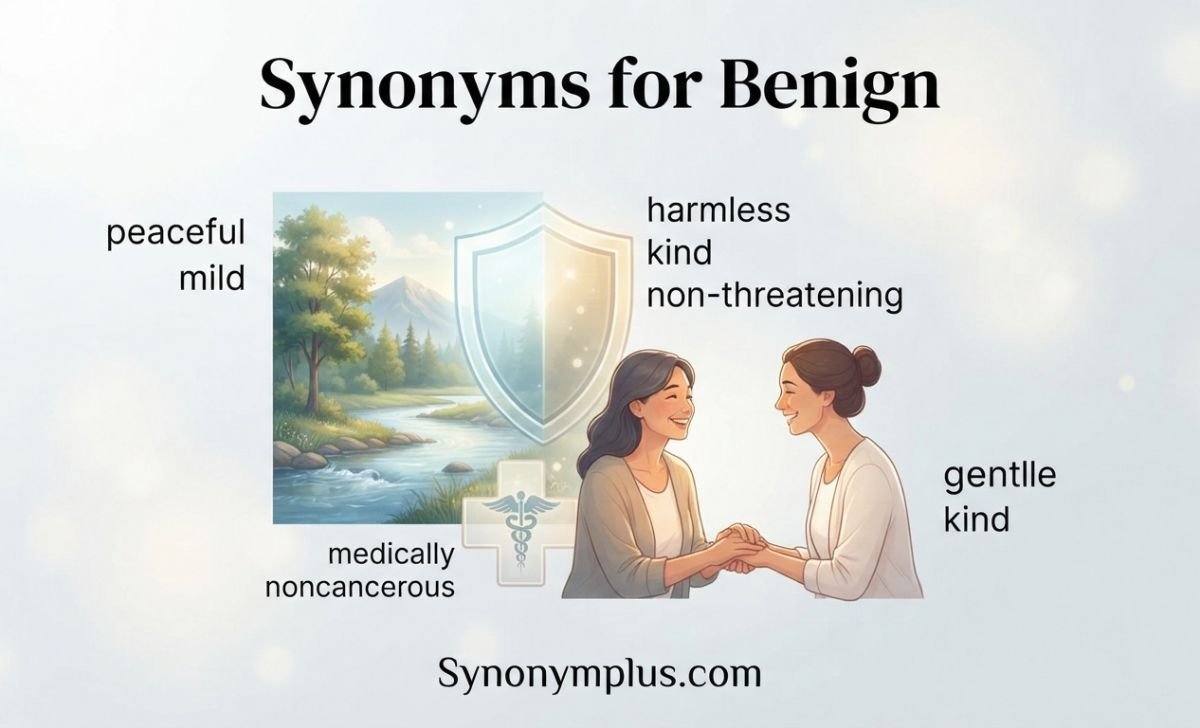
The word benign can describe a kind person, a harmless situation, a mild condition, or a growth that is not cancerous. Because it has several meanings, the best synonym depends on the sentence. For a person, kind, gentle, or benevolent may fit. For something harmless, innocuous or safe may work better.
In medical writing, nonmalignant is a more precise alternative when referring to a tumor or growth.
This guide covers synonyms for benign across these contexts, with simple examples and usage notes. It also explains the difference between benign and its common antonyms, especially malignant and harmful.
What Does Benign Mean?
Benign is an adjective with several related meanings.
When it describes a person or behavior, it usually means kind, gentle, or not intending to cause harm.
The teacher had a benign manner that made nervous students feel comfortable.
When it describes something that is harmless, it means it is not likely to cause damage or danger.
The chemical reaction appeared benign under normal conditions.
In a medical context, benign means not cancerous. A benign tumor can grow, but it does not spread to other parts of the body in the way a malignant tumor can.
The scan showed that the growth was benign.
Cambridge also lists meanings related to favorable conditions, mildness, and pleasant surroundings.
The important point is that benign does not have one perfect synonym for every situation. The right alternative depends on what you are describing.
50 Synonyms for Benign
1. Kind
Meaning: Kind describes someone who is caring, considerate, and willing to help others.
Best used when: You are talking about a person’s character or behavior.
Example:
The kind neighbor helped us carry the boxes upstairs.
Note: Kind is one of the most natural alternatives when benign describes a pleasant person. Cambridge lists it among the synonyms associated with benign.
2. Kindly
Meaning: Kindly means gentle, friendly, and considerate.
Best used when: You want to describe someone’s manner, attitude, or actions.
Example:
The doctor spoke in a kindly voice.
It can also work as an adverb:
She kindly offered to explain the instructions again.
3. Gentle
Meaning: Gentle describes someone or something that is mild, calm, or unlikely to cause harm.
Best used when: Benign refers to a person’s manner, touch, behavior, or general nature.
Example:
His gentle approach helped the child relax.
Note: Gentle can describe physical actions as well as personality, so it is broader than benign in some contexts.
4. Benevolent
Meaning: Benevolent means well-meaning and actively wishing good for others.
Best used when: You are describing a person, leader, organization, or action with good intentions.
Example:
The benevolent donor supported several local charities.
This word sounds more formal than kind.
5. Benignant
Meaning: Benignant means kind, pleasant, and well-disposed toward others.
Best used when: You need a formal or literary alternative to benign.
Note: Benignant is much less common in everyday English. Cambridge lists it as a formal synonym of benign.
6. Genial
Meaning: Genial describes someone who is friendly, cheerful, and pleasant.
Best used when: Benign refers to a person’s social manner.
Example:
Our genial host made everyone feel welcome.
Genial is especially useful for describing a warm social atmosphere.
7. Kindhearted
Meaning: Kindhearted means naturally caring and sympathetic toward other people.
Best used when: You want to emphasize someone’s good character.
Example:
She is known as a kindhearted person who helps her neighbors.
8. Tender
Meaning: Tender can describe someone who shows care, affection, or gentleness.
Best used when: The context involves emotions, affection, or gentle treatment.
Note: Tender is not interchangeable with benign in every sentence. It usually adds an emotional or caring sense.
9. Tender-hearted
Meaning: Tender-hearted describes someone who is sensitive, caring, and easily moved by others’ feelings.
Best used when: You are describing a person’s emotional nature.
Example:
Her tender-hearted nature made her especially caring toward animals.
10. Soft-hearted
Meaning: Soft-hearted describes someone who is easily moved by kindness or the suffering of others.
Best used when: The tone is informal or conversational.
Example:
He may seem strict, but he is actually soft-hearted.
Note: Soft-hearted can sometimes suggest that a person is too easily persuaded. It is therefore not a perfect substitute for benign.
11. Humane
Meaning: Humane means showing kindness, care, and respect for people or animals.
Best used when: You are describing treatment, policies, behavior, or a person’s attitude.
Example:
The shelter follows humane methods when caring for injured animals.
12. Gracious
Meaning: Gracious describes someone who is kind, polite, generous, or considerate.
Best used when: You are describing someone’s behavior toward others.
Example:
She was gracious when her colleague corrected the mistake.
It is especially useful in formal or polite situations.
13. Affable
Meaning: Affable means friendly and easy to talk to.
Best used when: Benign describes a person’s pleasant social manner.
Example:
The affable manager greeted every new employee personally.
Note: Affable focuses more on friendliness than on harmlessness.
14. Amiable
Meaning: Amiable means pleasant, friendly, and easy to get along with.
Best used when: You want to describe someone’s calm and friendly personality.
Example:
Despite his busy schedule, he remained amiable with visitors.
15. Compassionate
Meaning: Compassionate means showing concern for people who are suffering or in difficulty.
Best used when: The context involves empathy or helping someone in need.
Example:
The compassionate nurse stayed with the frightened patient.
It is stronger and more specific than benign when the focus is sympathy.
16. Sympathetic
Meaning: Sympathetic means understanding and caring about another person’s feelings or problems.
Best used when: You want to emphasize emotional understanding.
Example:
Her manager was sympathetic when she explained the family emergency.
Note: Sympathetic does not always mean kind in a general sense. It often focuses on understanding someone’s situation.
17. Merciful
Meaning: Merciful means showing compassion and choosing not to cause unnecessary pain or punishment.
Best used when: The context involves punishment, suffering, or forgiveness.
Example:
The judge was merciful because it was the defendant’s first offense.
18. Considerate
Meaning: Considerate describes someone who thinks about other people’s needs and feelings.
Best used when: You want a practical alternative to benign for someone’s behavior.
Example:
It was considerate of him to lower the music while the baby was sleeping.
19. Good-natured
Meaning: Good-natured means naturally pleasant, calm, and friendly.
Best used when: You are describing someone’s personality.
Example:
Our good-natured colleague rarely gets upset over small mistakes.
This is a natural choice in everyday English.
20. Goodhearted
Meaning: Goodhearted describes someone who is caring, generous, and morally kind.
Best used when: You want to praise someone’s character.
Example:
Everyone knew him as a goodhearted man who helped people in need.
21. Harmless
Meaning: Harmless means not able or likely to cause harm.
Best used when: Benign describes an object, action, person, joke, substance, or situation that poses little or no danger.
Example:
The dog looked frightening, but it was completely harmless.
Cambridge defines harmless as something that is not able or likely to cause harm.
Note: Harmless is usually a better choice than benign in casual everyday English when the main idea is simply “not dangerous.”
22. Innocuous
Meaning: Innocuous means harmless or unlikely to cause damage or offense.
Best used when: You are writing in a formal, academic, or professional context.
Example:
The comment seemed innocuous at first, but it caused confusion later.
Note: Innocuous often describes remarks, actions, substances, or situations rather than people.
23. Inoffensive
Meaning: Inoffensive means unlikely to upset, offend, or harm anyone.
Best used when: You are discussing speech, humor, behavior, or content.
Example:
The comedian chose an inoffensive joke for the family event.
24. Safe
Meaning: Safe means free from significant danger or risk.
Best used when: The main concern is whether something can be used or done without causing harm.
Example:
The technician confirmed that the equipment was safe to use.
Note: Safe is broader than benign and does not always carry the same meaning.
25. Nonthreatening
Meaning: Nonthreatening means not appearing dangerous, hostile, or likely to cause harm.
Best used when: You are describing a person, appearance, environment, or situation.
Example:
The visitor had a calm, nonthreatening manner.
26. Non-harmful
Meaning: Non-harmful means not causing harm.
Best used when: You need a direct and literal alternative, especially in technical or explanatory writing.
Example:
The study examined whether the treatment was non-harmful to healthy tissue.
Note: This phrase is more literal than natural. In many everyday sentences, harmless is smoother.
27. Mild
Meaning: Mild means gentle, moderate, or not severe.
Best used when: Benign describes symptoms, conditions, reactions, weather, or effects.
Example:
She experienced only mild discomfort after the procedure.
Note: Mild does not mean exactly the same as harmless. Something can be mild without being completely harmless.
28. Gentle
Meaning: Gentle can also describe something that has little force or severity.
Best used when: The context involves a mild action, effect, process, or treatment.
Example:
The cream provides a gentle treatment for sensitive skin.
Note: This is the same word as #3 but used in a different context. Because gentle naturally covers both people and things, its meaning changes with the sentence.
29. Favorable
Meaning: Favorable means positive, helpful, or producing a good result.
Best used when: Benign describes conditions, circumstances, signs, or outcomes rather than a person’s personality.
Example:
The patient showed a favorable response to the treatment.
30. Beneficial
Meaning: Beneficial means producing a useful or positive effect.
Best used when: You want to emphasize a good result rather than simply the absence of harm.
Example:
Regular exercise can have beneficial effects on overall health.
Note: Beneficial is not a direct replacement for benign in medical terminology. It means helpful, while benign has a more specific medical meaning.
31. Advantageous
Meaning: Advantageous means helpful because it provides a benefit or improves a situation.
Best used when: The context is professional, academic, or analytical.
Example:
The new schedule was advantageous for employees with long commutes.
32. Salutary
Meaning: Salutary means beneficial or producing a positive effect.
Best used when: You need a formal or literary alternative for a beneficial result.
Example:
The experience had a salutary effect on his attitude toward teamwork.
Note: Salutary is uncommon in casual conversation.
33. Auspicious
Meaning: Auspicious means suggesting that something will have a positive or successful outcome.
Best used when: Benign describes signs, beginnings, events, or circumstances that seem favorable.
Example:
The project began under auspicious conditions.
Note: Auspicious focuses on favorable prospects, not simply harmlessness.
34. Encouraging
Meaning: Encouraging means giving reason for hope or confidence.
Best used when: A benign result or sign suggests that a situation is developing well.
Example:
The early test results were encouraging.
35. Propitious
Meaning: Propitious means favorable or likely to lead to a good result.
Best used when: You want a formal word for favorable circumstances.
Example:
The team waited for a propitious moment to launch the campaign.
36. Temperate
Meaning: Temperate means moderate and not extreme.
Best used when: Benign describes a climate, environment, or conditions.
Example:
The region has a temperate climate with mild winters.
Note: Temperate is not a general synonym for benign. It fits specific contexts involving moderation.
37. Balmy
Meaning: Balmy describes weather that is pleasantly warm and mild.
Best used when: Benign refers to pleasant weather or climate.
Example:
We enjoyed a balmy evening by the coast.
This is more informal and vivid than temperate.
38. Pleasant
Meaning: Pleasant means enjoyable, agreeable, or comfortable.
Best used when: Benign describes a person, atmosphere, environment, experience, or condition.
Example:
The office has a pleasant atmosphere.
39. Agreeable
Meaning: Agreeable means pleasant, acceptable, or easy to enjoy.
Best used when: You are describing conditions, experiences, people, or arrangements.
Example:
The weather remained agreeable throughout the weekend.
40. Healthful
Meaning: Healthful means beneficial to health.
Best used when: The context involves food, living conditions, habits, or an environment that supports health.
Example:
The community promotes healthful eating habits.
Note: Healthful is more specific than benign because it suggests a positive effect on health.
41. Nonmalignant
Meaning: Nonmalignant means not cancerous.
Best used when: You are discussing a tumor or other medical growth.
Example:
The biopsy showed that the mass was nonmalignant.
This is one of the most precise alternatives to benign tumor in medical writing. The National Cancer Institute lists nonmalignant as another term for benign in this medical sense.
42. Noncancerous
Meaning: Noncancerous means not cancerous.
Best used when: You want a clear medical explanation for a general audience.
Example:
The doctor explained that the growth was noncancerous.
Note: This is often easier for everyday readers to understand than nonmalignant.
43. Not Malignant
Meaning: Not malignant means not showing the cancerous behavior associated with malignancy.
Best used when: You need a plain-language explanation of a medical result.
Example:
The report stated that the tumor was not malignant.
44. Not Cancerous
Meaning: Not cancerous directly states that a growth is not cancer.
Best used when: Explaining medical information in simple English.
Example:
The specialist confirmed that the lump was not cancerous.
Note: This phrase is clear and accessible, but it is not always suitable as a replacement in technical medical writing.
45. Noninvasive
Meaning: Noninvasive generally describes something that does not involve entering or damaging body tissue in an invasive way.
Best used when: The context specifically concerns a medical procedure, condition, or growth and its relationship to surrounding tissue.
Example:
The doctor recommended a noninvasive imaging test.
Important: Noninvasive is not a general synonym for benign. A medical procedure can be noninvasive without being benign, so use this word only when the context supports it.
46. Nonthreatening
Meaning: Nonthreatening means not presenting an obvious threat or danger.
Best used when: You are describing a situation, appearance, behavior, or environment.
Example:
The quiet setting created a nonthreatening environment for new patients.
Note: This is a context-specific alternative, not a universal synonym for benign.
47. Unharmful
Meaning: Unharmful means not causing harm.
Best used when: You need a literal alternative in explanatory writing.
Example:
The researchers looked for an unharmful way to reduce the waste.
Note: Harmless is much more natural in most everyday English.
48. Non-dangerous
Meaning: Non-dangerous means not dangerous or not likely to cause harm.
Best used when: You need very plain wording for a general audience.
Example:
The guide explains which household insects are non-dangerous.
Note: Native speakers usually prefer harmless or safe in natural conversation.
49. Good
Meaning: Good can sometimes replace benign when the word means favorable, positive, or well-intentioned.
Best used when: The sentence is informal and the intended meaning is clear.
Example:
The change had a good effect on the local community.
Note: Good is extremely broad. It should not replace benign in medical writing or in situations where a more precise meaning is needed.
50. Mildly Favorable
Meaning: Mildly favorable describes something that is somewhat positive or reassuring without suggesting a strong benefit.
Best used when: You need to describe a generally positive situation or result without overstating it.
Example:
The early response to the proposal was mildly favorable.
Note: This is a context-specific phrase, not a dictionary-level synonym for benign. It works only when benign carries the sense of favorable or reassuring.
Synonyms for Benign Person
When benign describes a person, the meaning usually relates to kindness, gentleness, or a lack of harmful intent. Cambridge gives examples of benign people and lists words such as kind, kindly, genial, kindhearted, gentle, benevolent, humane, gracious, and affable in this sense.
The most natural choices include:
- Kind — caring and considerate
- Gentle — calm and mild
- Benevolent — wishing good for others
- Kindhearted — naturally caring
- Good-natured — pleasant and easygoing
- Genial — friendly and cheerful
- Affable — easy to talk to
- Amiable — pleasant and friendly
- Gracious — polite and considerate
- Humane — showing compassion and respect
For everyday conversation, kind, gentle, and good-natured are usually more natural than the formal benignant.
Synonyms for Benign in a Medical Context
Medical usage is different from the personality sense.
When doctors describe a tumor or growth as benign, the term means that it is not cancer. The National Cancer Institute explains that benign tumors do not spread to other parts of the body, although they can grow larger and, in some cases, cause serious problems depending on where they occur.
Useful alternatives include:
| Term | Meaning | Tone | Best Used For |
|---|---|---|---|
| Nonmalignant | Not cancerous | Medical | Medical reports |
| Noncancerous | Not cancer | General | Patient-friendly explanations |
| Not malignant | Not malignant | Plain/medical | Explaining test results |
| Not cancerous | Not cancerous | Plain | Everyday explanations |
| Benignant | Benign | Specialized/formal | Rare medical usage |
| Harmless | Not likely to cause harm | General | Simple explanations |
The important distinction is that nonmalignant and noncancerous are much closer to the medical meaning of benign than words such as kind, pleasant, or gentle.
Also, a benign tumor is not automatically insignificant. The NCI notes that benign tumors can sometimes become large or cause serious symptoms depending on their location.
Benign vs. Harmless
Benign and harmless can overlap, but they are not always interchangeable.
Harmless directly means something is not able or likely to cause harm.
The insect is harmless.
Benign can also mean harmless, but it has additional meanings.
The doctor found a benign tumor.
You would not normally replace benign tumor with harmless tumor in a medical report. Nonmalignant or noncancerous is more precise.
Benign vs. Malignant
In medical language, benign and malignant are opposites.
A benign tumor is not cancerous. A malignant tumor is cancerous and can invade nearby tissue or spread to other parts of the body.
The scan showed a benign growth.
The biopsy confirmed a malignant tumor.
The antonym malignant should be reserved for contexts where it fits the medical or broader harmful sense. It is not the opposite of benign in every possible sentence.
Antonyms of Benign
The opposite of benign changes with the context.
When benign describes a kind or gentle person, possible opposites include:
- Unkind
- Harsh
- Cruel
- Malicious
- Malevolent
- Hateful
- Inhumane
- Unfriendly
When benign means harmless, common opposites include:
- Harmful
- Dangerous
- Damaging
- Threatening
- Destructive
In a medical context, the main opposite of benign is malignant. You can also use cancerous when talking about a tumor or growth.
The right antonym depends on what benign means in the sentence.s across the different meanings of benign.
Benign in a Sentence
Here are examples showing how the meaning changes with context:
- The new teacher had a benign and friendly manner.
- The joke was completely benign and caused no offense.
- The doctor confirmed that the tumor was benign.
- The region has a benign climate with mild temperatures.
- His benign smile helped put the nervous child at ease.
- The test revealed a nonmalignant growth.
- The substance appeared harmless under normal conditions.
- The early signs were favorable rather than threatening.
These examples show why choosing a synonym requires attention to context. A word that works for a person’s personality may not work for a medical condition.
Common Mistakes With Benign
Using “kind” for a medical tumor
Benign tumor does not mean a tumor is kind. In medical English, it means the tumor is not cancerous.
Treating “harmless” and “benign” as exact synonyms
They overlap in some situations, but benign has additional meanings. A benign person may be kind, while a harmless object may simply pose little danger.
Using “noninvasive” as a synonym for “benign”
These terms describe different things. Noninvasive relates to whether something enters or damages tissue in an invasive way. It does not automatically mean noncancerous.
Assuming benign always means completely safe
In medical contexts, benign means not cancerous, but a benign tumor can still cause problems because of its size or location.
What Is the Best Synonym for Benign?
There is no single best synonym for every sentence.
- For a person: kind, gentle, or benevolent
- For something harmless: harmless, innocuous, or inoffensive
- For a medical tumor: nonmalignant or noncancerous
- For a favorable situation: favorable, beneficial, or auspicious
- For a mild climate: temperate, balmy, or pleasant
- For formal or literary writing: benignant may fit in limited contexts
The best choice is the one that preserves the exact meaning of the original sentence.
FAQs
1. What is the most common synonym for benign?
It depends on the meaning. Kind is a common synonym when benign describes a person. Harmless works when the meaning is not harmful, while nonmalignant is appropriate for a medical tumor.
2. What is another word for a benign person?
Kind, gentle, benevolent, good-natured, amiable, and genial can describe a benign person. The choice depends on the person’s specific quality.
3. What is the synonym for a benign tumor?
Nonmalignant and noncancerous are close alternatives to benign tumor. The NCI specifically identifies nonmalignant as another term for benign in medical usage.
4. What is the opposite of benign?
The opposite depends on context. Malignant is the medical opposite of benign. Harmful, dangerous, cruel, and malicious can be opposites in other contexts.
5. Is harmless a synonym for benign?
Sometimes. Both can describe something that does not cause harm. However, benign can also describe kind people, favorable conditions, and noncancerous tumors, so harmless cannot replace it everywhere.
6. Is malignant the antonym of benign?
Yes, in medical contexts. A benign tumor is not cancerous, while a malignant tumor is cancerous and can invade nearby tissue or spread elsewhere.
7. What is a formal synonym for benign?
Benevolent, humane, benignant, favorable, and nonmalignant can work in specific formal contexts. The correct choice depends on what benign means in the sentence.
8. How do you use benign in a sentence?
You can use benign to describe a kind person, harmless behavior, favorable conditions, or a noncancerous medical growth.
The biopsy showed that the growth was benign.
Conclusion
The meaning of benign changes with context, so its synonym should change with it. Use kind, gentle, or benevolent for a person’s character; harmless or innocuous for something that causes little or no harm; and nonmalignant or noncancerous for a medical growth.
In formal writing, more precise alternatives can make your meaning clearer. Whether you are writing an email, essay, article, report, or everyday sentence, choose the word that matches the exact idea you want to express.
Read More Blogs
- 50 Synonyms for Better Vocabulary: A Simple English Lesson
- 50 Synonyms for Wire: Useful Alternatives With Simple Examples
- 50 Synonyms for Conclusions: Useful Alternatives and Examples

I am Junaid Tariq, the author of Synonymplus.com, with 3 years of experience in English vocabulary, synonyms, word usage, and writing. I enjoy creating clear and useful content that makes learning English easier and more practical.
My goal is to help readers find the right words, understand their meanings, and use them correctly in everyday communication. I focus on writing simple, accurate, and easy-to-understand content for students, writers, professionals, and anyone looking to improve their English vocabulary.
Through Synonymplus.com, I share helpful guides, synonym lists, word meanings, examples, and practical language tips. With my experience and passion for English, I aim to provide reliable content that helps readers write better, speak more confidently, and expand their vocabulary.