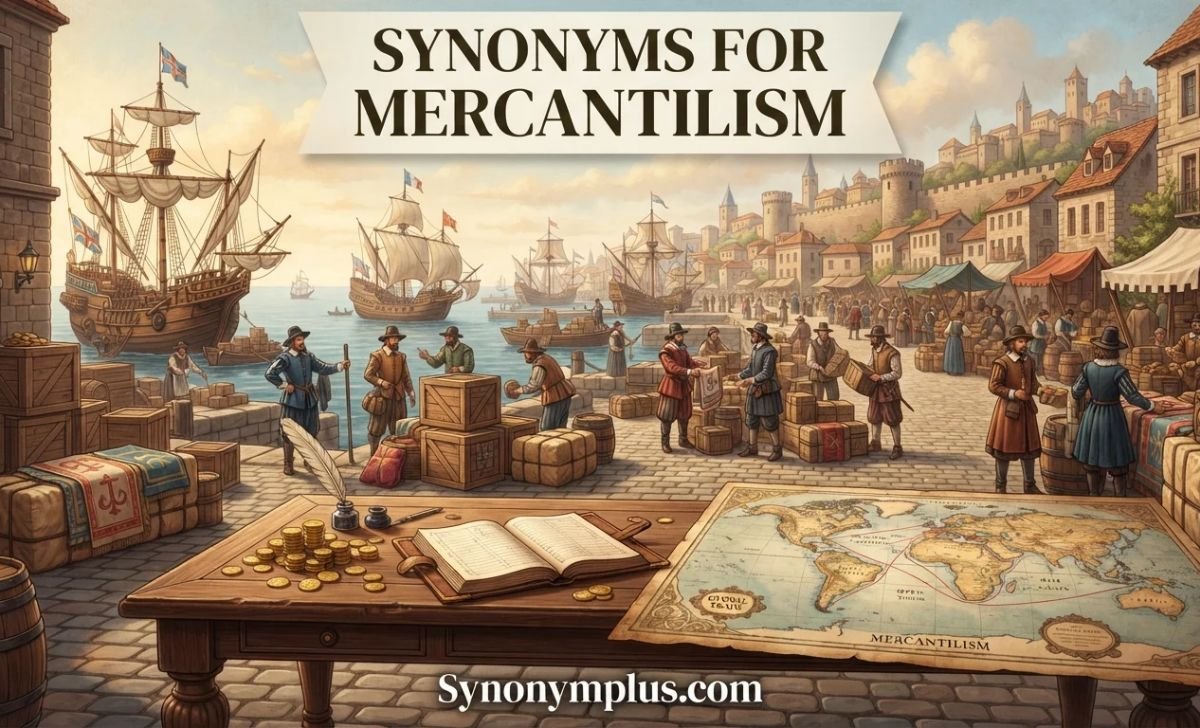
Mercantilism was an economic system that emphasized national wealth, exports, controlled trade, and the accumulation of gold and silver.
It became especially important in Europe from the 16th through the 18th centuries, when governments used tariffs, trade restrictions, colonial markets, and state-backed monopolies to strengthen their economies.
Because mercantilism describes a specific historical system, it does not have 50 perfect synonyms. Many words associated with it are instead close alternatives, historical terms, or related economic ideas.
This list of synonyms for mercantilism separates those terms by meaning and context so you can choose a word that fits your sentence, essay, or historical discussion.
What Does Mercantilism Mean?
Mercantilism was a system of economic thought and government policy that treated international trade as a way to increase national wealth and power. Governments often tried to encourage exports, restrict imports, protect domestic industries, and accumulate precious metals.
The system was closely linked to European colonialism and the growth of overseas empires. Colonies could supply raw materials and provide markets for manufactured goods.
For example:
Britain used mercantilist policies to control colonial trade and encourage exports.
The related adjective is mercantilist, as in mercantilist policy or mercantilist thinking.
50 Synonyms and Close Alternatives for Mercantilism
The following terms are not all exact synonyms. Some describe mercantilism itself, while others name a policy, theory, practice, or related historical concept.
1. Commercialism
Meaning: Commercialism emphasizes trade, business, and the pursuit of economic gain.
Best used when: You want a broader term connected with commerce rather than the specific historical system.
Example:
Commercialism became an important part of European economic development.
Note: Commercialism can also refer to an excessive focus on commercial interests, so it is not an exact synonym for mercantilism.
2. Economic Nationalism
Meaning: Economic nationalism places national economic interests ahead of unrestricted international trade.
Best used when: Discussing policies designed to strengthen domestic industries or national economic power.
Example:
Mercantilism is often described as an early form of economic nationalism.
Note: This is one of the closest modern conceptual alternatives, but economic nationalism is broader than mercantilism.
3. Protectionism
Meaning: Protectionism involves government measures that protect domestic producers from foreign competition.
Best used when: Referring to tariffs, import restrictions, quotas, or similar trade policies.
Example:
The government introduced protectionism to support local manufacturers.
Note: Protectionism is a policy approach, not a complete synonym for the historical mercantilist system.
4. Trade Protectionism
Meaning: Trade protectionism limits or regulates foreign competition to support domestic businesses.
Best used when: The discussion specifically concerns international trade.
Example:
Trade protectionism played an important role in several mercantilist economies.
5. Protectionist Economics
Meaning: Protectionist economics favors policies that shield domestic industries from foreign competition.
Best used when: Writing about economic policy rather than historical theory.
Example:
Protectionist economics can involve tariffs on imported goods.
6. Bullionism
Meaning: Bullionism emphasizes accumulating precious metals, especially gold and silver, as a measure of national wealth.
Best used when: Discussing the precious-metal aspect of mercantilist thinking.
Example:
Bullionism encouraged governments to view gold and silver reserves as important sources of national strength.
Note: Bullionism is closely associated with mercantilism but focuses more narrowly on precious-metal accumulation.
7. Mercantilist Economics
Meaning: Mercantilist economics refers to economic ideas based on the principles of mercantilism.
Best used when: Writing about the economic theory behind historical government policies.
Example:
Mercantilist economics favored policies that promoted exports over imports.
8. Mercantilist Policy
Meaning: Mercantilist policy refers to government measures based on mercantilist ideas.
Best used when: Describing actual historical actions rather than the theory itself.
Example:
The government adopted a mercantilist policy to restrict foreign competition.
9. Mercantilist System
Meaning: A mercantilist system is an economy organized around the main principles of mercantilism.
Best used when: Referring to the broader economic structure.
Example:
The colonial economy operated within a mercantilist system.
10. Mercantilist Doctrine
Meaning: Mercantilist doctrine refers to the collection of economic beliefs associated with mercantilism.
Best used when: Discussing historical economic thought.
Example:
The mercantilist doctrine placed great importance on trade and national economic power.
11. Mercantilist Theory
Meaning: Mercantilist theory describes the economic ideas that supported mercantilist policies.
Best used when: Writing an academic or historical explanation.
Example:
Mercantilist theory encouraged governments to manage foreign trade closely.
12. Mercantilist Economics
Meaning: This term describes the economic approach associated with mercantilist policies and beliefs.
Best used when: Explaining mercantilism in economics or history.
Example:
Mercantilist economics treated international trade as an important source of national strength.
13. State-Directed Trade
Meaning: State-directed trade is international commerce strongly influenced or controlled by government policy.
Best used when: Explaining the role of government in mercantilist trade.
Example:
State-directed trade allowed governments to control important imports and exports.
14. State-Controlled Commerce
Meaning: State-controlled commerce involves significant government regulation of trade and commercial activity.
Best used when: Describing strong government involvement in an economy.
Example:
State-controlled commerce was common under several European mercantilist policies.
15. Government-Regulated Trade
Meaning: Government-regulated trade is commerce shaped by laws, tariffs, restrictions, or other official measures.
Best used when: Explaining how governments managed international trade.
Example:
Government-regulated trade helped protect domestic industries.
16. Interventionist Trade Policy
Meaning: An interventionist trade policy uses government action to influence international commerce.
Best used when: Comparing mercantilism with freer forms of trade.
Example:
Mercantilism relied on an interventionist trade policy rather than unrestricted commerce.
17. State Intervention
Meaning: State intervention means direct government involvement in economic activity.
Best used when: Focusing on the government’s role rather than trade alone.
Example:
State intervention was central to many mercantilist policies.
18. Economic Interventionism
Meaning: Economic interventionism supports active government involvement in markets or economic activity.
Best used when: Discussing government control in broader economic terms.
Example:
Mercantilism is associated with a high level of economic interventionism.
Note: This is broader than mercantilism and applies to many other economic systems.
19. Export Promotion
Meaning: Export promotion involves policies designed to increase the sale of domestic goods abroad.
Best used when: Describing one major goal of mercantilist policy.
Example:
Export promotion helped domestic manufacturers reach foreign markets.
20. Export-Led Growth
Meaning: Export-led growth is an economic strategy that relies heavily on exports to support production and economic expansion.
Best used when: Discussing trade strategies in economic analysis.
Example:
The government encouraged export-led growth by supporting domestic manufacturers.
Note: This is a modern economic term and should not be treated as a perfect synonym for mercantilism.
21. Import Restriction
Meaning: An import restriction limits the amount or type of goods entering a country.
Best used when: Describing one specific mercantilist trade measure.
Example:
Import restrictions were used to reduce foreign competition.
22. Import Control
Meaning: Import control refers to government rules governing goods brought into a country.
Best used when: Discussing tariffs, quotas, licenses, or other restrictions.
Example:
Import controls supported the government’s protection of domestic industries.
23. Trade Barriers
Meaning: Trade barriers are government-imposed obstacles to international commerce.
Best used when: Referring to tariffs, quotas, restrictions, and similar measures.
Example:
Mercantilist governments often relied on trade barriers to limit imports.
24. Tariff Protection
Meaning: Tariff protection uses taxes on imported goods to make domestic products more competitive.
Best used when: Discussing the tariff side of mercantilist policy.
Example:
Tariff protection helped local producers compete with imported goods.
25. Protectionist Tariffs
Meaning: Protectionist tariffs are import taxes intended to protect domestic industries.
Best used when: Writing about specific trade measures.
Example:
Protectionist tariffs raised the cost of competing foreign products.
26. Export Subsidies
Meaning: Export subsidies are government benefits intended to encourage businesses to sell goods abroad.
Best used when: Describing another policy used to encourage exports.
Example:
Export subsidies gave domestic producers an incentive to enter foreign markets.
27. Trade Monopoly
Meaning: A trade monopoly gives exclusive control over particular commercial activity or markets.
Best used when: Discussing controlled commerce under historical governments.
Example:
The crown granted a company a trade monopoly over certain colonial goods.
28. State Monopoly
Meaning: A state monopoly exists when the government controls a particular commercial activity or grants exclusive rights over it.
Best used when: Describing government control of strategic trade.
Example:
The state monopoly limited who could legally participate in the trade.
29. Colonial Monopoly
Meaning: A colonial monopoly gives a government or approved company exclusive trading rights in a colonial market.
Best used when: Discussing European colonial mercantilism.
Example:
The colonial monopoly restricted trade between the colony and competing foreign merchants.
30. Chartered Company System
Meaning: This system gave companies official charters that granted commercial privileges, sometimes including exclusive trading rights.
Best used when: Explaining how governments and private companies worked together in historical trade.
Example:
The chartered company system connected private commerce with state economic goals.
31. Exclusive Trading Rights
Meaning: Exclusive trading rights give a person, company, or organization special authority to conduct particular commercial activities.
Best used when: Describing historical monopolies.
Example:
The company received exclusive trading rights in the region.
32. Favorable Balance of Trade
Meaning: A favorable balance of trade occurs when the value of exports exceeds the value of imports.
Best used when: Explaining a central goal traditionally associated with mercantilist thinking.
Example:
Mercantilist writers often emphasized maintaining a favorable balance of trade.
Note: The concept is closely associated with mercantilism but is not itself a synonym.
33. Trade Surplus
Meaning: A trade surplus occurs when a country exports more goods and services than it imports over a given period.
Best used when: Explaining the trade outcome that mercantilist policies often sought.
Example:
The country recorded a trade surplus after increasing exports.
34. National Wealth Accumulation
Meaning: National wealth accumulation refers to increasing the economic resources and wealth of a country.
Best used when: Explaining the broader objective behind mercantilist policy.
Example:
National wealth accumulation was a central concern of mercantilist thinkers.
35. Bullion Accumulation
Meaning: Bullion accumulation means increasing holdings of gold and silver.
Best used when: Discussing the precious-metal focus associated with early mercantilist thought.
Example:
Bullion accumulation was considered an important sign of national economic strength.
36. Commercial Nationalism
Meaning: Commercial nationalism emphasizes using trade and commerce to strengthen national interests.
Best used when: Describing the connection between economic policy and national power.
Example:
Commercial nationalism shaped several European trade policies during the early modern period.
Note: This is a related concept rather than a universally accepted exact synonym.
37. National Economic Policy
Meaning: National economic policy refers broadly to government decisions designed to influence a country’s economy.
Best used when: Discussing mercantilism as a form of state economic policy.
Example:
Mercantilism influenced national economic policy across parts of early modern Europe.
38. Colonial Economics
Meaning: Colonial economics concerns the economic organization of colonies, including production, trade, labor, and resource use.
Best used when: Discussing mercantilism in a colonial setting.
Example:
Colonial economics was closely connected with European trade policies.
Note: Colonial economics is broader than mercantilism.
39. Colonial Trade System
Meaning: A colonial trade system organizes commercial relationships between colonies and their governing powers.
Best used when: Explaining how colonial markets and resources supported European economies.
Example:
The colonial trade system directed valuable resources toward European markets.
40. Imperial Economics
Meaning: Imperial economics examines how economic policies and resources operate within an empire.
Best used when: Discussing the economic side of imperial expansion.
Example:
Imperial economics helped explain the value European powers placed on overseas territories.
Note: Imperial economics and mercantilism overlap historically but are not interchangeable.
41. Commercial Empire
Meaning: A commercial empire is an empire whose power is strongly connected to trade, markets, and commercial interests.
Best used when: Describing the relationship between imperial expansion and commerce.
Example:
European powers competed to build commercial empires and control overseas markets.
42. Early Modern Economics
Meaning: Early modern economics refers to economic ideas and practices associated with the period roughly from the 16th to the 18th centuries.
Best used when: Placing mercantilism within its historical period.
Example:
Mercantilism was a major feature of early modern economics.
Note: This is a broad historical category, not a direct synonym.
43. Political Economy
Meaning: Political economy examines the relationship between government, society, and economic activity.
Best used when: Studying mercantilism as both an economic and political system.
Example:
Mercantilism is an important subject in the history of political economy.
44. Commercial Policy
Meaning: Commercial policy refers to government rules and strategies concerning trade and commerce.
Best used when: Discussing the practical side of mercantilist thinking.
Example:
The government changed its commercial policy to encourage exports.
45. Trade Policy
Meaning: Trade policy consists of government decisions that shape imports, exports, tariffs, and international commerce.
Best used when: Describing specific policies associated with mercantilism.
Example:
The country’s trade policy favored domestic producers.
46. Economic National Policy
Meaning: Economic national policy refers to government measures intended to advance national economic interests.
Best used when: Connecting economic policy with national strength.
Example:
Mercantilism treated foreign trade as part of a broader economic national policy.
Note: This is a descriptive phrase rather than a standard exact synonym.
47. State Capitalism
Meaning: State capitalism describes an economic system in which the government plays a major role in owning, directing, or controlling economic activity.
Best used when: Making a broader comparison between state involvement and market activity.
Example:
Some scholars compare aspects of mercantilist state control with later forms of state capitalism.
Note: State capitalism is a modern concept and should not be used as a direct replacement for mercantilism in historical writing.
48. Interventionism
Meaning: Interventionism supports active government involvement in economic affairs.
Best used when: Focusing on the government’s role in markets and trade.
Example:
Mercantilism is often associated with economic interventionism.
Note: Interventionism applies to many economic systems, so the two terms are not interchangeable.
49. Neomercantilism
Meaning: Neomercantilism refers to modern policies or approaches that resemble selected mercantilist ideas, especially strong state support for exports, domestic industries, or national economic interests.
Best used when: Discussing modern policies that are compared with historical mercantilism.
Example:
Some economists use the term neomercantilism when discussing modern export-focused policies.
Note: Neomercantilism is a modern adaptation or comparison, not another name for historical mercantilism.
50. Economic Protection
Meaning: Economic protection refers broadly to government measures intended to protect domestic economic interests from external competition.
Best used when: Discussing the protective side of mercantilist policy.
Example:
Economic protection was used to support domestic production and limit foreign competition.
Note: This term is broader than mercantilism and can describe policies outside the mercantilist period.
The Closest Synonyms for Mercantilism
Because mercantilism describes a particular historical economic system, only a small number of terms can function as close replacements.
Mercantilist economics, mercantilist system, mercantilist doctrine, and mercantilist theory are the safest choices when you are referring directly to the historical system or its ideas.
Economic nationalism, commercialism, and protectionism are useful related terms, but their meanings are broader or different.
For example:
Mercantilism encouraged governments to manage international trade closely.
You could write:
The mercantilist system encouraged governments to manage international trade closely.
But replacing mercantilism with protectionism changes the meaning because protectionism refers specifically to protecting domestic producers from foreign competition.
Mercantilism Synonyms in History
When writing about mercantilism in history, the most useful related terms include:
- Mercantilist system
- Mercantilist economics
- Mercantilist doctrine
- Mercantilist policy
- Bullionism
- Economic nationalism
- Commercial nationalism
- Colonial trade system
- State-directed trade
- Protectionism
- Trade monopoly
- Chartered company system
- Favorable balance of trade
These terms help explain different parts of the historical system rather than simply repeating the word mercantilism.
For example:
European governments used mercantilist policies to protect domestic industries and control colonial trade.
This is more precise than replacing mercantilism with a single broad synonym.
Formal and Academic Alternatives
In an essay or academic discussion, these terms can provide useful variety:
- Mercantilist economic system
- Mercantilist doctrine
- Mercantilist theory
- Early modern economic policy
- Economic nationalism
- Political economy
- Commercial policy
- State-directed trade
- Protectionist economics
- Colonial trade system
Academic writing should be careful with terms such as capitalism, imperialism, and colonialism. They describe different historical concepts and should not be used as automatic synonyms for mercantilism.
Mercantilism vs. Protectionism
Mercantilism is a broader historical economic system involving trade regulation, national wealth, state intervention, colonial commerce, and policies designed to strengthen national power.
Protectionism is more specific. It refers to measures that protect domestic producers from foreign competition.
For example:
Mercantilism shaped Britain’s broader economic relationship with its colonies.
But:
Britain used protectionism to restrict competition from foreign goods.
The two concepts overlap, but they are not identical.
Mercantilism vs. Economic Nationalism
Economic nationalism is a broader idea that national economic interests should influence government policy.
Mercantilism can be viewed as a historical form of economic nationalism because mercantilist governments sought to increase national wealth and power through controlled trade.
Still, economic nationalism can describe modern policies that have nothing to do with historical mercantilism.
Mercantilism vs. Capitalism
Mercantilism and capitalism are different economic systems. Both influenced the development of modern economies.
Mercantilism was a historical system in which governments had strong control over trade. They protected domestic industries, encouraged exports, and aimed to increase national wealth.
Capitalism is based more on private ownership, market competition, investment, and the production of goods and services for profit.
The key difference is the role of government. Mercantilism gives the state a strong role in directing economic activity, while capitalism generally gives markets and private businesses more freedom. Because of this difference, capitalism should not be used as a synonym for mercantilism.
Mercantilism vs. Free Trade
Free trade generally favors fewer government restrictions on international commerce.
Mercantilism historically favored government management of trade, including tariffs, restrictions, monopolies, and policies designed to promote exports.
For example:
Mercantilist policy restricted some imports, while free-trade policies generally seek to reduce such barriers.
This contrast is useful when explaining the economic ideas that developed after mercantilism.
Antonyms of Mercantilism
There is no single perfect antonym for mercantilism, because it is a historical system rather than a simple quality with one opposite.
Depending on the context, useful contrasting terms include:
- Free trade
- Laissez-faire economics
- Free-market economics
- Economic liberalism
- Trade liberalization
- Open trade
- Market liberalism
- Liberal economic policy
Free trade is especially useful when discussing international commerce because it contrasts with the strong trade restrictions associated with many mercantilist policies.
For example:
Mercantilism favored government control of trade, while free trade favors fewer restrictions on international commerce.
Mercantilism in a Sentence
Here are several natural examples:
- Mercantilism shaped European trade policies during the early modern period.
- Britain used mercantilist policies to regulate colonial commerce.
- Mercantilism encouraged governments to promote exports and limit imports.
- Gold and silver played an important role in some forms of mercantilist thinking.
- The colonial trade system reflected several principles associated with mercantilism.
- Historians often connect mercantilism with economic nationalism and protectionism.
- The rise of free-trade ideas challenged many traditional mercantilist practices.
Common Mistakes With Mercantilism
One common mistake is treating every related economic term as a direct synonym.
For example, capitalism, colonialism, imperialism, and free trade should not be used as substitutes for mercantilism. Each describes a different concept.
Another mistake is assuming that protectionism and mercantilism mean exactly the same thing. Protectionism is one policy approach that can appear within a broader economic system.
It is also useful to distinguish mercantilism from bullionism. Bullionism focuses particularly on accumulating precious metals, while mercantilism encompasses a wider collection of economic policies and ideas.
FAQs
What is another word for mercantilism?
There is no single perfect replacement. Mercantilist system, mercantilist economics, and mercantilist doctrine are among the closest alternatives when discussing the historical system.
What are the closest synonyms for mercantilism in history?
Useful historical alternatives include mercantilist system, mercantilist economics, bullionism, economic nationalism, protectionism, and commercial policy. Their meanings are not identical, so context matters.
Is protectionism a synonym for mercantilism?
Not exactly. Protectionism describes policies that protect domestic industries from foreign competition. Mercantilism was a broader historical economic system that included protectionist measures.
Is economic nationalism the same as mercantilism?
No. Economic nationalism is broader. Mercantilism can be understood as an early historical form of economic nationalism, but modern economic nationalism can take many different forms.
What is the opposite of mercantilism?
There is no single exact opposite. Free trade, laissez-faire economics, and economic liberalism can serve as contrasting concepts, especially when discussing government involvement in international trade.
Is capitalism a synonym for mercantilism?
No. Capitalism and mercantilism describe different economic systems. They can appear in the same historical discussion, but one should not be substituted for the other.
What is a simple way to explain mercantilism?
A simple explanation is that mercantilism was a historical economic system in which governments tried to increase national wealth and power by managing trade, encouraging exports, restricting some imports, and controlling valuable resources and markets.
What is a modern term similar to mercantilism?
Neomercantilism is sometimes used for modern policies that resemble selected mercantilist ideas, especially strong government support for exports and domestic industries. It is not identical to historical mercantilism.
Conclusion
The best synonyms for mercantilism depend on what part of the concept you want to describe. Mercantilist system, mercantilist economics, and mercantilist doctrine are close choices for the historical system itself.
Protectionism, economic nationalism, bullionism, and state-directed trade describe related aspects rather than exact synonyms. Choosing the precise term makes historical essays, academic writing, and explanations clearer.
When discussing trade, colonial economies, or early modern Europe, focus on the specific idea you mean instead of replacing mercantilism with a broader economic term.
Read More Blogs
- Machine Learning Synonyms: 50 Related Terms and Alternatives
- Synonyms for Scarcity: 50 Words and Phrases for Limited Supply
- Synonyms for Apartment: Meanings, Examples, and Usage

I am Junaid Tariq, the author of Synonymplus.com, with 3 years of experience in English vocabulary, synonyms, word usage, and writing. I enjoy creating clear and useful content that makes learning English easier and more practical.
My goal is to help readers find the right words, understand their meanings, and use them correctly in everyday communication. I focus on writing simple, accurate, and easy-to-understand content for students, writers, professionals, and anyone looking to improve their English vocabulary.
Through Synonymplus.com, I share helpful guides, synonym lists, word meanings, examples, and practical language tips. With my experience and passion for English, I aim to provide reliable content that helps readers write better, speak more confidently, and expand their vocabulary.